



 Chat with AI
Exam 40: Population Ecology

Exam 1: The Science of Biology68 Questions
Exam 2: Lifes Chemical Basis79 Questions
Exam 3: Molecules of Life56 Questions
Exam 4: Cell Structure64 Questions
Exam 5: Ground Rules of Metabolism58 Questions
Exam 6: Where It Starts-Photosynthesis87 Questions
Exam 7: Releasing Chemical Energy80 Questions
Exam 8: DNA Structure and Function75 Questions
Exam 9: From DNA to Protein65 Questions
Exam 10: Control of Gene Expression61 Questions
Exam 11: How Cells Reproduce75 Questions
Exam 12: Meiosis and Sexual Reproduction68 Questions
Exam 13: Patterns in Inherited Traits54 Questions
Exam 14: Human Inheritance41 Questions
Exam 15: Biotechnology71 Questions
Exam 16: Evidence of Evolution69 Questions
Exam 17: Processes of Evolution83 Questions
Exam 18: Lifes Origin and Early Evolution49 Questions
Exam 19: Viruses, Bacteria, and Archaea42 Questions
Exam 20: The Protists56 Questions
Exam 21: Plant Evolution55 Questions
Exam 22: Fungi50 Questions
Exam 23: Animals I: Major Invertebrate Groups72 Questions
Exam 24: Animals Ii: the Chordates76 Questions
Exam 25: Plant Tissues67 Questions
Exam 26: Plant Nutrition and Transport67 Questions
Exam 27: Plant Reproduction and Development71 Questions
Exam 28: Animal Tissues and Organ Systems78 Questions
Exam 29: Neural Control80 Questions
Exam 30: Sensory Perception62 Questions
Exam 31: Endocrine Control65 Questions
Exam 32: Structural Support and Movement52 Questions
Exam 33: Circulation66 Questions
Exam 34: Immunity57 Questions
Exam 35: Respiration63 Questions
Exam 36: Digestion and Human Nutrition57 Questions
Exam 37: Maintaining the Internal Environment63 Questions
Exam 38: Reproduction and Development88 Questions
Exam 39: Animal Behavior73 Questions
Exam 40: Population Ecology55 Questions
Exam 41: Community Ecology73 Questions
Exam 42: Ecosystems52 Questions
Exam 43: The Biosphere74 Questions
Exam 44: Human Effects on the Biosphere73 Questions
Select questions type


Match the distribution pattern with the environmental factor that influences population distribution.
-is often a result of asexual reproduction
(Multiple Choice)
4.8/5  (80)
(80) The carrying capacity of an environment is determined by the ____.
(Multiple Choice)
4.9/5 (90)
(90) Match each statement to the correct ecological term.
-For most of human history, all regions were in this stage, but today no country is.
(Multiple Choice)
4.8/5 (92)
(92) Four of the five answers listed below are characteristics of an opportunistic life history. Select the exception.
(Multiple Choice)
4.8/5 (73)
(73) A group of organisms that interbreed with one another more often than they interbreed with other members of their species defines a(n) ____.
(Multiple Choice)
4.9/5 (79)
(79) Exponential growth will occur as long as r ____ and is ____ zero.
(Multiple Choice)
4.8/5 (68)
(68) 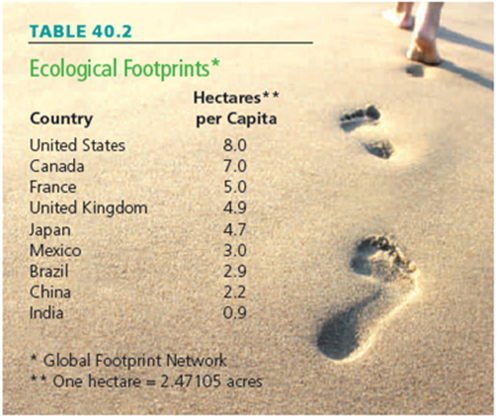 -According to the accompanying figure, the per capita ecological footprint for the United States is approximately ____ times the world average 2.7 hectares.
 (Multiple Choice)
4.9/5 (91)
(91) Estimates derived from plot sampling are most accurate when species are not very ____ and conditions across their habitat are uniform.
(Multiple Choice)
4.8/5 (78)
(78) An example of a density-independent limiting factor that influences population growth is ____.
(Multiple Choice)
4.7/5 (73)
(73) A situation in which the birth rate equals the death rate is called ____.
(Multiple Choice)
4.7/5 (83)
(83) Out of the countries listed, which has the largest ecological footprint?
(Multiple Choice)
4.7/5 (89)
(89) Four of the five answers are traits that influence the life history pattern of a living organism. Select the exception.
(Multiple Choice)
4.9/5 (83)
(83) The growth of a population per unit time is calculated by using this formula: G = r × N. What is the quantity r and how is it calculated?
(Multiple Choice)
4.7/5 (85)
(85) Match the distribution pattern with the environmental factor that influences population distribution.
-proximity to others neither benefits nor harms individuals
(Multiple Choice)
4.7/5 (76)
(76) Match the distribution pattern with the environmental factor that influences population distribution.
-involves intense competition for limited resources
(Multiple Choice)
4.9/5 (81)
(81) Which density-dependent factor controls the size of a population?
(Multiple Choice)
4.9/5 (72)
(72) Match the distribution pattern with the environmental factor that influences population distribution.
-some animals benefit by grouping together
(Multiple Choice)
4.8/5 (80)
(80) Match each statement to the correct ecological term.
-The world's least developed countries are in this stage (for example, Afghanistan and Ethiopia).
(Multiple Choice)
4.7/5 (80)
(80) The total number of individuals in a population is the ____.
(Multiple Choice)
4.9/5 (63)
(63) At time one, 50 butterflies were captured and marked with paint. Two days later, 100 were captured and 10 were previously marked. What is the estimated population size?
(Multiple Choice)
4.9/5 (81)
(81) 
Filters
- Essay(0)
- Multiple Choice(0)
- Short Answer(0)
- True False(0)
- Matching(0)