



 Chat with AI
Exam 34: Income Distribution, Poverty and Government Policy

Exam 1: Economics: The World Around You90 Questions
Exam 2: Choice, Opportunity Costs, and Specialization94 Questions
Exam 3: Markets, Demand and Supply, and the Price System97 Questions
Exam 5: The Market System and the Private and Public Sector97 Questions
Exam 4: Elasticity: Demand and Supply126 Questions
Exam 6: National Income Accounting104 Questions
Exam 7: an Introduction to the Foreign Exchange Market and the Balance of Payments90 Questions
Exam 8: Consumer Choice132 Questions
Exam 9: Supply: The Costs of Doing Business106 Questions
Exam 10: Unemployment and Inflation129 Questions
Exam 11: Macroeconomic Equilibrium: Aggregate Demand and Supply122 Questions
Exam 12: Profit Maximization122 Questions
Exam 13: Aggregate Expenditures115 Questions
Exam 14: Perfect Competition135 Questions
Exam 15: Income and Expenditures Equilibrium134 Questions
Exam 16: Monopoly118 Questions
Exam 17: Fiscal Policy93 Questions
Exam 18: Monopolistic Competition and Oligopoly111 Questions
Exam 19: Antitrust and Regulation100 Questions
Exam 10: Money and Banking125 Questions
Exam 21: Market Failures, Government Failures, and Rent Seeking121 Questions
Exam 22: Monetary Policy141 Questions
Exam 23: Macroeconomic Policy: Tradeoffs, Expectations, Credibility, and Sources of Business Cycles112 Questions
Exam 24: Resource Markets112 Questions
Exam 25: Macroeconomic Viewpoints: New Keynesian, Monetarist, and New Classical99 Questions
Exam 26: The Labor Market114 Questions
Exam 27: Capital Markets100 Questions
Exam 28: Economic Growth99 Questions
Exam 29: Development Economics104 Questions
Exam 30: the Land Market and Natural Resources55 Questions
Exam 31: Aging, Social Security and Health Care88 Questions
Exam 32: Globalization84 Questions
Exam 33: Elasticity: Demand and Supply126 Questions
Exam 34: Income Distribution, Poverty and Government Policy115 Questions
Exam 35: World Trade Equilibrium112 Questions
Exam 36: Consumer Choice132 Questions
Exam 37: International Trade Restrictions109 Questions
Exam 38: World Trade Equilibrium112 Questions
Exam 39: Exchange Rates and Financial Links Between Countries132 Questions
Exam 40: International Trade Restrictions109 Questions
Exam 41: Supply: the Costs of Doing Business106 Questions
Exam 42: Exchange Rates and Financial Links Between Countries132 Questions
Exam 43: Profit Maximization122 Questions
Exam 44: Perfect Competition135 Questions
Exam 45: Monopoly118 Questions
Exam 46: Monopolistic Competition and Oligopoly111 Questions
Exam 47: Antitrust and Regulation100 Questions
Exam 48: Market Failures, Government Failures, and Rent Seeking121 Questions
Exam 49: Resource Markets112 Questions
Exam 50: The Labor Market114 Questions
Exam 51: Capital Markets100 Questions
Exam 52: The Land Market and Natural Resources55 Questions
Exam 53: Aging, Social Security and Health Care87 Questions
Exam 54: Income Distribution, Poverty and Government Policy115 Questions
Exam 55: World Trade Equilibrium112 Questions
Exam 56: International Trade Restrictions109 Questions
Exam 57: Exchange Rates and Financial Links Between Countries132 Questions
Select questions type


The greater the negative income tax imposed on a family, greater is the family's incentive to earn more.
(True/False)
4.9/5  (81)
(81) Taxes are one method of funding the poverty alleviation programs by the government.Which of the following is an important impact of taxes?
(Multiple Choice)
4.7/5 (65)
(65) The table given below shows the absolute tax amounts under five different tax policies for respective income levels. Table 19.2
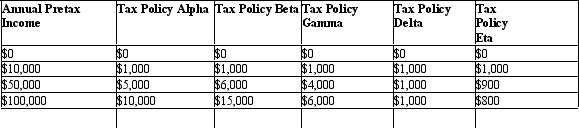 Refer to Table 19.2.Which of the tax policies is an example of a proportional tax?
 (Multiple Choice)
4.8/5 (82)
(82) If the Gini co-efficient for any economy is 0.85, which of the following statements is true?
(Multiple Choice)
4.9/5 (84)
(84) If the negative income tax rate is 25 percent and the break-even income of a family of four is $50, 000, the guaranteed income floor is:
(Multiple Choice)
4.8/5 (87)
(87) Someone who has the desire to work but has no exceptional abilities and has not acquired the skills necessary for a well-paying job is likely to escape poverty completely.
(True/False)
5.0/5 (81)
(81) The diagram that represents how income is distributed among members of a population is known as a(n):
(Multiple Choice)
4.8/5 (68)
(68) Which of the following statements concerning income distribution among nations is true?
(Multiple Choice)
4.9/5 (69)
(69) For people who are too well off to receive welfare benefits but who would become eligible for negative income tax payments, the negative income tax might create work disincentives.
(True/False)
4.8/5 (77)
(77) If the guaranteed income floor for a family of four is $14, 000 and the tax rate is 50 percent, then the break-even income for this family will be $28, 000.
(True/False)
4.8/5 (76)
(76) The poverty threshold is often determined in terms of the expenditure on meals that meet a predetermined nutritional standard.
(True/False)
4.7/5 (86)
(86) Even when legal title is established in the developing countries, it is often difficult to use that title because of the failure of countries to enforce people's ownership of property.
(True/False)
4.8/5 (75)
(75) The guaranteed transfer income of Angela's family, which consists of her parents and her sister, is $15, 000.This implies, if the family earns nothing it will receive a transfer of $15, 000.If a negative tax rate of 50 percent is levied, the family's break-even income is:
(Multiple Choice)
5.0/5 (79)
(79) Unemployment insurance programs provide benefits to permanently unemployed people.
(True/False)
4.8/5 (81)
(81) If the negative income tax rate is less than 100 percent, the break-even income level will be lower than the poverty level, and families who are officially considered poor will not receive the benefits.
(True/False)
5.0/5 (72)
(72) The table below shows the monthly income of a family and the fuel assistance received from the government. Table 19.4
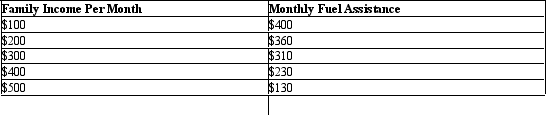 Refer to Table 19.4.The greatest disincentive to work for this family occurs between the income levels of _____ and _____.
 (Multiple Choice)
4.7/5 (66)
(66) The income variation across the countries is the result of differential rates of economic growth being experienced by them.
(True/False)
4.8/5 (76)
(76) 
Filters
- Essay(0)
- Multiple Choice(0)
- Short Answer(0)
- True False(0)
- Matching(0)