



 Chat with AI
Exam 37: International Trade Restrictions

Exam 1: Economics: The World Around You90 Questions
Exam 2: Choice, Opportunity Costs, and Specialization94 Questions
Exam 3: Markets, Demand and Supply, and the Price System97 Questions
Exam 5: The Market System and the Private and Public Sector97 Questions
Exam 4: Elasticity: Demand and Supply126 Questions
Exam 6: National Income Accounting104 Questions
Exam 7: an Introduction to the Foreign Exchange Market and the Balance of Payments90 Questions
Exam 8: Consumer Choice132 Questions
Exam 9: Supply: The Costs of Doing Business106 Questions
Exam 10: Unemployment and Inflation129 Questions
Exam 11: Macroeconomic Equilibrium: Aggregate Demand and Supply122 Questions
Exam 12: Profit Maximization122 Questions
Exam 13: Aggregate Expenditures115 Questions
Exam 14: Perfect Competition135 Questions
Exam 15: Income and Expenditures Equilibrium134 Questions
Exam 16: Monopoly118 Questions
Exam 17: Fiscal Policy93 Questions
Exam 18: Monopolistic Competition and Oligopoly111 Questions
Exam 19: Antitrust and Regulation100 Questions
Exam 10: Money and Banking125 Questions
Exam 21: Market Failures, Government Failures, and Rent Seeking121 Questions
Exam 22: Monetary Policy141 Questions
Exam 23: Macroeconomic Policy: Tradeoffs, Expectations, Credibility, and Sources of Business Cycles112 Questions
Exam 24: Resource Markets112 Questions
Exam 25: Macroeconomic Viewpoints: New Keynesian, Monetarist, and New Classical99 Questions
Exam 26: The Labor Market114 Questions
Exam 27: Capital Markets100 Questions
Exam 28: Economic Growth99 Questions
Exam 29: Development Economics104 Questions
Exam 30: the Land Market and Natural Resources55 Questions
Exam 31: Aging, Social Security and Health Care88 Questions
Exam 32: Globalization84 Questions
Exam 33: Elasticity: Demand and Supply126 Questions
Exam 34: Income Distribution, Poverty and Government Policy115 Questions
Exam 35: World Trade Equilibrium112 Questions
Exam 36: Consumer Choice132 Questions
Exam 37: International Trade Restrictions109 Questions
Exam 38: World Trade Equilibrium112 Questions
Exam 39: Exchange Rates and Financial Links Between Countries132 Questions
Exam 40: International Trade Restrictions109 Questions
Exam 41: Supply: the Costs of Doing Business106 Questions
Exam 42: Exchange Rates and Financial Links Between Countries132 Questions
Exam 43: Profit Maximization122 Questions
Exam 44: Perfect Competition135 Questions
Exam 45: Monopoly118 Questions
Exam 46: Monopolistic Competition and Oligopoly111 Questions
Exam 47: Antitrust and Regulation100 Questions
Exam 48: Market Failures, Government Failures, and Rent Seeking121 Questions
Exam 49: Resource Markets112 Questions
Exam 50: The Labor Market114 Questions
Exam 51: Capital Markets100 Questions
Exam 52: The Land Market and Natural Resources55 Questions
Exam 53: Aging, Social Security and Health Care87 Questions
Exam 54: Income Distribution, Poverty and Government Policy115 Questions
Exam 55: World Trade Equilibrium112 Questions
Exam 56: International Trade Restrictions109 Questions
Exam 57: Exchange Rates and Financial Links Between Countries132 Questions
Select questions type


Protection provided to the infant industries is rarely withdrawn because:
(Multiple Choice)
4.8/5  (82)
(82) While it is possible to erect barriers to foreign competition and save domestic jobs, restricting international trade may impose large costs on an economy.
(True/False)
4.9/5 (88)
(88) The figure given below depicts the negatively sloped demand and positively sloped supply curves of wheat in a country. Figure 20.2 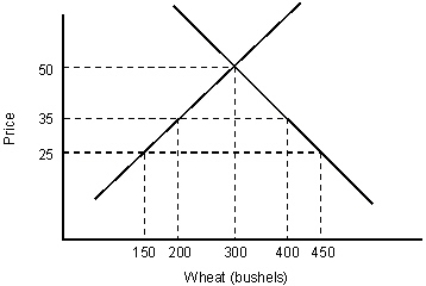 Refer to Figure 20.2.In the absence of international trade, what are the domestic equilibrium price and quantity?
 (Multiple Choice)
4.8/5 (89)
(89) When dealing with strategic trade policy, one practical problem for government is the likelihood of retaliation by the foreign government.
(True/False)
4.9/5 (84)
(84) Government standards for products sold in the domestic market can have the effect of protecting domestic producers from foreign competition.
(True/False)
4.8/5 (88)
(88) Tariffs are considered to be a popular tax in the first world countries, who justify them on the basis of the revenue they generate for government spending.
(True/False)
4.9/5 (90)
(90) It is often argued that if foreign goods are kept out of the domestic economy:
(Multiple Choice)
4.8/5 (82)
(82) In the light of the infant industry argument, identify the industry which is likely to have substantially high initial costs.
(Multiple Choice)
4.8/5 (72)
(72) By restricting the amount of a good that may be imported, quotas:
(Multiple Choice)
4.8/5 (86)
(86) The figure below shows the demand (D)and supply (S)curves of corn syrups. Figure 20.3 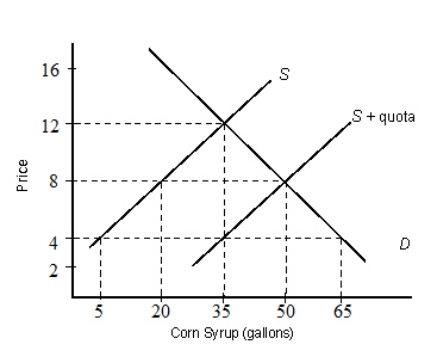 In Figure 20.3, what are the equilibrium price and quantity in the absence of trade?
 (Multiple Choice)
4.9/5 (92)
(92) The figure below shows the demand (D)and supply (S)curves of a good produced domestically in an economy as well as traded in the international market. Figure 20.1 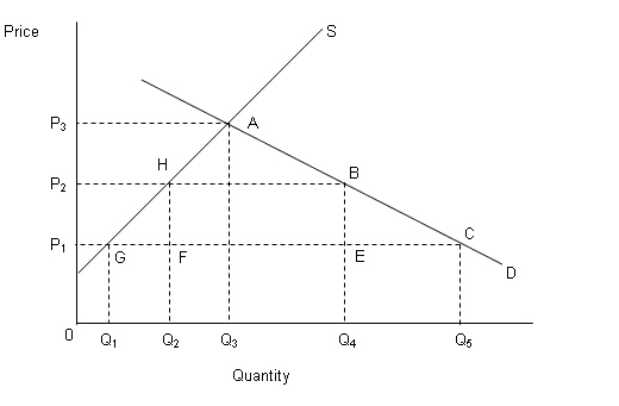 In the figure,
P1: Price of the good in the international market.
P2: Price of the good in the domestic market after the imposition of tariff by the government.
P3: No-trade price of the good in the domestic market.
Refer to Figure 20.1.If the government imposes a tariff such that the price of the good in the domestic market is P2 while the international price is P1, the dollar value of the tariff is equal to:
In the figure,
P1: Price of the good in the international market.
P2: Price of the good in the domestic market after the imposition of tariff by the government.
P3: No-trade price of the good in the domestic market.
Refer to Figure 20.1.If the government imposes a tariff such that the price of the good in the domestic market is P2 while the international price is P1, the dollar value of the tariff is equal to: (Multiple Choice)
4.8/5 (80)
(80) Suppose the production of helicopters is an industry characterized by increasing returns to scale and an Argentine firm, Cicare, is the only player in this market.The firm caters to the global market and earns a profit of $10 million.Flettner, a German firm has been considering entering this market for a while, but it is aware that its entry will cause each firm to lose about $4 million.Although a government subsidy allows Flettner to enter the helicopter market, the company is unable to reap profits in the long run.Which of the following could have led to this outcome?
(Multiple Choice)
4.8/5 (67)
(67) Protecting infant industries from foreign competition may make sense, but only until the industry matures.
(True/False)
5.0/5 (90)
(90) Steel producers in the United States observe that foreign sales of U.S.steel has drastically declined due to stringent trade policies adopted by the foreign governments and unfair treatment of U.S.steel exports in foreign countries.The lobbying efforts of such loss making U.S.steel manufacturers induces the domestic government to restrict the entry of imported steel and help stimulate the sales of domestically produced steel.Which of the following is most similar to the example mentioned above?
(Multiple Choice)
4.8/5 (77)
(77) Suppose the production of helicopters is an industry characterized by increasing returns to scale and an Argentine firm, Cicare, is the only player in this market.The firm caters to the global market and earns a profit of $10 million.Flettner, a German firm has been considering entering this market for a while, but it is aware that its entry will cause each firm to lose about $4 million.However, a government subsidy allows Flettner to enter the helicopter market and Cicare incurs a loss of $4 million due to its entry.Eventually, Flettner evolves as the monopoly supplier of helicopters while Cicare is forced to shut down.This conclusion rests on which of the following assumptions?
(Multiple Choice)
4.8/5 (87)
(87) Developing countries often justify imposition of tariffs because:
(Multiple Choice)
5.0/5 (67)
(67) The figure below shows the demand (D)and supply (S)curves of a good produced domestically in an economy as well as traded in the international market. Figure 20.1 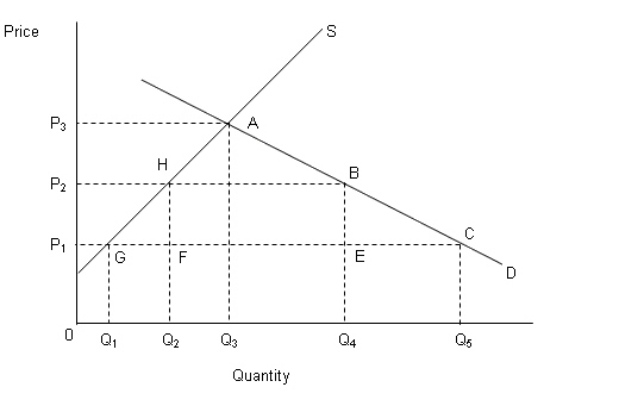 In the figure,
P1: Price of the good in the international market.
P2: Price of the good in the domestic market after the imposition of tariff by the government.
P3: No-trade price of the good in the domestic market.
According to Figure 20.1, the tariff revenue earned by the domestic government is equal to the:
In the figure,
P1: Price of the good in the international market.
P2: Price of the good in the domestic market after the imposition of tariff by the government.
P3: No-trade price of the good in the domestic market.
According to Figure 20.1, the tariff revenue earned by the domestic government is equal to the: (Multiple Choice)
4.9/5 (78)
(78) 
Filters
- Essay(0)
- Multiple Choice(0)
- Short Answer(0)
- True False(0)
- Matching(0)