



 Chat with AI
Exam 44: Perfect Competition

Exam 1: Economics: The World Around You90 Questions
Exam 2: Choice, Opportunity Costs, and Specialization94 Questions
Exam 3: Markets, Demand and Supply, and the Price System97 Questions
Exam 5: The Market System and the Private and Public Sector97 Questions
Exam 4: Elasticity: Demand and Supply126 Questions
Exam 6: National Income Accounting104 Questions
Exam 7: an Introduction to the Foreign Exchange Market and the Balance of Payments90 Questions
Exam 8: Consumer Choice132 Questions
Exam 9: Supply: The Costs of Doing Business106 Questions
Exam 10: Unemployment and Inflation129 Questions
Exam 11: Macroeconomic Equilibrium: Aggregate Demand and Supply122 Questions
Exam 12: Profit Maximization122 Questions
Exam 13: Aggregate Expenditures115 Questions
Exam 14: Perfect Competition135 Questions
Exam 15: Income and Expenditures Equilibrium134 Questions
Exam 16: Monopoly118 Questions
Exam 17: Fiscal Policy93 Questions
Exam 18: Monopolistic Competition and Oligopoly111 Questions
Exam 19: Antitrust and Regulation100 Questions
Exam 10: Money and Banking125 Questions
Exam 21: Market Failures, Government Failures, and Rent Seeking121 Questions
Exam 22: Monetary Policy141 Questions
Exam 23: Macroeconomic Policy: Tradeoffs, Expectations, Credibility, and Sources of Business Cycles112 Questions
Exam 24: Resource Markets112 Questions
Exam 25: Macroeconomic Viewpoints: New Keynesian, Monetarist, and New Classical99 Questions
Exam 26: The Labor Market114 Questions
Exam 27: Capital Markets100 Questions
Exam 28: Economic Growth99 Questions
Exam 29: Development Economics104 Questions
Exam 30: the Land Market and Natural Resources55 Questions
Exam 31: Aging, Social Security and Health Care88 Questions
Exam 32: Globalization84 Questions
Exam 33: Elasticity: Demand and Supply126 Questions
Exam 34: Income Distribution, Poverty and Government Policy115 Questions
Exam 35: World Trade Equilibrium112 Questions
Exam 36: Consumer Choice132 Questions
Exam 37: International Trade Restrictions109 Questions
Exam 38: World Trade Equilibrium112 Questions
Exam 39: Exchange Rates and Financial Links Between Countries132 Questions
Exam 40: International Trade Restrictions109 Questions
Exam 41: Supply: the Costs of Doing Business106 Questions
Exam 42: Exchange Rates and Financial Links Between Countries132 Questions
Exam 43: Profit Maximization122 Questions
Exam 44: Perfect Competition135 Questions
Exam 45: Monopoly118 Questions
Exam 46: Monopolistic Competition and Oligopoly111 Questions
Exam 47: Antitrust and Regulation100 Questions
Exam 48: Market Failures, Government Failures, and Rent Seeking121 Questions
Exam 49: Resource Markets112 Questions
Exam 50: The Labor Market114 Questions
Exam 51: Capital Markets100 Questions
Exam 52: The Land Market and Natural Resources55 Questions
Exam 53: Aging, Social Security and Health Care87 Questions
Exam 54: Income Distribution, Poverty and Government Policy115 Questions
Exam 55: World Trade Equilibrium112 Questions
Exam 56: International Trade Restrictions109 Questions
Exam 57: Exchange Rates and Financial Links Between Countries132 Questions
Select questions type


If the market price of oats is $2.5 per bushel and a farmer decides to sell at $2.8 per bushel, he is likely to sell:
(Multiple Choice)
4.9/5  (74)
(74) Which of the following is true of the model of perfect competition?
(Multiple Choice)
4.8/5 (77)
(77) A firm will shut down permanently if total revenue is not sufficient to pay for total costs in the long run.
(True/False)
4.7/5 (93)
(93) The table given below shows the price of each unit of the product manufactured by a firm and the marginal cost of producing different units of the output. Table: 23.1
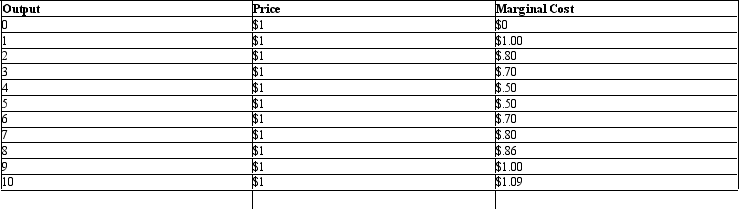 According to the information in Table 23.1, the marginal revenue of the firm:
 (Multiple Choice)
4.8/5 (83)
(83) The following figure shows equilibrium at the industry and firm level. Figure 23.6 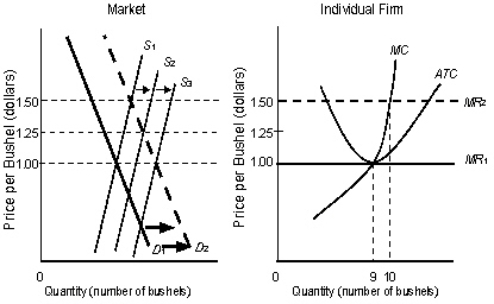 In the figure,
S1, S2, S3 are the market supply curves.
D1 and D2 are the market demand curves.
MC is the marginal cost curve of the firm.
MR1 and MR2 are the marginal revenue curves of the firm.
ATC is the average-total-cost curve of the firm.
According to Figure 23.6, a shift of the S curves in the graph on the left side represents:
In the figure,
S1, S2, S3 are the market supply curves.
D1 and D2 are the market demand curves.
MC is the marginal cost curve of the firm.
MR1 and MR2 are the marginal revenue curves of the firm.
ATC is the average-total-cost curve of the firm.
According to Figure 23.6, a shift of the S curves in the graph on the left side represents: (Multiple Choice)
4.8/5 (72)
(72) The table given below shows the price of each unit of the product manufactured by a firm and the marginal cost of producing different units of the output. Table: 23.1
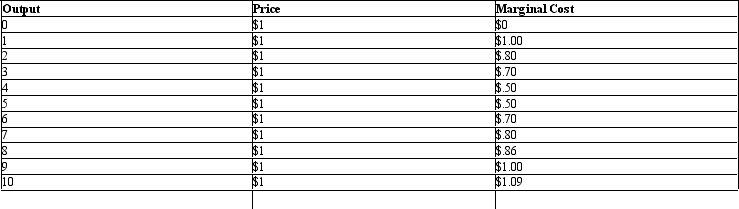 Refer to Table 23.1.If the market price of the good falls to $0.80 per unit, the firm:
 (Multiple Choice)
4.7/5 (79)
(79) Which of the following statements concerning perfect competition is not true?
(Multiple Choice)
4.9/5 (79)
(79) One method that firms in many nations use to exit the market is the use of:
(Multiple Choice)
4.8/5 (75)
(75) Under the long-run equilibrium for perfectly competitive markets without any government intervention:
(Multiple Choice)
4.9/5 (74)
(74) If at the profit maximizing level of output, the AR curve lies below the ATC curve in the short run, the firm is earning positive economic profit.
(True/False)
4.9/5 (81)
(81) At an output level above the profit-maximizing one for a perfectly competitive firm, a reduction in output will:
(Multiple Choice)
4.9/5 (86)
(86) At the twenty-fifth anniversary of the Woodstock Festival in 1994, there were many vendors who sold tie-dyed t-shirts.No matter where one went, each vendor was selling these t-shirts for $15 apiece.Which market structure model would best characterize such a situation?
(Multiple Choice)
4.8/5 (73)
(73) The figure given below shows the revenue and cost curves of a perfectly competitive firm. Figure 23.2 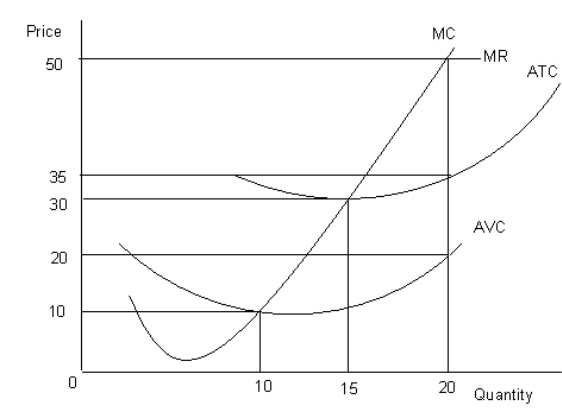 MC: Marginal cost curve
MR: Marginal revenue curve
ATC: Average-total-cost curve
AVC: Average-variable-cost curve
Refer to Figure 23.2.What is the profit-maximizing price and output level?
MC: Marginal cost curve
MR: Marginal revenue curve
ATC: Average-total-cost curve
AVC: Average-variable-cost curve
Refer to Figure 23.2.What is the profit-maximizing price and output level? (Multiple Choice)
4.8/5 (72)
(72) The figure given below shows the revenue and cost curves of a perfectly competitive firm. Figure 23.2 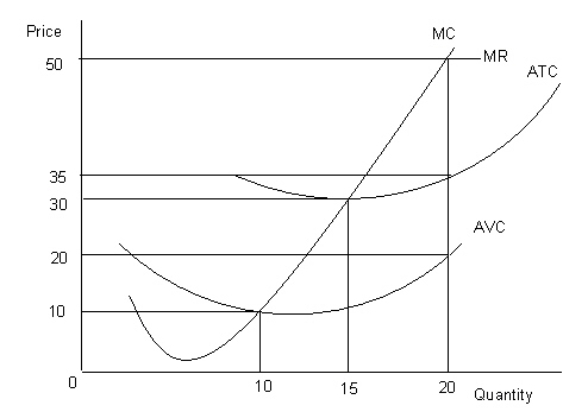 MC: Marginal cost curve
MR: Marginal revenue curve
ATC: Average-total-cost curve
AVC: Average-variable-cost curve
Refer to Figure 23.2.What is the firm's total fixed cost at the profit-maximizing output level?
MC: Marginal cost curve
MR: Marginal revenue curve
ATC: Average-total-cost curve
AVC: Average-variable-cost curve
Refer to Figure 23.2.What is the firm's total fixed cost at the profit-maximizing output level? (Multiple Choice)
4.7/5 (84)
(84) Under perfect competition, existing firms leave the market in the long run if the price falls below total fixed cost.
(True/False)
4.9/5 (80)
(80) Economic efficiency is achieved when the price of a unit of a commodity is equal to the marginal cost of producing that unit.
(True/False)
4.8/5 (69)
(69) A perfectly competitive firm incurs loss in the short run if at the profit maximizing level of output:
(Multiple Choice)
4.9/5 (70)
(70) 
Filters
- Essay(0)
- Multiple Choice(0)
- Short Answer(0)
- True False(0)
- Matching(0)