



 Chat with AI
Exam 46: Monopolistic Competition and Oligopoly

Exam 1: Economics: The World Around You90 Questions
Exam 2: Choice, Opportunity Costs, and Specialization94 Questions
Exam 3: Markets, Demand and Supply, and the Price System97 Questions
Exam 5: The Market System and the Private and Public Sector97 Questions
Exam 4: Elasticity: Demand and Supply126 Questions
Exam 6: National Income Accounting104 Questions
Exam 7: an Introduction to the Foreign Exchange Market and the Balance of Payments90 Questions
Exam 8: Consumer Choice132 Questions
Exam 9: Supply: The Costs of Doing Business106 Questions
Exam 10: Unemployment and Inflation129 Questions
Exam 11: Macroeconomic Equilibrium: Aggregate Demand and Supply122 Questions
Exam 12: Profit Maximization122 Questions
Exam 13: Aggregate Expenditures115 Questions
Exam 14: Perfect Competition135 Questions
Exam 15: Income and Expenditures Equilibrium134 Questions
Exam 16: Monopoly118 Questions
Exam 17: Fiscal Policy93 Questions
Exam 18: Monopolistic Competition and Oligopoly111 Questions
Exam 19: Antitrust and Regulation100 Questions
Exam 10: Money and Banking125 Questions
Exam 21: Market Failures, Government Failures, and Rent Seeking121 Questions
Exam 22: Monetary Policy141 Questions
Exam 23: Macroeconomic Policy: Tradeoffs, Expectations, Credibility, and Sources of Business Cycles112 Questions
Exam 24: Resource Markets112 Questions
Exam 25: Macroeconomic Viewpoints: New Keynesian, Monetarist, and New Classical99 Questions
Exam 26: The Labor Market114 Questions
Exam 27: Capital Markets100 Questions
Exam 28: Economic Growth99 Questions
Exam 29: Development Economics104 Questions
Exam 30: the Land Market and Natural Resources55 Questions
Exam 31: Aging, Social Security and Health Care88 Questions
Exam 32: Globalization84 Questions
Exam 33: Elasticity: Demand and Supply126 Questions
Exam 34: Income Distribution, Poverty and Government Policy115 Questions
Exam 35: World Trade Equilibrium112 Questions
Exam 36: Consumer Choice132 Questions
Exam 37: International Trade Restrictions109 Questions
Exam 38: World Trade Equilibrium112 Questions
Exam 39: Exchange Rates and Financial Links Between Countries132 Questions
Exam 40: International Trade Restrictions109 Questions
Exam 41: Supply: the Costs of Doing Business106 Questions
Exam 42: Exchange Rates and Financial Links Between Countries132 Questions
Exam 43: Profit Maximization122 Questions
Exam 44: Perfect Competition135 Questions
Exam 45: Monopoly118 Questions
Exam 46: Monopolistic Competition and Oligopoly111 Questions
Exam 47: Antitrust and Regulation100 Questions
Exam 48: Market Failures, Government Failures, and Rent Seeking121 Questions
Exam 49: Resource Markets112 Questions
Exam 50: The Labor Market114 Questions
Exam 51: Capital Markets100 Questions
Exam 52: The Land Market and Natural Resources55 Questions
Exam 53: Aging, Social Security and Health Care87 Questions
Exam 54: Income Distribution, Poverty and Government Policy115 Questions
Exam 55: World Trade Equilibrium112 Questions
Exam 56: International Trade Restrictions109 Questions
Exam 57: Exchange Rates and Financial Links Between Countries132 Questions
Select questions type


The market structure called monopolistic competition is named using both monopoly and perfect competition.Why?
(Multiple Choice)
4.7/5  (82)
(82) The market structure in which the largest quantity of output is sold at the minimum possible price is:
(Multiple Choice)
4.8/5 (89)
(89) One major similarity between perfect competition and monopolistic competition is that:
(Multiple Choice)
4.9/5 (77)
(77) Because of their brand names, Kodak, IBM, Honda, Daimler-Chrysler, and other well-known firms are able to charge significantly higher prices for their products than their competitors without losing any business.Expenditures made by firms to create brand names:
(Multiple Choice)
4.8/5 (81)
(81) Oligopolies can arise as a result of both natural barriers and governmentally created barriers.
(True/False)
4.8/5 (80)
(80) In monopolistic competition, firms may differentiate their products in many ways except on the basis of:
(Multiple Choice)
4.9/5 (90)
(90) The condition under which a cartel can maintain its stability is that:
(Multiple Choice)
4.8/5 (61)
(61) Which of the following is not an example of nonprice competition?
(Multiple Choice)
4.9/5 (84)
(84) The following table shows the payoff matrix of the two firms (Firm X and Firm Y)in dollars when they advertise and when they do not advertise. Table 25.1 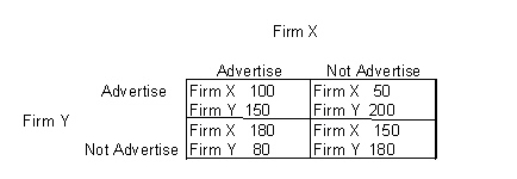 According to the Table 25.1, if the firms collude and decide not to advertise their combined payoff is:
 (Multiple Choice)
4.9/5 (59)
(59) Which of the following theories applies to strategic behavior?
(Multiple Choice)
4.7/5 (81)
(81) The following table shows the payoff matrix of the two firms (Firm X and Firm Y)in dollars when they advertise and when they do not advertise. Table 25.1 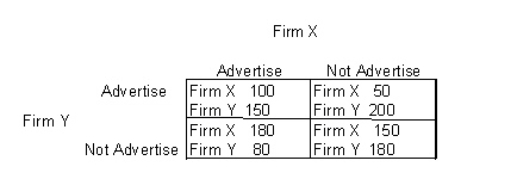 According to Table 25.1, if both the firms follow their dominant strategies:
 (Multiple Choice)
4.7/5 (79)
(79) Successful product differentiation by a monopolistically competitive firm makes the demand curve faced by the firm steeper.
(True/False)
4.8/5 (64)
(64) For years, Intel was able to charge a higher price for microchips because:
(Multiple Choice)
4.8/5 (75)
(75) A monopolistically competitive firm's demand curve slopes downward because:
(Multiple Choice)
4.9/5 (80)
(80) The following table shows the payoff matrix of the two firms (Firm X and Firm Y)in dollars when they advertise and when they do not advertise. Table 25.1 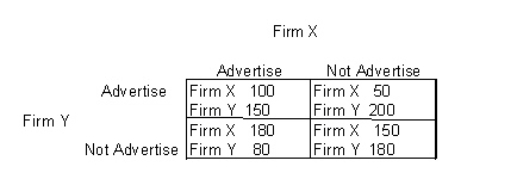 According to the payoffs in Table 25.1:
 (Multiple Choice)
4.9/5 (89)
(89) The following table shows the payoff matrix of the two firms (Firm X and Firm Y)in dollars when they advertise and when they do not advertise. Table 25.1 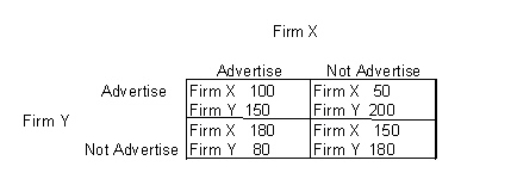 According to Table 25.1, if firm X advertises and Y does not advertise:
 (Multiple Choice)
4.8/5 (72)
(72) Since only a few firms dominate the oligopoly market, cutthroat competition does not exist.
(True/False)
4.9/5 (77)
(77) 
Filters
- Essay(0)
- Multiple Choice(0)
- Short Answer(0)
- True False(0)
- Matching(0)