



 Chat with AI
Exam 56: International Trade Restrictions

Exam 1: Economics: The World Around You90 Questions
Exam 2: Choice, Opportunity Costs, and Specialization94 Questions
Exam 3: Markets, Demand and Supply, and the Price System97 Questions
Exam 5: The Market System and the Private and Public Sector97 Questions
Exam 4: Elasticity: Demand and Supply126 Questions
Exam 6: National Income Accounting104 Questions
Exam 7: an Introduction to the Foreign Exchange Market and the Balance of Payments90 Questions
Exam 8: Consumer Choice132 Questions
Exam 9: Supply: The Costs of Doing Business106 Questions
Exam 10: Unemployment and Inflation129 Questions
Exam 11: Macroeconomic Equilibrium: Aggregate Demand and Supply122 Questions
Exam 12: Profit Maximization122 Questions
Exam 13: Aggregate Expenditures115 Questions
Exam 14: Perfect Competition135 Questions
Exam 15: Income and Expenditures Equilibrium134 Questions
Exam 16: Monopoly118 Questions
Exam 17: Fiscal Policy93 Questions
Exam 18: Monopolistic Competition and Oligopoly111 Questions
Exam 19: Antitrust and Regulation100 Questions
Exam 10: Money and Banking125 Questions
Exam 21: Market Failures, Government Failures, and Rent Seeking121 Questions
Exam 22: Monetary Policy141 Questions
Exam 23: Macroeconomic Policy: Tradeoffs, Expectations, Credibility, and Sources of Business Cycles112 Questions
Exam 24: Resource Markets112 Questions
Exam 25: Macroeconomic Viewpoints: New Keynesian, Monetarist, and New Classical99 Questions
Exam 26: The Labor Market114 Questions
Exam 27: Capital Markets100 Questions
Exam 28: Economic Growth99 Questions
Exam 29: Development Economics104 Questions
Exam 30: the Land Market and Natural Resources55 Questions
Exam 31: Aging, Social Security and Health Care88 Questions
Exam 32: Globalization84 Questions
Exam 33: Elasticity: Demand and Supply126 Questions
Exam 34: Income Distribution, Poverty and Government Policy115 Questions
Exam 35: World Trade Equilibrium112 Questions
Exam 36: Consumer Choice132 Questions
Exam 37: International Trade Restrictions109 Questions
Exam 38: World Trade Equilibrium112 Questions
Exam 39: Exchange Rates and Financial Links Between Countries132 Questions
Exam 40: International Trade Restrictions109 Questions
Exam 41: Supply: the Costs of Doing Business106 Questions
Exam 42: Exchange Rates and Financial Links Between Countries132 Questions
Exam 43: Profit Maximization122 Questions
Exam 44: Perfect Competition135 Questions
Exam 45: Monopoly118 Questions
Exam 46: Monopolistic Competition and Oligopoly111 Questions
Exam 47: Antitrust and Regulation100 Questions
Exam 48: Market Failures, Government Failures, and Rent Seeking121 Questions
Exam 49: Resource Markets112 Questions
Exam 50: The Labor Market114 Questions
Exam 51: Capital Markets100 Questions
Exam 52: The Land Market and Natural Resources55 Questions
Exam 53: Aging, Social Security and Health Care87 Questions
Exam 54: Income Distribution, Poverty and Government Policy115 Questions
Exam 55: World Trade Equilibrium112 Questions
Exam 56: International Trade Restrictions109 Questions
Exam 57: Exchange Rates and Financial Links Between Countries132 Questions
Select questions type


Generally speaking, protection from foreign competition benefits:
(Multiple Choice)
4.9/5  (77)
(77) The notion of reciprocity means that one nation will impose import restrictions on another in order to:
(Multiple Choice)
4.9/5 (77)
(77) The figure given below depicts the negatively sloped demand and positively sloped supply curves of wheat in a country. Figure 35.2 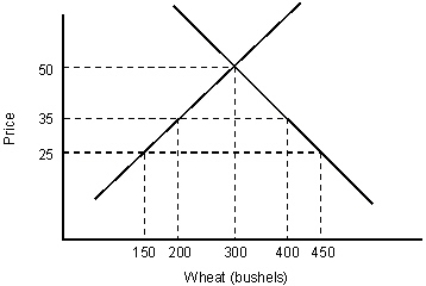 In Figure 35.2, if the world price per bushel of wheat is $25, and a tariff of $10 is imposed, what is the domestic production?
 (Multiple Choice)
4.9/5 (85)
(85) According to economists, which of the following acts was partially responsible for the Great Depression of the 1930s?
(Multiple Choice)
4.7/5 (85)
(85) The figure below shows the demand (D)and supply (S)curves of cocoa in the U.S. Figure 35.4 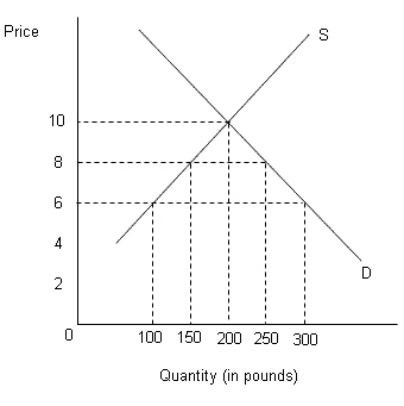 Refer to Figure 35.4.If cocoa sells for $6 per pound in the world market, determine the volume of U.S.cocoa imports.
 (Multiple Choice)
5.0/5 (85)
(85) The figure below shows the demand (D)and supply (S)curves of corn syrups. Figure 35.3 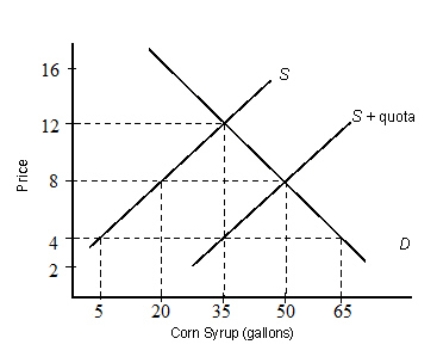 In Figure 35.3, if the world price per gallon is $8, then without quotas:
 (Multiple Choice)
4.8/5 (84)
(84) Creating conditions for fair trade by limiting imports will make the domestic consumers better off, as they will be required to pay low prices for the products.
(True/False)
4.9/5 (78)
(78) The figure below shows the demand (D)and supply (S)curves of corn syrups. Figure 35.3 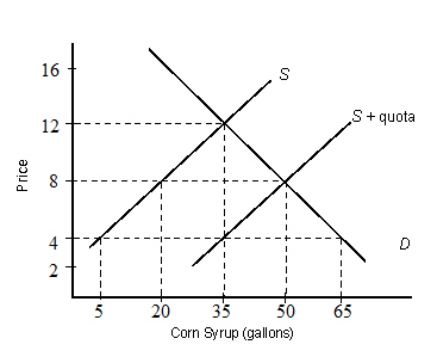 In Figure 35.3, suppose an import quota of 30 gallons of corn syrup is imposed.If the world price per gallon is $4:
 (Multiple Choice)
4.8/5 (82)
(82) The figure given below depicts the negatively sloped demand and positively sloped supply curves of wheat in a country. Figure 35.2 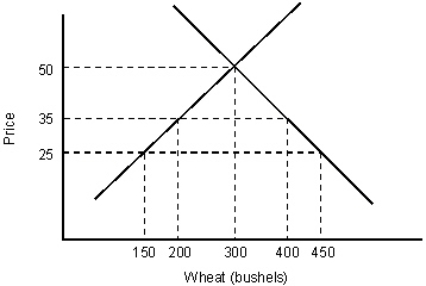 According to Figure 35.2, if the world price per bushel of wheat is $25, how much is the domestic demand?
 (Multiple Choice)
4.8/5 (85)
(85) 
Filters
- Essay(0)
- Multiple Choice(0)
- Short Answer(0)
- True False(0)
- Matching(0)