



 Chat with AI
Exam 4: Economic Efficiency, government Price Setting, and Taxes

Exam 1: Economics: Foundations and Models447 Questions
Exam 2: Trade-Offs, comparative Advantage, and the Market System492 Questions
Exam 3: Where Prices Come From: the Interaction of Demand and Supply476 Questions
Exam 4: Economic Efficiency, government Price Setting, and Taxes420 Questions
Exam 5: Externalities, environmental Policy, and Public Goods263 Questions
Exam 6: Elasticity: the Responsiveness of Demand and Supply294 Questions
Exam 7: The Economics of Health Care338 Questions
Exam 8: Firms,the Stock Market,and Corporate Governance522 Questions
Exam 9: Comparative Advantage and the Gains From International Trade377 Questions
Exam 10: Consumer Choice and Behavioral Economics300 Questions
Exam 11: Technology,production,and Costs327 Questions
Exam 12: Firms in Perfectly Competitive Markets296 Questions
Exam 13: Monopolistic Competition: the Competitive Model in a More Realistic Setting272 Questions
Exam 14: Oligopoly: Firms in Less Competitive Markets258 Questions
Exam 15: Monopoly and Antitrust Policy279 Questions
Exam 16: Pricing Strategy261 Questions
Exam 17: The Markets for Labor and Other Factors of Production281 Questions
Exam 18: Public Choice, taxes, and the Distribution of Income258 Questions
Exam 19: Gdp: Measuring Total Production and Income261 Questions
Exam 20: Unemployment and Inflation291 Questions
Exam 21: Economic Growth, the Financial System, and Business Cycles253 Questions
Exam 22: Long-Run Economic Growth: Sources and Policies262 Questions
Exam 23: Aggregate Expenditure and Output in the Short Run301 Questions
Exam 24: Aggregate Demand and Aggregate Supply Analysis286 Questions
Exam 25: Money,banks,and the Federal Reserve System281 Questions
Exam 26: Monetary Policy275 Questions
Exam 27: Fiscal Policy306 Questions
Exam 28: Inflation, unemployment, and Federal Reserve Policy257 Questions
Exam 29: Macroeconomics in an Open Economy278 Questions
Exam 30: The International Financial System258 Questions
Select questions type


 Figure 4-4 shows the market for tiger shrimp.The market is initially in equilibrium at a price of $15 and a quantity of 80.Now suppose producers decide to cut output to 40 in order to raise the price to $18.
-Refer to Figure 4-4.What is the value of producer surplus at a price of $18?
Figure 4-4 shows the market for tiger shrimp.The market is initially in equilibrium at a price of $15 and a quantity of 80.Now suppose producers decide to cut output to 40 in order to raise the price to $18.
-Refer to Figure 4-4.What is the value of producer surplus at a price of $18? (Multiple Choice)
4.9/5  (74)
(74) What is marginal benefit? Which curve is also referred to as a marginal benefit curve?
(Essay)
4.9/5 (81)
(81) Table 4-14
Demand Supply P=60-2Q =15+Q =30-0.5P = -15
-Refer to Table 4-14.The equations above describe the demand and supply for Pauline's Pickled Pomegranates.The equilibrium price and quantity for Pauline's Pickled Pomegranates are $30 and 15 thousand units.What is the value of consumer surplus?
(Multiple Choice)
4.8/5 (81)
(81) Government intervention in agricultural markets in the U.S.began in the
(Multiple Choice)
4.8/5 (87)
(87) Table 4-5
Consumer Willingness to Pay Violet \ 48 Walter 40 Xavier 30 Yolanda 24 Zachary 14
-Refer to Table 4-5.The table above lists the highest prices five consumers are willing to pay for a concert ticket.If the price of one of the tickets is $36
(Multiple Choice)
4.7/5 (73)
(73) Table 4-6
Marko's Polos Marginal Cost (dollars) 1 st shirt \ 7 2nd shirt 10 3rd shirt 15 4th shirt 20
-Refer to Table 4-6.The table above lists the marginal cost of polo shirts by Marko's,a firm that specializes in producing men's clothing.If the market price of Marko's polo shirts is $13,Marko's will produce
(Multiple Choice)
4.7/5 (67)
(67) The total amount of consumer surplus in a market is equal to the area below the demand curve.
(True/False)
4.8/5 (77)
(77) 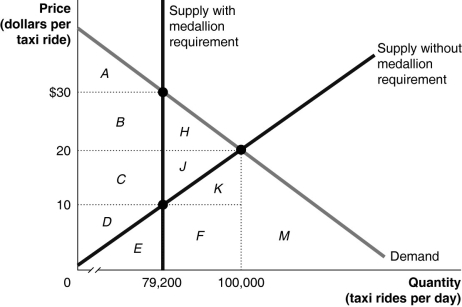 Figure 4-14 shows the market for taxi rides.The following question(s)are based on this figure.
-Refer to Figure 4-14.To legally drive a taxicab in New York City,you must have a medallion issued by the city government.Assume that only 13,200 medallions have been issued.Let's also assume this puts an absolute limit on the number of taxi rides that can be supplied in New York City on any day,because no one breaks the law by driving a taxi without a medallion.Assume as well that each taxi provides 6 trips per day.In that case,the quantity of taxi rides supplied is 79,200 (or 6 rides per taxi × 13,200 taxis).This is shown in the diagram with a vertical line at this quantity.Assume that there are no government controls on the prices that drivers can charge for rides.
a.What would the equilibrium price and quantity be in this market if there was no medallion requirement?
b.If there was no medallion requirement,indicate the area that represents consumer surplus.
c.If there was no medallion requirement,indicate the area that represents producer surplus.
d.If there was no medallion requirement,indicate the area that represents economic surplus.
e.What are the price and quantity with the medallion requirement?
f.With a medallion requirement in place,what area represents consumer surplus?
g.With a medallion requirement in place,what area represents producer surplus?
h.With a medallion requirement in place,what area represents the deadweight loss?
i.Based on your answers to parts (c)and (g),are taxicab drivers better off with the medallion requirement for taxicabs than without?
j.Are consumers better off with or without the medallion requirement for taxicabs?
Figure 4-14 shows the market for taxi rides.The following question(s)are based on this figure.
-Refer to Figure 4-14.To legally drive a taxicab in New York City,you must have a medallion issued by the city government.Assume that only 13,200 medallions have been issued.Let's also assume this puts an absolute limit on the number of taxi rides that can be supplied in New York City on any day,because no one breaks the law by driving a taxi without a medallion.Assume as well that each taxi provides 6 trips per day.In that case,the quantity of taxi rides supplied is 79,200 (or 6 rides per taxi × 13,200 taxis).This is shown in the diagram with a vertical line at this quantity.Assume that there are no government controls on the prices that drivers can charge for rides.
a.What would the equilibrium price and quantity be in this market if there was no medallion requirement?
b.If there was no medallion requirement,indicate the area that represents consumer surplus.
c.If there was no medallion requirement,indicate the area that represents producer surplus.
d.If there was no medallion requirement,indicate the area that represents economic surplus.
e.What are the price and quantity with the medallion requirement?
f.With a medallion requirement in place,what area represents consumer surplus?
g.With a medallion requirement in place,what area represents producer surplus?
h.With a medallion requirement in place,what area represents the deadweight loss?
i.Based on your answers to parts (c)and (g),are taxicab drivers better off with the medallion requirement for taxicabs than without?
j.Are consumers better off with or without the medallion requirement for taxicabs? (Essay)
5.0/5 (85)
(85) Table 4-14
Demand Supply P=60-2Q =15+Q =30-0.5P = -15
-Refer to Table 4-14.The equations above describe the demand and supply for Pauline's Pickled Pomegranates.What are the equilibrium price and quantity (in thousands)for Pauline's Pickled Pomegranates?
(Multiple Choice)
4.9/5 (77)
(77) Economic efficiency in a competitive market is achieved when
(Multiple Choice)
4.9/5 (71)
(71) A black market is a market where buying and selling take place
(Multiple Choice)
4.9/5 (86)
(86) Economic efficiency is defined as a market outcome in which the marginal benefit to consumers of the last unit produced is equal to the marginal cost of production,and in which
(Multiple Choice)
4.7/5 (81)
(81) Table 4-2
Consumer Willingness to Pay Anya \ 24 Basil 20 Celeste 15 Dralon 12 Esther 7
-Refer to Table 4-2.The table above lists the highest prices five consumers are willing to pay for a theater ticket.If the price of one ticket is $25
(Multiple Choice)
4.7/5 (81)
(81) If marginal benefit is greater than marginal cost,output is inefficiently high.
(True/False)
4.9/5 (65)
(65) Figure 4-7  -Refer to Figure 4-7.The figure above represents the market for iced tea.Assume that this is a competitive market.If the price of iced tea is $3,what changes in the market would result in an economically efficient output?
 (Multiple Choice)
4.8/5 (78)
(78) Table 4-13
Demand Supply P=50-Q P=10+1/3Q Q=50-P Q=3P-30
-Refer to Table 4-13.The equations above describe the demand and supply for Aunt Maud's Premium Hand Lotion.The equilibrium price and quantity for Aunt Maud's lotion are $20 and 30 thousand units.What is the value of consumer surplus?
(Multiple Choice)
4.9/5 (83)
(83) Figure 4-19 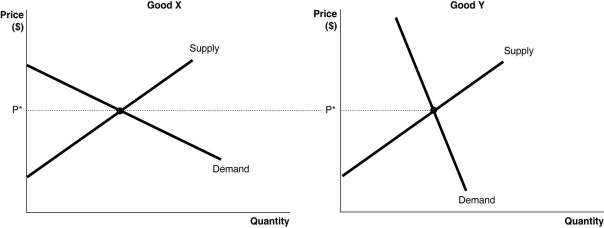 -Refer to Figure 4-19.The figure above illustrates the markets for two goods,Good X and Good Y.Suppose an identical dollar tax is imposed on sellers in each market.
a.Compare the consumer burden and producer burden in each market.Illustrate your answer graphically.
b.If the goal of the government is to raise revenue with minimum impact to quantity consumed,in which market should the tax be imposed?
c.If the goal of the government is to discourage consumption,in which market should the tax be imposed?
-Refer to Figure 4-19.The figure above illustrates the markets for two goods,Good X and Good Y.Suppose an identical dollar tax is imposed on sellers in each market.
a.Compare the consumer burden and producer burden in each market.Illustrate your answer graphically.
b.If the goal of the government is to raise revenue with minimum impact to quantity consumed,in which market should the tax be imposed?
c.If the goal of the government is to discourage consumption,in which market should the tax be imposed? (Essay)
5.0/5 (80)
(80) Figure 4-7
-Refer to Figure 4-7.The figure above represents the market for iced tea.Assume that this is a competitive market.If 10,000 units of iced tea are sold
-Refer to Figure 4-7.The figure above represents the market for iced tea.Assume that this is a competitive market.If 10,000 units of iced tea are sold (Multiple Choice)
4.8/5 (71)
(71) 
Filters
- Essay(0)
- Multiple Choice(0)
- Short Answer(0)
- True False(0)
- Matching(0)