



 Chat with AI
Exam 4: Economic Efficiency, government Price Setting, and Taxes

Exam 1: Economics: Foundations and Models447 Questions
Exam 2: Trade-Offs, comparative Advantage, and the Market System492 Questions
Exam 3: Where Prices Come From: the Interaction of Demand and Supply476 Questions
Exam 4: Economic Efficiency, government Price Setting, and Taxes420 Questions
Exam 5: Externalities, environmental Policy, and Public Goods263 Questions
Exam 6: Elasticity: the Responsiveness of Demand and Supply294 Questions
Exam 7: The Economics of Health Care338 Questions
Exam 8: Firms,the Stock Market,and Corporate Governance522 Questions
Exam 9: Comparative Advantage and the Gains From International Trade377 Questions
Exam 10: Consumer Choice and Behavioral Economics300 Questions
Exam 11: Technology,production,and Costs327 Questions
Exam 12: Firms in Perfectly Competitive Markets296 Questions
Exam 13: Monopolistic Competition: the Competitive Model in a More Realistic Setting272 Questions
Exam 14: Oligopoly: Firms in Less Competitive Markets258 Questions
Exam 15: Monopoly and Antitrust Policy279 Questions
Exam 16: Pricing Strategy261 Questions
Exam 17: The Markets for Labor and Other Factors of Production281 Questions
Exam 18: Public Choice, taxes, and the Distribution of Income258 Questions
Exam 19: Gdp: Measuring Total Production and Income261 Questions
Exam 20: Unemployment and Inflation291 Questions
Exam 21: Economic Growth, the Financial System, and Business Cycles253 Questions
Exam 22: Long-Run Economic Growth: Sources and Policies262 Questions
Exam 23: Aggregate Expenditure and Output in the Short Run301 Questions
Exam 24: Aggregate Demand and Aggregate Supply Analysis286 Questions
Exam 25: Money,banks,and the Federal Reserve System281 Questions
Exam 26: Monetary Policy275 Questions
Exam 27: Fiscal Policy306 Questions
Exam 28: Inflation, unemployment, and Federal Reserve Policy257 Questions
Exam 29: Macroeconomics in an Open Economy278 Questions
Exam 30: The International Financial System258 Questions
Select questions type


Deadweight loss refers to a loss in revenue resulting from producers having to reduce their selling price to remain competitive.
(True/False)
4.9/5  (79)
(79) Figure 4-13 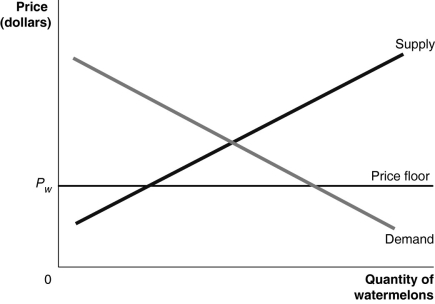 -Refer to Figure 4-13 which shows the market for watermelons.Suppose the government imposes a price floor of Pw.How will the price floor affect the quantity supplied,quantity demanded,and quantity exchanged?
 (Essay)
4.8/5 (86)
(86) Table 4-12
Demand Supply P=50-2 P=35+ =25-0.5P =P-35
-Refer to Table 4-12.The equations above describe the demand and supply for Bubba's Fried Jellybeans.The equilibrium price and quantity for Bubba's Fried Jellybeans are $40 and 5 thousand units.What is the value of economic surplus in this market?
(Multiple Choice)
4.9/5 (83)
(83)  Figure 4-4 shows the market for tiger shrimp.The market is initially in equilibrium at a price of $15 and a quantity of 80.Now suppose producers decide to cut output to 40 in order to raise the price to $18.
-Refer to Figure 4-4.What is the value of consumer surplus at the equilibrium price of $15?
Figure 4-4 shows the market for tiger shrimp.The market is initially in equilibrium at a price of $15 and a quantity of 80.Now suppose producers decide to cut output to 40 in order to raise the price to $18.
-Refer to Figure 4-4.What is the value of consumer surplus at the equilibrium price of $15? (Multiple Choice)
4.8/5 (84)
(84) Is there a difference between the "true burden" of a tax and who is legally required to pay a tax? Briefly explain.
(Essay)
4.9/5 (91)
(91) The difference between consumer surplus and producer surplus in a market is equal to the deadweight loss.
(True/False)
4.9/5 (71)
(71) Figure 4-16 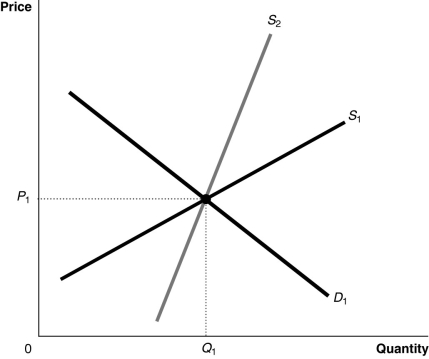 -Refer to Figure 4-16.Suppose the market is initially in equilibrium at price P1 and now the government imposes a tax on every unit sold.Which of the following statements best describes the impact of the tax? For demand curve D1
 (Multiple Choice)
4.8/5 (79)
(79) Economists are reluctant to state that price controls are desirable or undesirable because
(Multiple Choice)
4.8/5 (79)
(79) The following equations represent the demand and supply for kumquats. QD = 60 - 3P
QS = -20 + 5P
What is the equilibrium price (P)and quantity (Q - in thousands)of kumquats?
(Multiple Choice)
4.8/5 (75)
(75)  Figure 4-18 shows the market for cigarettes.The government plans to impose a unit tax in this market.
-Refer to Figure 4-18.As a result of the tax,is there a loss in producer surplus?
Figure 4-18 shows the market for cigarettes.The government plans to impose a unit tax in this market.
-Refer to Figure 4-18.As a result of the tax,is there a loss in producer surplus? (Multiple Choice)
4.9/5 (75)
(75) The additional cost to a firm of producing one more unit of a good or service is the
(Multiple Choice)
4.9/5 (85)
(85) A tax is imposed on employers and workers that are used to fund Social Security and Medicare.This tax is sometimes referred to as
(Multiple Choice)
4.8/5 (88)
(88) Table 4-3
The Waco Kid's Cowboy Hats Marginal Cost (dollars) 1st hat \ 24 2nd hat 30 3rd hat 38 4th hat 46
-Refer to Table 4-3.The table above lists the marginal cost of cowboy hats by The Waco Kid,a firm that specializes in producing western wear.If the market price of cowboy hats is $35,The Waco Kid will produce
(Multiple Choice)
5.0/5 (82)
(82) Compared to prices charged by Uber,traditional taxi companies charge government-regulated prices.These government-regulated prices ________ in the market for shared rides.
(Multiple Choice)
4.8/5 (80)
(80) Figure 4-5  -Refer to Figure 4-5.The figure above represents the market for pecans.Assume that this is a competitive market.If the price of pecans is $3
 (Multiple Choice)
4.9/5 (74)
(74) Table 4-5
Consumer Willingness to Pay Violet \ 48 Walter 40 Xavier 30 Yolanda 24 Zachary 14
-Refer to Table 4-5.The table above lists the highest prices five consumers are willing to pay for a concert ticket.If the price of one of the tickets is $20
(Multiple Choice)
4.7/5 (97)
(97) Marginal benefit is equal to the ________ benefit a consumer receives from consuming one more unit of a good or service.
(Multiple Choice)
4.7/5 (72)
(72) 
Filters
- Essay(0)
- Multiple Choice(0)
- Short Answer(0)
- True False(0)
- Matching(0)