



 Chat with AI
Exam 4: Economic Efficiency, government Price Setting, and Taxes

Exam 1: Economics: Foundations and Models447 Questions
Exam 2: Trade-Offs, comparative Advantage, and the Market System492 Questions
Exam 3: Where Prices Come From: the Interaction of Demand and Supply476 Questions
Exam 4: Economic Efficiency, government Price Setting, and Taxes420 Questions
Exam 5: Externalities, environmental Policy, and Public Goods263 Questions
Exam 6: Elasticity: the Responsiveness of Demand and Supply294 Questions
Exam 7: The Economics of Health Care338 Questions
Exam 8: Firms,the Stock Market,and Corporate Governance522 Questions
Exam 9: Comparative Advantage and the Gains From International Trade377 Questions
Exam 10: Consumer Choice and Behavioral Economics300 Questions
Exam 11: Technology,production,and Costs327 Questions
Exam 12: Firms in Perfectly Competitive Markets296 Questions
Exam 13: Monopolistic Competition: the Competitive Model in a More Realistic Setting272 Questions
Exam 14: Oligopoly: Firms in Less Competitive Markets258 Questions
Exam 15: Monopoly and Antitrust Policy279 Questions
Exam 16: Pricing Strategy261 Questions
Exam 17: The Markets for Labor and Other Factors of Production281 Questions
Exam 18: Public Choice, taxes, and the Distribution of Income258 Questions
Exam 19: Gdp: Measuring Total Production and Income261 Questions
Exam 20: Unemployment and Inflation291 Questions
Exam 21: Economic Growth, the Financial System, and Business Cycles253 Questions
Exam 22: Long-Run Economic Growth: Sources and Policies262 Questions
Exam 23: Aggregate Expenditure and Output in the Short Run301 Questions
Exam 24: Aggregate Demand and Aggregate Supply Analysis286 Questions
Exam 25: Money,banks,and the Federal Reserve System281 Questions
Exam 26: Monetary Policy275 Questions
Exam 27: Fiscal Policy306 Questions
Exam 28: Inflation, unemployment, and Federal Reserve Policy257 Questions
Exam 29: Macroeconomics in an Open Economy278 Questions
Exam 30: The International Financial System258 Questions
Select questions type


Hourly Wage (dollars) Quantity of Labor Supplied Quantity of Labor Demanded \ 8.00 350,000 390,000 8.50 360,000 380,000 9.00 370,000 370,000 9.50 380,000 360,000 10.00 390,000 350,000 10.50 400,000 340,000 Table 4-8 shows the demand and supply schedules for the low-skilled labor market in the city of Westover.
-Refer to Table 4-8.If a minimum wage of $10.00 an hour is mandated,what is the quantity of labor supplied?
(Multiple Choice)
4.9/5  (83)
(83) If a tax is imposed on a product,the buyer will always bear the entire burden of the tax.
(True/False)
4.8/5 (86)
(86) Figure 4-21 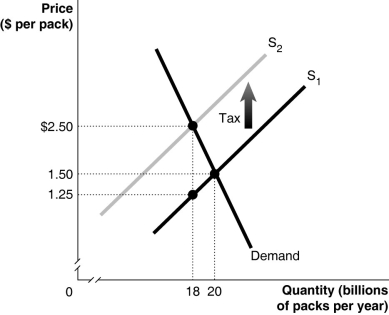 -Refer to Figure 4-21.The figure above represents demand and supply in the market for cigarettes.Use the diagram to answer the following questions.
a.How much is the government tax on each pack of cigarettes?
b.What portion of the unit tax is paid by consumers?
c.What portion of the unit tax is paid by producers?
d.What is the quantity sold after the imposition of the tax?
e.What is the after-tax revenue per pack received by producers?
f.What is the total tax revenue collected by the government?
g.What is the value of the excess burden of the tax?
h.Is this cigarette tax efficient?
-Refer to Figure 4-21.The figure above represents demand and supply in the market for cigarettes.Use the diagram to answer the following questions.
a.How much is the government tax on each pack of cigarettes?
b.What portion of the unit tax is paid by consumers?
c.What portion of the unit tax is paid by producers?
d.What is the quantity sold after the imposition of the tax?
e.What is the after-tax revenue per pack received by producers?
f.What is the total tax revenue collected by the government?
g.What is the value of the excess burden of the tax?
h.Is this cigarette tax efficient? (Essay)
4.7/5 (73)
(73)  Figure 4-6 shows the market for granola.The market is initially in equilibrium at a price of P1 and a quantity of Q1.Now suppose producers decide to cut output to Q2 in order to raise the price to P2.
-Refer to Figure 4-6.What area represents the deadweight loss at P2?
Figure 4-6 shows the market for granola.The market is initially in equilibrium at a price of P1 and a quantity of Q1.Now suppose producers decide to cut output to Q2 in order to raise the price to P2.
-Refer to Figure 4-6.What area represents the deadweight loss at P2? (Multiple Choice)
4.9/5 (83)
(83) In the market for gasoline,an increase in the federal excise tax on gasoline would shift the supply curve up.
(True/False)
4.8/5 (80)
(80) Figure 4-6 shows the market for granola.The market is initially in equilibrium at a price of P1 and a quantity of Q1.Now suppose producers decide to cut output to Q2 in order to raise the price to P2.
-Refer to Figure 4-6.What area represents producer surplus at the equilibrium price of P1?
Figure 4-6 shows the market for granola.The market is initially in equilibrium at a price of P1 and a quantity of Q1.Now suppose producers decide to cut output to Q2 in order to raise the price to P2.
-Refer to Figure 4-6.What area represents producer surplus at the equilibrium price of P1? (Multiple Choice)
4.7/5 (78)
(78)  Figure 4-3 shows Kendra's demand curve for ice cream cones.
-Refer to Figure 4-3.If the market price is $3.00,what is the consumer surplus on the second ice cream cone?
Figure 4-3 shows Kendra's demand curve for ice cream cones.
-Refer to Figure 4-3.If the market price is $3.00,what is the consumer surplus on the second ice cream cone? (Multiple Choice)
4.8/5 (84)
(84) ________ refers to the reduction in economic surplus resulting from not being in competitive equilibrium.
(Multiple Choice)
4.9/5 (76)
(76) Which of the following statements best describes the concept of consumer surplus?
(Multiple Choice)
4.8/5 (80)
(80) The difference between the ________ for a good and the ________ is called consumer surplus.
(Multiple Choice)
4.9/5 (77)
(77) ________ dictates the lowest wage that firms may pay for labor.
(Multiple Choice)
4.8/5 (95)
(95) The graph below represents the market for alfalfa.The market price is $7.00 per bushel.Identify the areas representing consumer surplus,producer surplus,and economic surplus. 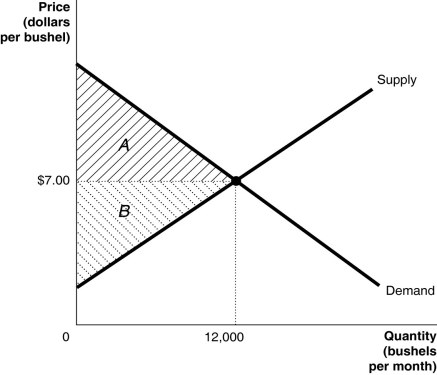
(Essay)
4.8/5 (79)
(79) A ________ curve shows the marginal cost of producing one more unit of a good or service.
(Multiple Choice)
4.8/5 (77)
(77)  Figure 4-1 shows Arnold's demand curve for burritos.
-Refer to Figure 4-1.If the market price is $1.50,what is Arnold's consumer surplus?
Figure 4-1 shows Arnold's demand curve for burritos.
-Refer to Figure 4-1.If the market price is $1.50,what is Arnold's consumer surplus? (Multiple Choice)
4.8/5 (95)
(95) Table 4-3
The Waco Kid's Cowboy Hats Marginal Cost (dollars) 1st hat \ 24 2nd hat 30 3rd hat 38 4th hat 46
-Refer to Table 4-3.The table above lists the marginal cost of cowboy hats by The Waco Kid,a firm that specializes in producing western wear.If the price of cowboy hats decreases from $38 to $30
(Multiple Choice)
4.9/5 (85)
(85) Figure 4-5  -Refer to Figure 4-5.The figure above represents the market for pecans.Assume that this is a competitive market.If the price of pecans is $9,what changes in the market would result in an economically efficient output?
 (Multiple Choice)
4.7/5 (62)
(62) In a competitive market equilibrium the ________ equals the ________ of the last unit sold.
(Multiple Choice)
4.8/5 (77)
(77) 
Filters
- Essay(0)
- Multiple Choice(0)
- Short Answer(0)
- True False(0)
- Matching(0)