



 Chat with AI
Exam 4: Economic Efficiency, government Price Setting, and Taxes

Exam 1: Economics: Foundations and Models447 Questions
Exam 2: Trade-Offs, comparative Advantage, and the Market System492 Questions
Exam 3: Where Prices Come From: the Interaction of Demand and Supply476 Questions
Exam 4: Economic Efficiency, government Price Setting, and Taxes420 Questions
Exam 5: Externalities, environmental Policy, and Public Goods263 Questions
Exam 6: Elasticity: the Responsiveness of Demand and Supply294 Questions
Exam 7: The Economics of Health Care338 Questions
Exam 8: Firms,the Stock Market,and Corporate Governance522 Questions
Exam 9: Comparative Advantage and the Gains From International Trade377 Questions
Exam 10: Consumer Choice and Behavioral Economics300 Questions
Exam 11: Technology,production,and Costs327 Questions
Exam 12: Firms in Perfectly Competitive Markets296 Questions
Exam 13: Monopolistic Competition: the Competitive Model in a More Realistic Setting272 Questions
Exam 14: Oligopoly: Firms in Less Competitive Markets258 Questions
Exam 15: Monopoly and Antitrust Policy279 Questions
Exam 16: Pricing Strategy261 Questions
Exam 17: The Markets for Labor and Other Factors of Production281 Questions
Exam 18: Public Choice, taxes, and the Distribution of Income258 Questions
Exam 19: Gdp: Measuring Total Production and Income261 Questions
Exam 20: Unemployment and Inflation291 Questions
Exam 21: Economic Growth, the Financial System, and Business Cycles253 Questions
Exam 22: Long-Run Economic Growth: Sources and Policies262 Questions
Exam 23: Aggregate Expenditure and Output in the Short Run301 Questions
Exam 24: Aggregate Demand and Aggregate Supply Analysis286 Questions
Exam 25: Money,banks,and the Federal Reserve System281 Questions
Exam 26: Monetary Policy275 Questions
Exam 27: Fiscal Policy306 Questions
Exam 28: Inflation, unemployment, and Federal Reserve Policy257 Questions
Exam 29: Macroeconomics in an Open Economy278 Questions
Exam 30: The International Financial System258 Questions
Select questions type


Figure 4-2 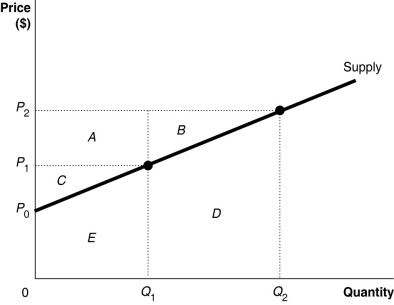 -Refer to Figure 4-2.What area represents the increase in producer surplus when the market price rises from P1 to P2?
 (Multiple Choice)
4.8/5  (69)
(69) Economic efficiency is a market outcome in which the marginal benefit to consumers is equal to the marginal cost of production and the sum of consumer surplus and producer surplus is maximized.
(True/False)
4.8/5 (74)
(74) In cities with rent controls,the actual rents paid can be ________ than the legal maximum.One explanation for this is because there is a ________ of apartments,tenants are ________.
(Multiple Choice)
4.7/5 (69)
(69) The following equations represent the demand and supply for bottles of nail polish. QD = 25 - P
QS = -15 + 3P
What is the equilibrium price (P)and quantity (Q - in thousands)of bottles of nail polish?
(Multiple Choice)
4.8/5 (81)
(81) The total amount of producer surplus in a market is equal to the area below the supply curve.
(True/False)
4.8/5 (75)
(75) In Singapore the government places a $5,000 tax on the buyers of new automobiles.After the purchase of a new car,a buyer must pay the government $5,000.How would the imposition of the tax on buyers be illustrated in a graph?
(Multiple Choice)
4.9/5 (87)
(87) Hourly Wage (dollars) Quantity of Labor Supplied Quantity of Labor Demanded \ 7.50 530,000 650,000 8.50 550,000 630,000 9.50 570,000 610,000 10.50 590,000 590,000 11.50 610,000 570,000 12.50 630,000 550,000 Table 4-7 shows the demand and supply schedules for the labor market in the city of Pixley.
-Refer to Table 4-7.Suppose that the quantity of labor demanded decreases by 80,000 at each wage level.What are the new free market equilibrium hourly wage and the new equilibrium quantity of labor?
(Multiple Choice)
4.9/5 (75)
(75) Article Summary
Among a package of anti-smoking bills designed to lower California's health care costs by reducing the use of tobacco products is a bill sponsored by Dr.Richard Pan that would increase the tax on a pack of cigarettes by $2.California currently has a tobacco tax of 87-cents-per-pack,making California's tax 33rd in the nation and well below the New York state tax of $4.35 a pack.The state taxes are in addition to a $1.01 federal tax on cigarettes.The bill stipulates that the revenue collected must be used to increase the number of physicians in California as well as support existing health care programs managed by the state.A Field Poll taken one day following the announcement of the bill found that two-thirds of California voters support the increase in the cigarette tax.
-Refer to the Article Summary.The additional tax of $2 per pack of cigarettes being proposed by Senator Pan would have which of the following effects on the market for cigarettes in California?
(Multiple Choice)
4.9/5 (87)
(87) Brett buys a new cell phone for $100.He receives consumer surplus of $80 from the purchase.How much does Brett value his cell phone?
(Multiple Choice)
4.7/5 (75)
(75) Using a supply and demand graph,illustrate the effect of the addition of a $10.00 per-unit unit tax on digital cameras,where the entire tax burden falls on the seller.Assume the equilibrium price before the tax is $125 and the equilibrium quantity is 50,000.What happens to the price and quantity after the tax is implemented?
(Essay)
4.7/5 (82)
(82) Lucinda buys a new GPS system for $250.She receives consumer surplus of $75 from the purchase.What value does Lucinda place on her GPS system?
(Multiple Choice)
4.9/5 (83)
(83)  Figure 4-3 shows Kendra's demand curve for ice cream cones.
-Refer to Figure 4-3.If the market price is $3.00,what is Kendra's consumer surplus?
Figure 4-3 shows Kendra's demand curve for ice cream cones.
-Refer to Figure 4-3.If the market price is $3.00,what is Kendra's consumer surplus? (Multiple Choice)
4.9/5 (90)
(90) Suppose the demand curve for a product is downward sloping and the supply curve is upward sloping.If a unit tax is imposed in the market for this product
(Multiple Choice)
4.8/5 (88)
(88) Suppliers will be willing to supply a product in all of the following situations except when
(Multiple Choice)
4.8/5 (78)
(78) Which of the following is not a consequence of minimum wage laws?
(Multiple Choice)
4.9/5 (76)
(76) What is marginal cost? Which curve is also referred to as the marginal cost curve?
(Essay)
4.7/5 (83)
(83)  Figure 4-10 shows the market for apartments in Bay City.Recently,the government imposed a rent ceiling at R0.
-Refer to Figure 4-10.Suppose that instead of a price ceiling,the government imposed a price floor of R1.What area represents the deadweight loss after the imposition of the price floor?
Figure 4-10 shows the market for apartments in Bay City.Recently,the government imposed a rent ceiling at R0.
-Refer to Figure 4-10.Suppose that instead of a price ceiling,the government imposed a price floor of R1.What area represents the deadweight loss after the imposition of the price floor? (Multiple Choice)
4.7/5 (75)
(75) 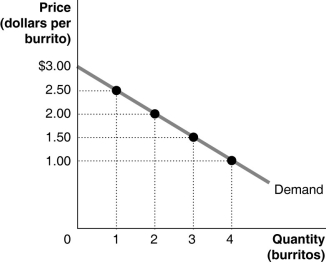 Figure 4-1 shows Arnold's demand curve for burritos.
-Refer to Figure 4-1.Arnold's marginal benefit from consuming the third burrito is
Figure 4-1 shows Arnold's demand curve for burritos.
-Refer to Figure 4-1.Arnold's marginal benefit from consuming the third burrito is (Multiple Choice)
4.9/5 (73)
(73) 
Filters
- Essay(0)
- Multiple Choice(0)
- Short Answer(0)
- True False(0)
- Matching(0)