



 Chat with AI
Exam 4: Economic Efficiency, government Price Setting, and Taxes

Exam 1: Economics: Foundations and Models447 Questions
Exam 2: Trade-Offs, comparative Advantage, and the Market System492 Questions
Exam 3: Where Prices Come From: the Interaction of Demand and Supply476 Questions
Exam 4: Economic Efficiency, government Price Setting, and Taxes420 Questions
Exam 5: Externalities, environmental Policy, and Public Goods263 Questions
Exam 6: Elasticity: the Responsiveness of Demand and Supply294 Questions
Exam 7: The Economics of Health Care338 Questions
Exam 8: Firms,the Stock Market,and Corporate Governance522 Questions
Exam 9: Comparative Advantage and the Gains From International Trade377 Questions
Exam 10: Consumer Choice and Behavioral Economics300 Questions
Exam 11: Technology,production,and Costs327 Questions
Exam 12: Firms in Perfectly Competitive Markets296 Questions
Exam 13: Monopolistic Competition: the Competitive Model in a More Realistic Setting272 Questions
Exam 14: Oligopoly: Firms in Less Competitive Markets258 Questions
Exam 15: Monopoly and Antitrust Policy279 Questions
Exam 16: Pricing Strategy261 Questions
Exam 17: The Markets for Labor and Other Factors of Production281 Questions
Exam 18: Public Choice, taxes, and the Distribution of Income258 Questions
Exam 19: Gdp: Measuring Total Production and Income261 Questions
Exam 20: Unemployment and Inflation291 Questions
Exam 21: Economic Growth, the Financial System, and Business Cycles253 Questions
Exam 22: Long-Run Economic Growth: Sources and Policies262 Questions
Exam 23: Aggregate Expenditure and Output in the Short Run301 Questions
Exam 24: Aggregate Demand and Aggregate Supply Analysis286 Questions
Exam 25: Money,banks,and the Federal Reserve System281 Questions
Exam 26: Monetary Policy275 Questions
Exam 27: Fiscal Policy306 Questions
Exam 28: Inflation, unemployment, and Federal Reserve Policy257 Questions
Exam 29: Macroeconomics in an Open Economy278 Questions
Exam 30: The International Financial System258 Questions
Select questions type


Table 4-11
Demand Supply P=80- P=50+1/2 =80-P =2P-100
-Refer to Table 4-11.The equations above describe the demand and supply for Chef Ernie's Sushi-on-a-Stick.What are the equilibrium price and quantity (in thousands)for Chef Ernie's sushi?
(Multiple Choice)
5.0/5  (74)
(74)  Figure 4-3 shows Kendra's demand curve for ice cream cones.
-Refer to Figure 4-3.If the market price is $2.50,what is Kendra's consumer surplus?
Figure 4-3 shows Kendra's demand curve for ice cream cones.
-Refer to Figure 4-3.If the market price is $2.50,what is Kendra's consumer surplus? (Multiple Choice)
4.9/5 (84)
(84) If the price of toothpaste is represented by equation P = 40 - .5QD,then the corresponding quantity of toothpaste demanded is represented by the equation
(Multiple Choice)
4.7/5 (70)
(70)  Figure 4-8 shows the market for apartments in Springfield.Recently,the government imposed a rent ceiling of $1,000 per month.
-Refer to Figure 4-8.What is the value of producer surplus after the imposition of the ceiling?
Figure 4-8 shows the market for apartments in Springfield.Recently,the government imposed a rent ceiling of $1,000 per month.
-Refer to Figure 4-8.What is the value of producer surplus after the imposition of the ceiling? (Multiple Choice)
4.8/5 (77)
(77)  Figure 4-6 shows the market for granola.The market is initially in equilibrium at a price of P1 and a quantity of Q1.Now suppose producers decide to cut output to Q2 in order to raise the price to P2.
-Refer to Figure 4-6.What area represents consumer surplus at the equilibrium price of P1?
Figure 4-6 shows the market for granola.The market is initially in equilibrium at a price of P1 and a quantity of Q1.Now suppose producers decide to cut output to Q2 in order to raise the price to P2.
-Refer to Figure 4-6.What area represents consumer surplus at the equilibrium price of P1? (Multiple Choice)
4.8/5 (88)
(88) Paul goes to Sportsmart to buy a new tennis racquet.He is willing to pay $200 for a new racquet,but buys one on sale for $125.Paul's consumer surplus from the purchase is
(Multiple Choice)
4.7/5 (73)
(73) When Airbnb customers in Malibu start paying hotel taxes,this will have the potential to raise the equilibrium price in this market and,therefore,decrease efficiency.This would have a tendency to
(Multiple Choice)
4.8/5 (85)
(85) The division of the burden of a tax between buyers and sellers in a market is called tax incidence.
(True/False)
4.8/5 (69)
(69) Suppose a price floor on sparkling wine is proposed by the Health Minister of the country of Vinyardia.What will be the likely effect on the market for sparkling wine in Vinyardia?
(Multiple Choice)
4.8/5 (72)
(72) Article Summary
Among a package of anti-smoking bills designed to lower California's health care costs by reducing the use of tobacco products is a bill sponsored by Dr.Richard Pan that would increase the tax on a pack of cigarettes by $2.California currently has a tobacco tax of 87-cents-per-pack,making California's tax 33rd in the nation and well below the New York state tax of $4.35 a pack.The state taxes are in addition to a $1.01 federal tax on cigarettes.The bill stipulates that the revenue collected must be used to increase the number of physicians in California as well as support existing health care programs managed by the state.A Field Poll taken one day following the announcement of the bill found that two-thirds of California voters support the increase in the cigarette tax.
-Refer to the Article Summary.The additional tax of $2 per pack of cigarettes being proposed by Senator Pan would have which of the following effects on the market for cigarettes in California?
(Multiple Choice)
4.8/5 (81)
(81)  Figure 4-4 shows the market for tiger shrimp.The market is initially in equilibrium at a price of $15 and a quantity of 80.Now suppose producers decide to cut output to 40 in order to raise the price to $18.
-Refer to Figure 4-4.What is the value of the deadweight loss at the equilibrium price of $15?
Figure 4-4 shows the market for tiger shrimp.The market is initially in equilibrium at a price of $15 and a quantity of 80.Now suppose producers decide to cut output to 40 in order to raise the price to $18.
-Refer to Figure 4-4.What is the value of the deadweight loss at the equilibrium price of $15? (Multiple Choice)
4.7/5 (92)
(92) Marco goes to the pet store to buy a dozen Koi fish for his new Koi pond.He is willing to pay $200 for the dozen fish,but buys them for a total of $140.Marco's consumer surplus from the purchase is
(Multiple Choice)
4.8/5 (88)
(88) Economists refer a to a market where buying and selling take place at prices that violate government price regulations as
(Multiple Choice)
5.0/5 (75)
(75) Equilibrium in a competitive market results in the greatest amount of economic surplus from the production of a good or service.
(True/False)
4.8/5 (85)
(85) Which of the following describes the difference between "scarcity" and "shortage"?
(Multiple Choice)
4.7/5 (74)
(74) Increases in the minimum wage are intended to raise the incomes of low-income workers.Many economists favor a different policy to achieve this goal,a policy that avoids the deadweight losses that result from the minimum wage.What is this policy?
(Multiple Choice)
4.8/5 (77)
(77)  Figure 4-10 shows the market for apartments in Bay City.Recently,the government imposed a rent ceiling at R0.
-Refer to Figure 4-10.What area represents the deadweight loss after the imposition of the ceiling?
Figure 4-10 shows the market for apartments in Bay City.Recently,the government imposed a rent ceiling at R0.
-Refer to Figure 4-10.What area represents the deadweight loss after the imposition of the ceiling? (Multiple Choice)
4.9/5 (79)
(79) Figure 4-2 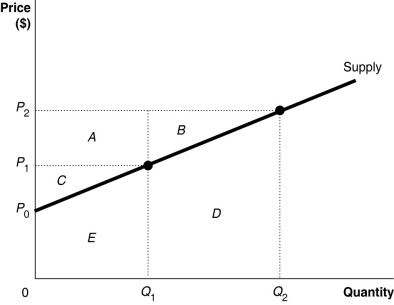 -Refer to Figure 4-2.What area represents producer surplus at a price of P2?
 (Multiple Choice)
4.9/5 (84)
(84)  Figure 4-15 shows the market for beer.The government plans to impose a per-unit tax in this market.
-Refer to Figure 4-15.The price buyers pay after the tax is
Figure 4-15 shows the market for beer.The government plans to impose a per-unit tax in this market.
-Refer to Figure 4-15.The price buyers pay after the tax is (Multiple Choice)
4.7/5 (79)
(79) 
Filters
- Essay(0)
- Multiple Choice(0)
- Short Answer(0)
- True False(0)
- Matching(0)