



 Chat with AI
Exam 13: Firms in Competitive Markets

Exam 1: Ten Principles of Economics438 Questions
Exam 2: Thinking Like an Economist620 Questions
Exam 3: Interdependence and the Gains From Trade527 Questions
Exam 4: The Market Forces of Supply and Demand700 Questions
Exam 5: Elasticity and Its Application598 Questions
Exam 6: Supply, Demand, and Government Policies648 Questions
Exam 7: Consumers, Producers, and the Efficiency of Markets550 Questions
Exam 8: Application: The Costs of Taxation514 Questions
Exam 9: Application: International Trade496 Questions
Exam 10: Externalities522 Questions
Exam 11: Public Goods and Common Resources434 Questions
Exam 12: The Costs of Production420 Questions
Exam 13: Firms in Competitive Markets543 Questions
Exam 14: Monopoly637 Questions
Exam 15: Measuring a Nations Income522 Questions
Exam 16: Measuring the Cost of Living545 Questions
Exam 17: Production and Growth507 Questions
Exam 18: Saving, Investment, and the Financial System567 Questions
Exam 19: The Basic Tools of Finance513 Questions
Exam 20: Unemployment699 Questions
Exam 21: The Monetary System518 Questions
Exam 22: Money Growth and Inflation487 Questions
Exam 23: Aggregate Demand and Aggregate Supply563 Questions
Exam 24: The Influence of Monetary and Fiscal Policy on Aggregate Demand512 Questions
Select questions type


Table 14-6
The following table presents cost and revenue information for a firm operating in a competitive industry.
 -Refer to Table 14-6. What is the average revenue when 4 units are sold?
 (Multiple Choice)
4.9/5  (76)
(76) Table 14-14
The following table presents cost and revenue information for Bob's bakery production and sales.
 -Refer to Table 14-14. At what quantity will Bob maximize his profit?
 (Multiple Choice)
5.0/5 (82)
(82) Scenario 14-4
The information below applies to a competitive firm that sells its output for $40 per unit.
• When the firm produces and sells 150 units of output, its average total cost is $24.50.
• When the firm produces and sells 151 units of output, its average total cost is $24.55.
-Refer to Scenario 14-4. Suppose the firm is producing 150 units of output and its fixed cost is $975. Then its variable cost amounts to
(Multiple Choice)
4.7/5 (77)
(77) When an individual firm in a competitive market decreases its production, it is likely that the market price will rise.
(True/False)
4.8/5 (87)
(87) Because the goods offered for sale in a competitive market are largely the same,
(Multiple Choice)
4.9/5 (80)
(80) In a competitive market, the actions of any single buyer or seller will
(Multiple Choice)
4.8/5 (87)
(87) Land of Many Lakes LML) sells butter to a broker in Albert Lea, Minnesota. Because the market for butter is generally considered to be competitive, LML
(Multiple Choice)
4.9/5 (76)
(76) Table 14-11
Suppose that a firm in a competitive market faces the following prices and costs:
 -Refer to Table 14-11. If the firm is producing 3 units of output, it should produce
 (Multiple Choice)
4.8/5 (80)
(80) Scenario 14-4
Victor is the recipient of $1 million from a lawsuit. Victor decides to use the money to purchase a small business in Florida. His business operates in a perfectly competitive industry. If Victor would have invested the $1 million in a risk-free bond fund, he could have earned $100,000 each year. After he bought the small business, Victor quit his job as a market analyst with Research, Inc., where he used to earn $75,000 per year.
-Refer to Scenario 14-4. How large would Victor's accounting profits need to be to allow him to attain zero economic profit?
(Multiple Choice)
4.9/5 (89)
(89) Describe the difference between average revenue and marginal revenue. Why are both of these revenue measures important to a profit-maximizing firm?
(Essay)
4.7/5 (73)
(73) Land of Many Lakes LML) sells butter to a broker in Albert Lea, Minnesota. Because the market for butter is generally considered to be competitive, LML does not
(Multiple Choice)
4.8/5 (88)
(88) Figure 14-4
Suppose a firm operating in a competitive market has the following cost curves:  -Refer to Figure 14-4. At which price range will the firm continue to operate in the short run but earn negative profits?
 (Multiple Choice)
4.9/5 (89)
(89) Figure 14-5
Suppose a firm operating in a competitive market has the following cost curves:  -Refer to Figure 14-5. In the short run, if the market price is P4, individual firms in a competitive industry will earn
 (Multiple Choice)
4.8/5 (81)
(81) Suppose a firm in a competitive market produces and sells 150 units of output and earns $1,800 in total revenue from the sales. If the firm increases its output to 200 units, the average revenue of the 200th unit will be
(Multiple Choice)
4.8/5 (76)
(76) In the long run, when price is greater than average total cost, some firms in a competitive market will choose to enter the market.
(True/False)
4.9/5 (72)
(72) Table 14-12
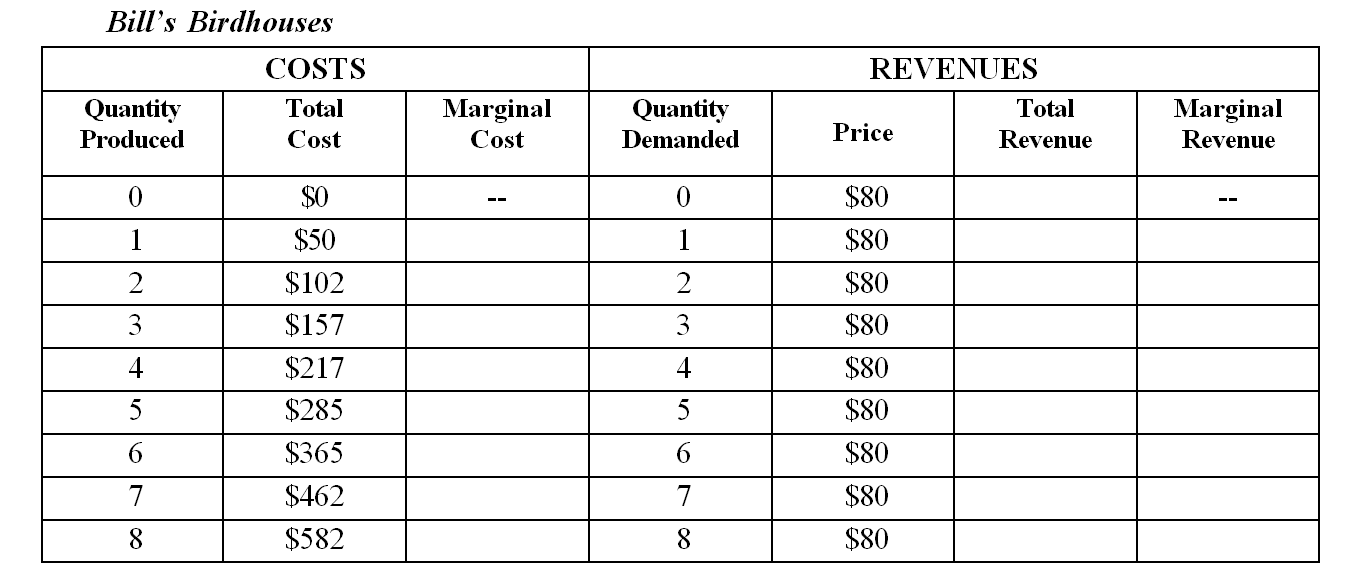 -Refer to Table 14-12. What is Bill's economic profit at the profit-maximizing output level?
 (Multiple Choice)
4.9/5 (94)
(94) If there is an increase in market demand in a perfectly competitive market, then in the short run
(Multiple Choice)
4.8/5 (67)
(67) List and describe the characteristics of a perfectly competitive market.
(Essay)
4.8/5 (77)
(77) Figure 14-12
-Refer to Figure 14-12. If the figure in panel a) reflects the long-run equilibrium of a profit-maximizing firm in a competitive market, the figure in panel b) most likely reflects 
(Multiple Choice)
4.8/5 (88)
(88) The accountants hired by the Brookside Racquet Club have determined total fixed cost to be $75,000, total variable cost to be $130,000, and total revenue to be $125,000. Because of this information, in the short run, the Brookside Racquet Club should
(Multiple Choice)
4.8/5 (80)
(80) 
Filters
- Essay(0)
- Multiple Choice(0)
- Short Answer(0)
- True False(0)
- Matching(0)