



 Chat with AI
Exam 13: Firms in Competitive Markets

Exam 1: Ten Principles of Economics438 Questions
Exam 2: Thinking Like an Economist620 Questions
Exam 3: Interdependence and the Gains From Trade527 Questions
Exam 4: The Market Forces of Supply and Demand700 Questions
Exam 5: Elasticity and Its Application598 Questions
Exam 6: Supply, Demand, and Government Policies648 Questions
Exam 7: Consumers, Producers, and the Efficiency of Markets550 Questions
Exam 8: Application: The Costs of Taxation514 Questions
Exam 9: Application: International Trade496 Questions
Exam 10: Externalities522 Questions
Exam 11: Public Goods and Common Resources434 Questions
Exam 12: The Costs of Production420 Questions
Exam 13: Firms in Competitive Markets543 Questions
Exam 14: Monopoly637 Questions
Exam 15: Measuring a Nations Income522 Questions
Exam 16: Measuring the Cost of Living545 Questions
Exam 17: Production and Growth507 Questions
Exam 18: Saving, Investment, and the Financial System567 Questions
Exam 19: The Basic Tools of Finance513 Questions
Exam 20: Unemployment699 Questions
Exam 21: The Monetary System518 Questions
Exam 22: Money Growth and Inflation487 Questions
Exam 23: Aggregate Demand and Aggregate Supply563 Questions
Exam 24: The Influence of Monetary and Fiscal Policy on Aggregate Demand512 Questions
Select questions type


Figure 14-7  -Refer to Figure 14-7. Let Q represent the quantity of output and suppose the price of the good is $125. Then marginal revenue is
 (Multiple Choice)
4.9/5  (79)
(79) Which of the following represents the firm's long-run condition for exiting a market?
(Multiple Choice)
4.9/5 (78)
(78) Use a graph to demonstrate the circumstances that would prevail in a competitive market where firms are earning economic profits. Can this scenario be maintained in the long run? Explain your answer.
(Essay)
4.7/5 (79)
(79) Which of the following is a characteristic of a competitive market?
(Multiple Choice)
4.8/5 (84)
(84) In the long-run equilibrium of a market with free entry and exit, if all firms have the same cost structure, then
(Multiple Choice)
4.8/5 (87)
(87) Figure 14-3
Suppose a firm operating in a competitive market has the following cost curves:  -Refer to Figure 14-3. If the market price is $10, what is the firm's total cost?
 (Multiple Choice)
4.8/5 (86)
(86) Table 14-10
Suppose that a firm in a competitive market faces the following revenues and costs:
 -Refer to Table 14-10. Which level of production in the table has the lowest average variable cost?
 (Multiple Choice)
4.8/5 (82)
(82) A firm is currently producing 100 units of output per day. The manager reports to the owner that producing the 100th unit costs the firm $5. The firm can sell the unit for $6. The firm should produce more than 100 units in order to maximize its profits or minimize its losses).
(True/False)
4.8/5 (80)
(80) When existing firms in a competitive market are profitable, an incentive exists for
(Multiple Choice)
4.9/5 (88)
(88) Table 14-12
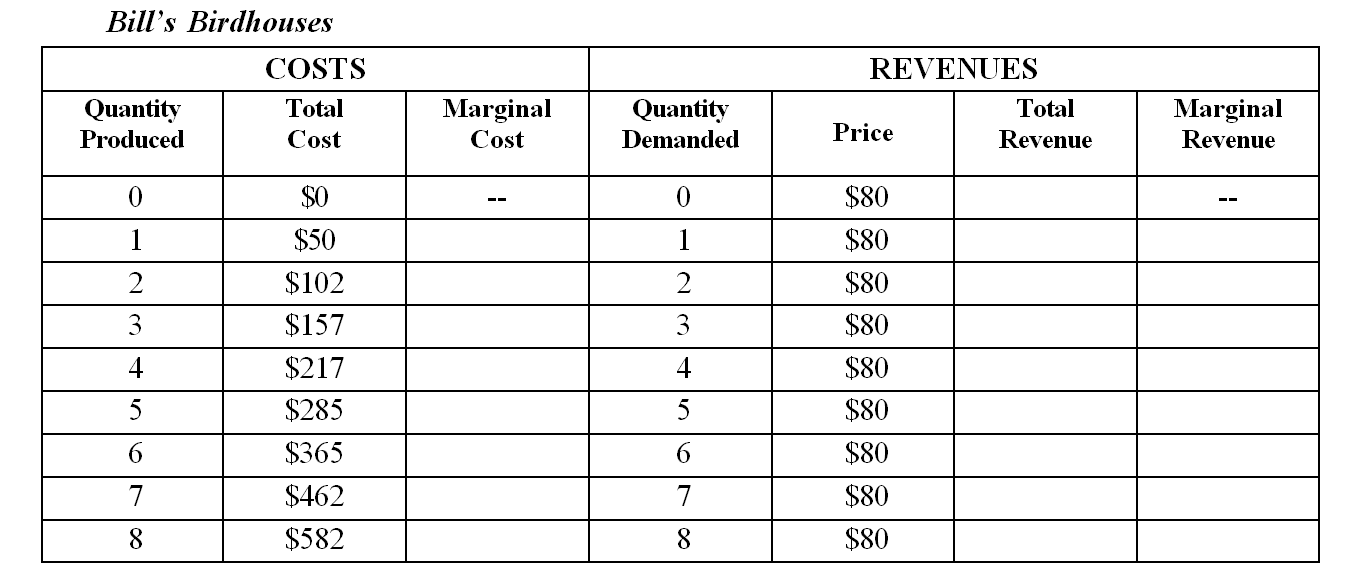 -Refer to Table 14-12. What is the marginal cost of the 8th unit?
 (Multiple Choice)
4.7/5 (88)
(88) If identical firms that remain in a competitive market over the long run make zero economic profit, why do these firms choose to remain in the market?
(Essay)
4.8/5 (88)
(88) Firms operating in competitive markets produce output levels where marginal revenue equals
(Multiple Choice)
4.9/5 (83)
(83) Figure 14-2
Suppose a firm operating in a competitive market has the following cost curves:  -Refer to Figure 14-2. Which of the four prices corresponds to a firm earning zero economic profits in the short run?
 (Multiple Choice)
5.0/5 (94)
(94) If firms are competitive and profit maximizing, the price of a good equals the
(Multiple Choice)
4.8/5 (73)
(73) Assume a firm in a competitive industry is producing 800 units of output, and it sells each unit for $6. Its average total cost is $4. Its profit is
(Multiple Choice)
4.9/5 (78)
(78) Consider a competitive market with a large number of identical firms. The firms in this market do not use any resources that are available only in limited quantities. In long-run equilibrium, market price is determined by
(Multiple Choice)
4.7/5 (71)
(71) Robin owns a horse stables and riding academy and gives riding lessons for children at "pony camp." Her business operates in a competitive industry. Robin gives riding lessons to 20 children per month. Her monthly total revenue is $4,000. The marginal cost of pony camp is $200 per child. In order to maximize profits, Robin should
(Multiple Choice)
4.9/5 (87)
(87) If a competitive firm is currently producing a level of output at which profit is not maximized, then it must be true that
(Multiple Choice)
4.8/5 (67)
(67) In the long run, a firm will exit a competitive industry if
(Multiple Choice)
4.7/5 (85)
(85) Figure 14-2
Suppose a firm operating in a competitive market has the following cost curves:
-Refer to Figure 14-2. Which of the four prices corresponds to a firm earning positive economic profits in the short run?
-Refer to Figure 14-2. Which of the four prices corresponds to a firm earning positive economic profits in the short run? (Multiple Choice)
4.8/5 (82)
(82) 
Filters
- Essay(0)
- Multiple Choice(0)
- Short Answer(0)
- True False(0)
- Matching(0)