



 Chat with AI
Exam 13: Firms in Competitive Markets

Exam 1: Ten Principles of Economics438 Questions
Exam 2: Thinking Like an Economist620 Questions
Exam 3: Interdependence and the Gains From Trade527 Questions
Exam 4: The Market Forces of Supply and Demand700 Questions
Exam 5: Elasticity and Its Application598 Questions
Exam 6: Supply, Demand, and Government Policies648 Questions
Exam 7: Consumers, Producers, and the Efficiency of Markets550 Questions
Exam 8: Application: The Costs of Taxation514 Questions
Exam 9: Application: International Trade496 Questions
Exam 10: Externalities522 Questions
Exam 11: Public Goods and Common Resources434 Questions
Exam 12: The Costs of Production420 Questions
Exam 13: Firms in Competitive Markets543 Questions
Exam 14: Monopoly637 Questions
Exam 15: Measuring a Nations Income522 Questions
Exam 16: Measuring the Cost of Living545 Questions
Exam 17: Production and Growth507 Questions
Exam 18: Saving, Investment, and the Financial System567 Questions
Exam 19: The Basic Tools of Finance513 Questions
Exam 20: Unemployment699 Questions
Exam 21: The Monetary System518 Questions
Exam 22: Money Growth and Inflation487 Questions
Exam 23: Aggregate Demand and Aggregate Supply563 Questions
Exam 24: The Influence of Monetary and Fiscal Policy on Aggregate Demand512 Questions
Select questions type


Table 14-4
The table represents a demand curve faced by a firm in a competitive market.
 -Refer to Table 14-4. For this firm, the price is
 (Multiple Choice)
4.8/5  (77)
(77) Suppose that the organic-produce industry is composed of a large number of small firms. In recent years, these firms have suffered economic losses, and many sellers have left the industry. Economic theory suggests that these conditions will
(Multiple Choice)
4.9/5 (81)
(81) A market might have an upward-sloping long-run supply curve if
(Multiple Choice)
4.8/5 (71)
(71) A firm is currently producing 100 units of output per day. The manager reports to the owner that producing the 100th unit costs the firm $5. The firm can sell the 100th unit for $5. The firm should continue to produce 100 units in order to maximize its profits or minimize its losses).
(True/False)
4.8/5 (78)
(78) Suppose a firm operates in the short run at a price above its average total cost of production. In the long run the firm should expect
(Multiple Choice)
4.7/5 (74)
(74) A firm will shut down in the short run if, for all positive levels of output,
(Multiple Choice)
4.9/5 (91)
(91) A firm in a competitive market has the following cost structure: 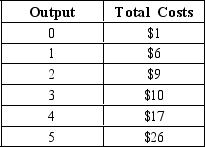 What is the lowest price at which this firm might choose to operate?
 (Multiple Choice)
4.9/5 (83)
(83) Figure 14-1
Suppose that a firm in a competitive market has the following cost curves:  -Refer to Figure 14-1. The firm will earn a negative economic profit but remain in business in the short run if the market price is
 (Multiple Choice)
4.8/5 (63)
(63) Figure 14-2
Suppose a firm operating in a competitive market has the following cost curves:  -Refer to Figure 14-2. Which of the four prices corresponds to a firm earning negative economic profits in the short run and shutting down?
 (Multiple Choice)
4.9/5 (84)
(84) If identical firms that remain in a competitive market over the long run make zero economic profit, why do these firms choose to remain in the market?
(Essay)
4.9/5 (80)
(80) Suppose a profit-maximizing firm in a competitive market produces rubber bands. When the market price for rubber bands rises above the minimum of its average variable cost, but still lies below the minimum of average total cost, in the short run the firm will
(Multiple Choice)
4.8/5 (81)
(81) The accountants hired by the Brookside Racquet Club have determined total fixed cost to be $75,000, total variable cost to be $130,000, and total revenue to be $145,000. Because of this information, in the short run, the Brookside Racquet Club should
(Multiple Choice)
4.7/5 (84)
(84) Figure 14-7  -Refer to Figure 14-7. Let Q represent the quantity of output and suppose the price of the good is $125. Then marginal revenue is $125 at
 (Multiple Choice)
4.7/5 (94)
(94) Figure 14-14
 -Refer to Figure 14-14. Assume that the market starts in equilibrium at point W in panel b). An increase in demand from D0 to D1 will result in
 (Multiple Choice)
4.9/5 (61)
(61) Robin owns a horse stables and riding academy and gives riding lessons for children at "pony camp." Her business operates in a competitive industry. Robin gives riding lessons to 20 children per month. Her monthly total revenue is $4,000. The marginal cost of pony camp is $250 per child. In order to maximize profits, Robin should
(Multiple Choice)
4.9/5 (84)
(84) Scenario 14-1
Assume a certain firm in a competitive market is producing Q = 1,000 units of output. At Q = 1,000, the firm's marginal cost equals $15 and its average total cost equals $11. The firm sells its output for $12 per unit.
-Refer to Scenario 14-1. At Q = 1,000, the firm's profits equal
(Multiple Choice)
4.9/5 (75)
(75) The assumption of a fixed number of firms is appropriate for analysis of
(Multiple Choice)
4.7/5 (81)
(81) If your local gasoline station raised its price by 20 percent, its sales of gasoline would decrease substantially because your local gas station
(Multiple Choice)
4.9/5 (74)
(74) 
Filters
- Essay(0)
- Multiple Choice(0)
- Short Answer(0)
- True False(0)
- Matching(0)