



 Chat with AI
Exam 13: Firms in Competitive Markets

Exam 1: Ten Principles of Economics438 Questions
Exam 2: Thinking Like an Economist620 Questions
Exam 3: Interdependence and the Gains From Trade527 Questions
Exam 4: The Market Forces of Supply and Demand700 Questions
Exam 5: Elasticity and Its Application598 Questions
Exam 6: Supply, Demand, and Government Policies648 Questions
Exam 7: Consumers, Producers, and the Efficiency of Markets550 Questions
Exam 8: Application: The Costs of Taxation514 Questions
Exam 9: Application: International Trade496 Questions
Exam 10: Externalities522 Questions
Exam 11: Public Goods and Common Resources434 Questions
Exam 12: The Costs of Production420 Questions
Exam 13: Firms in Competitive Markets543 Questions
Exam 14: Monopoly637 Questions
Exam 15: Measuring a Nations Income522 Questions
Exam 16: Measuring the Cost of Living545 Questions
Exam 17: Production and Growth507 Questions
Exam 18: Saving, Investment, and the Financial System567 Questions
Exam 19: The Basic Tools of Finance513 Questions
Exam 20: Unemployment699 Questions
Exam 21: The Monetary System518 Questions
Exam 22: Money Growth and Inflation487 Questions
Exam 23: Aggregate Demand and Aggregate Supply563 Questions
Exam 24: The Influence of Monetary and Fiscal Policy on Aggregate Demand512 Questions
Select questions type


In the short run, there are 500 identical firms in a competitive market. The firms do not use any resources that are available in limited quantities, and each of them has the following cost structure: 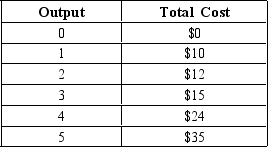 Which of the following is a point on the long-run supply curve?
 (Multiple Choice)
4.9/5  (89)
(89) Figure 14-4
Suppose a firm operating in a competitive market has the following cost curves:  -Refer to Figure 14-4. When price rises from P2 to P3, the firm finds that
 (Multiple Choice)
4.8/5 (81)
(81) Cold Duck Airlines flies between Tacoma and Portland. The company leases planes on a year-long contract at a cost that averages $600 per flight. Other costs fuel, flight attendants, etc.) amount to $550 per flight. Currently, Cold Duck's revenues are $1,000 per flight. All prices and costs are expected to continue at their present levels. If it wants to maximize profit, Cold Duck Airlines should
(Multiple Choice)
4.8/5 (98)
(98) Firms that operate in perfectly competitive markets try to
(Multiple Choice)
4.8/5 (78)
(78) Suppose a competitive market has a horizontal long-run supply curve and is in long-run equilibrium. If demand decreases, we can be certain that in the short-run,
(Multiple Choice)
4.8/5 (81)
(81) If a firm in a competitive market doubles its number of units sold, total revenue for the firm will
(Multiple Choice)
4.9/5 (80)
(80) Scenario 14-4
The information below applies to a competitive firm that sells its output for $40 per unit.
• When the firm produces and sells 150 units of output, its average total cost is $24.50.
• When the firm produces and sells 151 units of output, its average total cost is $24.55.
-Refer to Scenario 14-4. Let Q represent the quantity of output. Which of the following magnitudes has the same value at Q = 150 and at Q = 151?
(Multiple Choice)
4.9/5 (61)
(61) Suppose you value a special watch at $100. You purchase it for $75. On your way home from class one day, you lose the watch. The store is still selling the same watch, but the price has risen to $85. Assume that losing the watch has not altered how you value it. What should you do?
(Multiple Choice)
4.9/5 (86)
(86) For a certain firm, the 100th unit of output that the firm produces has a marginal revenue of $7 and a marginal cost of $10. It follows that the
(Multiple Choice)
4.8/5 (86)
(86) In the short run for a particular market, there are 5,000 firms. Each firm has a marginal cost of $7 when it produces 200 units of output. One point on the market supply curve is
(Multiple Choice)
5.0/5 (77)
(77) A popular resort restaurant will maximize profits if it chooses to stay open during the lesscrowded "off season" when its total revenues exceed its fixed costs.
(True/False)
4.9/5 (73)
(73) Table 14-6
The following table presents cost and revenue information for a firm operating in a competitive industry.
 -Refer to Table 14-6. What is the total revenue from selling 4 units?
 (Multiple Choice)
4.7/5 (74)
(74) Table 14-3
The table represents a demand curve faced by a firm in a competitive market.
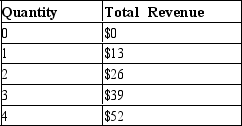 -Refer to Table 14-3. For this firm, the price is
 (Multiple Choice)
4.9/5 (91)
(91) Firms operating in perfectly competitive markets try to maximize profits.
(True/False)
4.9/5 (73)
(73) In a competitive market, the actions of any single buyer or seller will
(Multiple Choice)
4.9/5 (68)
(68) When a resource used in the production of a good sold in a competitive market is available in only limited quantities, the long-run supply curve is likely to be upward sloping.
(True/False)
4.9/5 (91)
(91) Suppose that a firm operating in perfectly competitive market sells 300 units of output at a price of $3 each. Which of the following statements is correct? i) Marginal revenue equals $3.
Ii) Average revenue equals $100.
Iii) Total revenue equals $300.
(Multiple Choice)
4.8/5 (82)
(82) Figure 14-6
Suppose a firm operating in a competitive market has the following cost curves:  -Refer to Figure 14-6. When market price is P3, a profit-maximizing firm's profit
 (Multiple Choice)
4.8/5 (70)
(70) 
Filters
- Essay(0)
- Multiple Choice(0)
- Short Answer(0)
- True False(0)
- Matching(0)