



 Chat with AI
Exam 13: Firms in Competitive Markets

Exam 1: Ten Principles of Economics438 Questions
Exam 2: Thinking Like an Economist620 Questions
Exam 3: Interdependence and the Gains From Trade527 Questions
Exam 4: The Market Forces of Supply and Demand700 Questions
Exam 5: Elasticity and Its Application598 Questions
Exam 6: Supply, Demand, and Government Policies648 Questions
Exam 7: Consumers, Producers, and the Efficiency of Markets550 Questions
Exam 8: Application: The Costs of Taxation514 Questions
Exam 9: Application: International Trade496 Questions
Exam 10: Externalities522 Questions
Exam 11: Public Goods and Common Resources434 Questions
Exam 12: The Costs of Production420 Questions
Exam 13: Firms in Competitive Markets543 Questions
Exam 14: Monopoly637 Questions
Exam 15: Measuring a Nations Income522 Questions
Exam 16: Measuring the Cost of Living545 Questions
Exam 17: Production and Growth507 Questions
Exam 18: Saving, Investment, and the Financial System567 Questions
Exam 19: The Basic Tools of Finance513 Questions
Exam 20: Unemployment699 Questions
Exam 21: The Monetary System518 Questions
Exam 22: Money Growth and Inflation487 Questions
Exam 23: Aggregate Demand and Aggregate Supply563 Questions
Exam 24: The Influence of Monetary and Fiscal Policy on Aggregate Demand512 Questions
Select questions type


Table 14-4
The table represents a demand curve faced by a firm in a competitive market.
 -Refer to Table 14-4. For this firm, the marginal revenue is
 (Multiple Choice)
4.8/5  (71)
(71) Figure 14-3
Suppose a firm operating in a competitive market has the following cost curves:  -Refer to Figure 14-3. If the market price is $6, what is the firm's shortrun economic profit?
 (Multiple Choice)
4.8/5 (83)
(83) If a profit-maximizing firm in a competitive market discovers that, at its current level of production, price is greater than marginal cost, it should
(Multiple Choice)
4.8/5 (68)
(68) At its current level of production a profit-maximizing firm in a competitive market receives $12.50 for each unit it produces and faces an average total cost of $10. At the market price of $12.50 per unit, the firm's marginal cost curve crosses the marginal revenue curve at an output level of 1,000 units. What is the firm's current profit? What is likely to occur in this market and why?
(Essay)
4.9/5 (78)
(78) In the long run, all of a firm's costs are variable. In this case the exit criterion for a profit-maximizing firm is to shut down if
(Multiple Choice)
4.9/5 (77)
(77) In order to maximize profits in the short run, a firm should produce where
(Multiple Choice)
5.0/5 (56)
(56) Table 14-14
The following table presents cost and revenue information for Bob's bakery production and sales.
 -Refer to Table 14-14. What is the marginal revenue of the 4th unit?
 (Multiple Choice)
4.7/5 (85)
(85) The manager of a firm operating in a competitive market can ignore sunk costs when making business decisions.
(True/False)
4.9/5 (73)
(73) A firm's marginal cost has a minimum value of $4, its average variable cost has a minimum value of $6, and its average total cost has a minimum value of $7. Then the firm will shut down in the short run once the price of its product falls below
(Multiple Choice)
4.9/5 (81)
(81) Figure 14-1
Suppose that a firm in a competitive market has the following cost curves:  -Refer to Figure 14-1. If the market price falls below $4.50, the firm will earn
 (Multiple Choice)
5.0/5 (69)
(69) Consider a competitive market with 50 identical firms. Suppose the market demand is given by the equation QD = 200 - 10P and the market supply is given by the equation QS = 10P. In addition, suppose the following table shows the marginal cost of production for various levels of output for firms in this market. 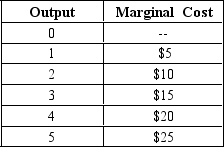 How many units should a firm in this market produce to maximize profit?
 (Multiple Choice)
4.9/5 (78)
(78) Regardless of the cost structure of firms in a competitive market, in the long run
(Multiple Choice)
4.8/5 (68)
(68) When firms in a perfectly competitive market face the same costs, in the long run they must be operating
(Multiple Choice)
4.9/5 (74)
(74) Table 14-14
The following table presents cost and revenue information for Bob's bakery production and sales.
-Refer to Table 14-14. Suppose that due to a decrease in the market demand for bread the market price of bread drops to $2.75 per loaf. At this new price, what is Bob's profitmaximizing quantity?
-Refer to Table 14-14. Suppose that due to a decrease in the market demand for bread the market price of bread drops to $2.75 per loaf. At this new price, what is Bob's profitmaximizing quantity? (Multiple Choice)
4.9/5 (67)
(67) Table 14-11
Suppose that a firm in a competitive market faces the following prices and costs:
 -Refer to Table 14-11. In order to maximize profits, the firm should stop producing after it makes the
 (Multiple Choice)
5.0/5 (82)
(82) In a perfectly competitive market, the horizontal sum of all the individual firms' supply curves is
(Multiple Choice)
4.7/5 (88)
(88) In a market with a fixed number of firms, as long as price is above average
(Multiple Choice)
4.9/5 (81)
(81) When firms in a competitive market have different costs, it is likely that
(Multiple Choice)
4.8/5 (82)
(82) 
Filters
- Essay(0)
- Multiple Choice(0)
- Short Answer(0)
- True False(0)
- Matching(0)