



 Chat with AI
Exam 14: Monopoly

Exam 1: Ten Principles of Economics438 Questions
Exam 2: Thinking Like an Economist620 Questions
Exam 3: Interdependence and the Gains From Trade527 Questions
Exam 4: The Market Forces of Supply and Demand700 Questions
Exam 5: Elasticity and Its Application598 Questions
Exam 6: Supply, Demand, and Government Policies648 Questions
Exam 7: Consumers, Producers, and the Efficiency of Markets550 Questions
Exam 8: Application: The Costs of Taxation514 Questions
Exam 9: Application: International Trade496 Questions
Exam 10: Externalities522 Questions
Exam 11: Public Goods and Common Resources434 Questions
Exam 12: The Costs of Production420 Questions
Exam 13: Firms in Competitive Markets543 Questions
Exam 14: Monopoly637 Questions
Exam 15: Measuring a Nations Income522 Questions
Exam 16: Measuring the Cost of Living545 Questions
Exam 17: Production and Growth507 Questions
Exam 18: Saving, Investment, and the Financial System567 Questions
Exam 19: The Basic Tools of Finance513 Questions
Exam 20: Unemployment699 Questions
Exam 21: The Monetary System518 Questions
Exam 22: Money Growth and Inflation487 Questions
Exam 23: Aggregate Demand and Aggregate Supply563 Questions
Exam 24: The Influence of Monetary and Fiscal Policy on Aggregate Demand512 Questions
Select questions type


Figure 15-18  -Refer to Figure 15-18. If the monopoly firm is not allowed to price discriminate, then consumer surplus amounts to
Free
(Multiple Choice)
4.8/5  (73)
(73) Correct Answer: Verified
A
One problem with government operation of monopolies is that
Free
(Multiple Choice)
4.8/5 (85)
(85) Correct Answer:Verified
VerifiedC
Scenario 15-2
Consider a local, privately-owned electrical cooperative named Poweshiek Power Company PPCo). PPCo has just completed a clean-coal-burning electrical power plant in Iowa. Currently, PPCo can meet the electricity needs of all residents in the county. In fact, its capacity far exceeds the needs of the county. After just a few years of operation, the shareholders of PPCo experienced incredibly high rates of return on their investment due to the profitability of the corporation.
-Refer to Scenario 15-2. Which of the following statements is most likely to be true? i) New entrants to the market know they will have a smaller market share than PPCo currently has.
Ii) PPCo is most likely experiencing rising marginal cost.
Iii) PPCo is a natural monopoly.
Iv) PPCo is most likely experiencing declining average total cost.
Free
(Multiple Choice)
4.8/5 (75)
(75) Correct Answer:Verified
VerifiedC
When a monopolist increases the amount of output that it produces and sells, average revenue
(Multiple Choice)
4.8/5 (76)
(76) Figure 15-19  -Refer to Figure 15-19. If the monopoly firm perfectly price discriminates, then consumer surplus amounts to
 (Multiple Choice)
4.8/5 (87)
(87) Private ownership of a monopoly may benefit society because the monopoly will have an incentive to
(Multiple Choice)
4.9/5 (94)
(94) Table 15-13
The following table gives information on the price, quantity, and total cost of production for a monopolist.
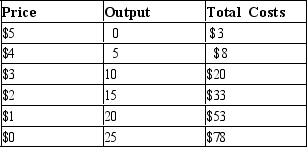 -Refer to Table 15-13. How much profit will the firm earn at the profit-maximizing price?
 (Multiple Choice)
4.8/5 (77)
(77) In many countries, the government chooses to "internalize" the monopoly by owning monopoly providers of goods and services. In some cases these firms are "nationalized," and the government actually buys or confiscates firms that operate in monopoly markets). What would be the advantages and disadvantages of such an approach to ensure that the "best interest of society" is promoted in these markets? Explain your answer.
(Essay)
4.8/5 (69)
(69) Table 15-18
A monopolist faces the following demand curve:
 Suppose marginal cost is constant at $8 per unit.
-Refer to Table 15-18. The monopolist's total revenue from selling 4 units of output is
Suppose marginal cost is constant at $8 per unit.
-Refer to Table 15-18. The monopolist's total revenue from selling 4 units of output is (Multiple Choice)
4.7/5 (87)
(87) In both perfectly competitive and monopoly markets, the price per unit of a good is equal to the _______
(Short Answer)
4.8/5 (79)
(79) Figure 15-9  -Refer to Figure 15-9. To maximize total surplus, a benevolent social planner would choose which of the following outcomes?
 (Multiple Choice)
4.7/5 (80)
(80) Comparing firms in perfectly competitive markets to monopoly firms, which charges a price equal to marginal cost?
(Short Answer)
4.8/5 (90)
(90) Figure 15-17  -Refer to Figure 15-17. Which of the following areas represents the deadweight loss from this profit-maximizing monopolist?
 (Multiple Choice)
5.0/5 (82)
(82) Figure 15-1  -Refer to Figure 15-1. Considering the relationship between average total cost and marginal cost, the marginal cost curve for this firm must
 (Multiple Choice)
4.9/5 (60)
(60) An industry is a natural monopoly when i) the government assists the firm in maintaining the monopoly.
Ii) a single firm owns a key resource.
Iii) a single firm can supply a good or service to an entire market at a smaller cost than could two or more firms.
(Multiple Choice)
4.8/5 (80)
(80) Which of the following statements is correct? Monopolies are socially inefficient because they i) charge a price above marginal cost.
Ii) produce too little output.
Iii) earn profits at the expense of consumers.
Iv) maximize the market's total surplus.
(Multiple Choice)
4.8/5 (81)
(81) Because monopoly firms do not have to compete with other firms, the outcome in a market with a monopoly is often
(Multiple Choice)
4.8/5 (84)
(84) Table 15-6
A monopolist faces the following demand curve:
 -Refer to Table 15-6. What is the marginal revenue from the sale of the 2nd unit?
 (Multiple Choice)
4.7/5 (89)
(89) 
Filters
- Essay(0)
- Multiple Choice(0)
- Short Answer(0)
- True False(0)
- Matching(0)