



 Chat with AI
Exam 14: Monopoly

Exam 1: Ten Principles of Economics438 Questions
Exam 2: Thinking Like an Economist620 Questions
Exam 3: Interdependence and the Gains From Trade527 Questions
Exam 4: The Market Forces of Supply and Demand700 Questions
Exam 5: Elasticity and Its Application598 Questions
Exam 6: Supply, Demand, and Government Policies648 Questions
Exam 7: Consumers, Producers, and the Efficiency of Markets550 Questions
Exam 8: Application: The Costs of Taxation514 Questions
Exam 9: Application: International Trade496 Questions
Exam 10: Externalities522 Questions
Exam 11: Public Goods and Common Resources434 Questions
Exam 12: The Costs of Production420 Questions
Exam 13: Firms in Competitive Markets543 Questions
Exam 14: Monopoly637 Questions
Exam 15: Measuring a Nations Income522 Questions
Exam 16: Measuring the Cost of Living545 Questions
Exam 17: Production and Growth507 Questions
Exam 18: Saving, Investment, and the Financial System567 Questions
Exam 19: The Basic Tools of Finance513 Questions
Exam 20: Unemployment699 Questions
Exam 21: The Monetary System518 Questions
Exam 22: Money Growth and Inflation487 Questions
Exam 23: Aggregate Demand and Aggregate Supply563 Questions
Exam 24: The Influence of Monetary and Fiscal Policy on Aggregate Demand512 Questions
Select questions type


Table 15-4
A monopolist faces the following demand curve:
 -Refer to Table 15-4. If the monopolist produces 5 units, what is its marginal revenue?
 (Multiple Choice)
4.8/5  (75)
(75) Which of the following is not a characteristic of a monopoly?
(Multiple Choice)
4.8/5 (79)
(79) If the government deems a newly-invented drug to be truly original, the pharmaceutical company is given the exclusive right to manufacture and sell the drug for 50 years.
(True/False)
4.8/5 (85)
(85) Scenario 15-1
Consider a transportation corporation named Reading's that has just completed the development of a new light rail system in Minneapolis. Currently, there are plenty of seats on the train, and it is never crowded. Its capacity far exceeds the needs of the city. After just a few years of operation, the shareholders of Reading's experienced incredibly high rates of return on their investment due to the profitability of the corporation.
-Refer to Scenario 15-1. Which of the following statements is most likely to be true? i) New entrants to the market know they will have a smaller market share than Reading's
Currently has.
Ii) Reading's is most likely experiencing decreasing average total cost.
Iii) Reading's is a natural monopoly.
(Multiple Choice)
4.8/5 (75)
(75) When a monopolist decreases the price of its good, consumers
(Multiple Choice)
4.9/5 (71)
(71) Figure 15-18  -Refer to Figure 15-18. If there are no fixed costs of production, monopoly profit without price discrimination equals
 (Multiple Choice)
4.9/5 (79)
(79) Figure 15-5  -Refer to Figure 15-5. A profit-maximizing monopoly will charge a price of
 (Multiple Choice)
4.9/5 (71)
(71) Which of the following is an example of a barrier to entry?
(Multiple Choice)
4.9/5 (103)
(103) When a firm experiences continually declining average total costs, the firm is a
(Multiple Choice)
4.9/5 (79)
(79) Table 15-6
A monopolist faces the following demand curve:
 -Refer to Table 15-6. Suppose the monopolist has total fixed costs equal to $5 and a variable cost equal to $4 per unit for all units produced. What is the total profit if she operates at her profit-maximizing price?
 (Multiple Choice)
4.9/5 (83)
(83) Table 15-13
The following table gives information on the price, quantity, and total cost of production for a monopolist.
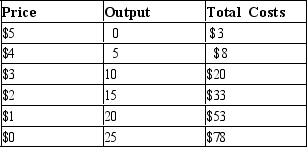 -Refer to Table 15-13. If the monopolist maximizes profits, he will charge a price of
 (Multiple Choice)
4.8/5 (70)
(70) Policymakers are discussing various proposals regarding how to deal with natural monopolies. Senator Huff wants to regulate natural monopolies by equating price with average total cost. Huff contends that such a policy will ensure that monopolies make every effort to reduce costs. Senator Puff wants the government to own natural monopolies. Puff argues that government-owned monopolies usually do a better job of holding down costs than privately owned monopolies. Which senator's argument is correct?
(Multiple Choice)
4.8/5 (82)
(82) Figure 15-17  -Refer to Figure 15-17. Which of the following statements best describes the changes that would occur if this firm were to switch from operating as a single price profit-maximizing monopolist to perfect price discrimination?
 (Multiple Choice)
4.8/5 (73)
(73) Describe how government is involved in creating a monopoly. Why might the government create one? Give an example.
(Essay)
4.8/5 (71)
(71) Additional firms often do not try to compete with a natural monopoly because
(Multiple Choice)
4.8/5 (76)
(76) Figure 15-6 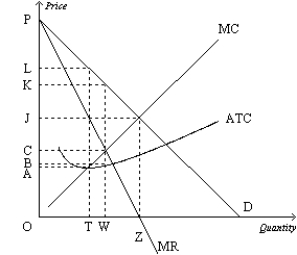 -Refer to Figure 15-6. What area measures the monopolist's profit?
 (Multiple Choice)
4.8/5 (86)
(86) Table 15-19
A monopolist faces the following demand curve:
 -Refer to Table 15-19. If a monopolist faces a constant marginal cost of $9, how much output should the firm produce?
 (Multiple Choice)
4.9/5 (77)
(77) Which of the following is not an example of a barrier to entry?
(Multiple Choice)
4.7/5 (60)
(60) 
Filters
- Essay(0)
- Multiple Choice(0)
- Short Answer(0)
- True False(0)
- Matching(0)