



 Chat with AI
Exam 14: Monopoly

Exam 1: Ten Principles of Economics438 Questions
Exam 2: Thinking Like an Economist620 Questions
Exam 3: Interdependence and the Gains From Trade527 Questions
Exam 4: The Market Forces of Supply and Demand700 Questions
Exam 5: Elasticity and Its Application598 Questions
Exam 6: Supply, Demand, and Government Policies648 Questions
Exam 7: Consumers, Producers, and the Efficiency of Markets550 Questions
Exam 8: Application: The Costs of Taxation514 Questions
Exam 9: Application: International Trade496 Questions
Exam 10: Externalities522 Questions
Exam 11: Public Goods and Common Resources434 Questions
Exam 12: The Costs of Production420 Questions
Exam 13: Firms in Competitive Markets543 Questions
Exam 14: Monopoly637 Questions
Exam 15: Measuring a Nations Income522 Questions
Exam 16: Measuring the Cost of Living545 Questions
Exam 17: Production and Growth507 Questions
Exam 18: Saving, Investment, and the Financial System567 Questions
Exam 19: The Basic Tools of Finance513 Questions
Exam 20: Unemployment699 Questions
Exam 21: The Monetary System518 Questions
Exam 22: Money Growth and Inflation487 Questions
Exam 23: Aggregate Demand and Aggregate Supply563 Questions
Exam 24: The Influence of Monetary and Fiscal Policy on Aggregate Demand512 Questions
Select questions type


Table 15-1
 -Refer to Table 15-1. When 4 units of output are produced and sold, what is average revenue?
 (Multiple Choice)
4.8/5  (79)
(79) During the holiday season, high-end retailers frequently place a high price on merchandise on weekends and discount the price during the week. They do this because they believe that two groups of customers exist: shoppers with little free time and bargain hunters. Bargain hunters have time to shop around and frequently shop during the week. What do economists call this price strategy used by high-end retailers?
(Multiple Choice)
4.9/5 (78)
(78) Which of the following strategies is not an effective strategy to reduce monopoly inefficiency?
(Multiple Choice)
4.8/5 (84)
(84) Figure 15-23  -Refer to Figure 15-23. If the firm profit-maximizes, how much profit will it earn?
 (Short Answer)
4.9/5 (85)
(85) Figure 15-7  -Refer to Figure 15-7. In order to maximize profits, the monopolist should produce
 (Multiple Choice)
4.7/5 (84)
(84) Monopolies are socially inefficient because the price they charge is
(Multiple Choice)
4.8/5 (83)
(83) Figure 15-21  -Refer to Figure 15-21. Which of the following areas describes the profit of this natural monopolist under socially optimal pricing?
 (Multiple Choice)
4.7/5 (68)
(68) Table 15-1
-Refer to Table 15-1. If the monopolist wants to maximize its revenue, how many units of its product should it sell?
-Refer to Table 15-1. If the monopolist wants to maximize its revenue, how many units of its product should it sell? (Multiple Choice)
4.8/5 (63)
(63) Figure 15-1 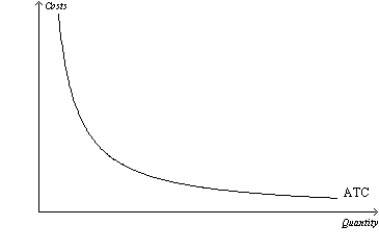 -Refer to Figure 15-1. The shape of the average total cost curve reveals information about the nature of the barrier to entry that might exist in a monopoly market. Which of the following monopoly types best coincides with the figure?
 (Multiple Choice)
5.0/5 (72)
(72) A rational pricing strategy for a profit-maximizing monopolist is
(Multiple Choice)
4.7/5 (84)
(84) The assessment by George Stigler concerning the tradeoffs between "market failure" and "political failure" in the American economy provides support for which of the following solutions to the problems of monopolies?
(Multiple Choice)
4.9/5 (76)
(76) Figure 15-5  -Refer to Figure 15-5. A profit-maximizing monopoly's profit is equal to
 (Multiple Choice)
4.8/5 (84)
(84) A patent gives a single person or firm the exclusive right to sell some good or service forever.
(True/False)
4.7/5 (87)
(87) Granting a pharmaceutical company a patent for a new medicine will lead to i) a product that is priced higher than it would be without the exclusive rights.
Ii) incentives for pharmaceutical companies to invest in research and development.
Iii) higher quantities of output than without the patent.
(Multiple Choice)
4.9/5 (61)
(61) In a competitive market, a firm's supply curve dictates the amount it will supply. In a monopoly market the
(Multiple Choice)
4.9/5 (95)
(95) When a firm's average total cost curve continually declines, the firm is a
(Multiple Choice)
4.8/5 (77)
(77) 
Filters
- Essay(0)
- Multiple Choice(0)
- Short Answer(0)
- True False(0)
- Matching(0)