



 Chat with AI
Exam 14: Monopoly

Exam 1: Ten Principles of Economics438 Questions
Exam 2: Thinking Like an Economist620 Questions
Exam 3: Interdependence and the Gains From Trade527 Questions
Exam 4: The Market Forces of Supply and Demand700 Questions
Exam 5: Elasticity and Its Application598 Questions
Exam 6: Supply, Demand, and Government Policies648 Questions
Exam 7: Consumers, Producers, and the Efficiency of Markets550 Questions
Exam 8: Application: The Costs of Taxation514 Questions
Exam 9: Application: International Trade496 Questions
Exam 10: Externalities522 Questions
Exam 11: Public Goods and Common Resources434 Questions
Exam 12: The Costs of Production420 Questions
Exam 13: Firms in Competitive Markets543 Questions
Exam 14: Monopoly637 Questions
Exam 15: Measuring a Nations Income522 Questions
Exam 16: Measuring the Cost of Living545 Questions
Exam 17: Production and Growth507 Questions
Exam 18: Saving, Investment, and the Financial System567 Questions
Exam 19: The Basic Tools of Finance513 Questions
Exam 20: Unemployment699 Questions
Exam 21: The Monetary System518 Questions
Exam 22: Money Growth and Inflation487 Questions
Exam 23: Aggregate Demand and Aggregate Supply563 Questions
Exam 24: The Influence of Monetary and Fiscal Policy on Aggregate Demand512 Questions
Select questions type


When we compare economic welfare in a monopoly market to a competitive market, the profits earned by the monopolist represent
(Multiple Choice)
4.8/5  (83)
(83) If the distribution of water is a natural monopoly, then i) imultiple firms would likely each have to pay large fixed costs to develop their own network of pipes.
Ii) allowing for competition among different firms in the water-distribution industry is efficient.
Iii) a single firm can serve the market at the lowest possible average total cost.
(Multiple Choice)
4.8/5 (75)
(75) At the profit-maximizing quantity of output for a monopolist, average revenue, marginal revenue, and price are all equal.
(True/False)
4.9/5 (80)
(80) Which statement best describes the effects) that occur when a monopoly firm reduces the price of its product?
(Multiple Choice)
4.8/5 (83)
(83) Name brand drugs are able to continue capitalizing on their market power even after generic drugs enter the market because i) almost all people fear the generic drug companies are devoting too few resources to research and development.
Ii) some people fear that generic drugs are inferior.
Iii) some people are loyal to the name brand.
(Multiple Choice)
4.8/5 (80)
(80) Table 15-15
A monopolist faces the following demand curve:
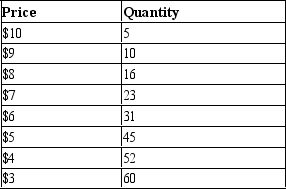 -Refer to Table 15-15. The monopolist has total fixed costs of $40 and a constant marginal cost of $5. At the profit-maximizing level of output, the monopolist's profit is
 (Multiple Choice)
4.9/5 (83)
(83) Figure 15-3  -Refer to Figure 15-3. Which panel could represent the demand curve facing a local cable television provider if that firm in a monopolist?
 (Multiple Choice)
4.8/5 (88)
(88) Suppose a monopolist is able to charge each customer a price equal to that customer's willingnesstopay for the product. Then the monopolist is engaging in
(Multiple Choice)
4.8/5 (84)
(84) Table 15-11
The following table shows quantity, price, and marginal cost information for a monopoly:
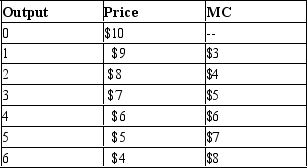 -Refer to Table 15-11. What price should the firm charge to maximize its profit?
 (Multiple Choice)
4.8/5 (77)
(77) Scenario 15-3
A monopoly firm maximizes its profit by producing Q = 500 units of output. At that level of output, its marginal revenue is $30, its average revenue is $60, and its average total cost is $34.
-Refer to Scenario 15-3. At Q = 500, the firm's total revenue is
(Multiple Choice)
5.0/5 (86)
(86) Bob's Butcher Shop is the only place within 100 miles that sells bison burgers. Assuming that Bob is maximizing his profit, which of the following statements is true?
(Multiple Choice)
4.9/5 (89)
(89) Table 15-7
Sally owns the only shoe store in town. She has the following cost and revenue information.
 -Refer to Table 15-7. Sally will maximize her profits by selling
 (Multiple Choice)
4.8/5 (75)
(75) One example of price discrimination occurs in the publishing industry when a publisher initially releases an expensive hardcover edition of a popular novel and later releases a cheaper paperback edition. Use this example to demonstrate the benefits and potential pitfalls of a price discrimination pricing strategy.
(Essay)
4.8/5 (70)
(70) In order for a firm to maximize profits through price discrimination, the firm must have some market power and be able to prevent arbitrage.
(True/False)
4.8/5 (77)
(77) Figure 15-13 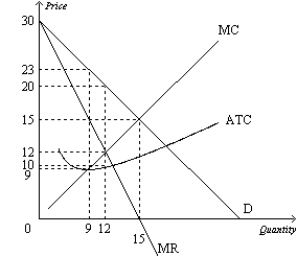 -Refer to Figure 15-13. A profit-maximizing monopolist would create a deadweight loss to society valued at
 (Multiple Choice)
4.8/5 (70)
(70) When a monopolist increases the quantity that it sells, all else equal, total revenue increases, which is called the output effect.
(True/False)
4.7/5 (73)
(73) Scenario 15-4
Suppose a monopolist has a demand curve that can be expressed as P=90-Q. The monopolist's marginal revenue curve can be expressed as MR=90-2Q. The monopolist has constant marginal costs and average total costs of $10.
-Refer to Scenario 15-4. The profit-maximizing monopolist will have a deadweight loss of
(Multiple Choice)
4.9/5 (88)
(88) 
Filters
- Essay(0)
- Multiple Choice(0)
- Short Answer(0)
- True False(0)
- Matching(0)