



 Chat with AI
Exam 14: Monopoly

Exam 1: Ten Principles of Economics438 Questions
Exam 2: Thinking Like an Economist620 Questions
Exam 3: Interdependence and the Gains From Trade527 Questions
Exam 4: The Market Forces of Supply and Demand700 Questions
Exam 5: Elasticity and Its Application598 Questions
Exam 6: Supply, Demand, and Government Policies648 Questions
Exam 7: Consumers, Producers, and the Efficiency of Markets550 Questions
Exam 8: Application: The Costs of Taxation514 Questions
Exam 9: Application: International Trade496 Questions
Exam 10: Externalities522 Questions
Exam 11: Public Goods and Common Resources434 Questions
Exam 12: The Costs of Production420 Questions
Exam 13: Firms in Competitive Markets543 Questions
Exam 14: Monopoly637 Questions
Exam 15: Measuring a Nations Income522 Questions
Exam 16: Measuring the Cost of Living545 Questions
Exam 17: Production and Growth507 Questions
Exam 18: Saving, Investment, and the Financial System567 Questions
Exam 19: The Basic Tools of Finance513 Questions
Exam 20: Unemployment699 Questions
Exam 21: The Monetary System518 Questions
Exam 22: Money Growth and Inflation487 Questions
Exam 23: Aggregate Demand and Aggregate Supply563 Questions
Exam 24: The Influence of Monetary and Fiscal Policy on Aggregate Demand512 Questions
Select questions type


Compared to the monopoly outcome with a single price, imperfect price discrimination i) sometimes raises total surplus.
Ii) sometimes lowers total surplus.
Iii) always leads to a lower quantity of output.
(Multiple Choice)
4.7/5  (75)
(75) Figure 15-25  -Refer to Figure 15-25. If a regulator requires this firm to charge a socially optimal price, how much deadweight loss results?
 (Short Answer)
4.8/5 (86)
(86) Monopoly pricing prevents some mutually beneficial trades from taking place. These unrealized, mutually beneficial trades are
(Multiple Choice)
4.7/5 (89)
(89) Because a monopolist is the sole producer in its market, it can necessarily alter the price of its good i) without affecting the quantity sold.
Ii) without affecting its average total cost.
Iii) by adjusting the quantity it supplies to the market.
(Multiple Choice)
4.7/5 (85)
(85) If a profit-maximizing monopolist faces a downward-sloping market demand curve, its
(Multiple Choice)
4.8/5 (85)
(85) Which of the following is not one of the ways that antitrust laws promote competition?
(Multiple Choice)
4.9/5 (89)
(89) The De Beers Diamond company advertises heavily to promote the sale of all diamonds, not just its own. This is evidence that it has a monopoly position to some degree.
(True/False)
5.0/5 (75)
(75) Financial aid to college students, quantity discounts, and senior citizen discounts are all examples of
(Multiple Choice)
4.7/5 (78)
(78) Suppose a profit-maximizing monopolist faces a constant marginal cost of $20, produces an output level of 100 units, and charges a price of $50. The socially efficient level of output is 200 units. Assume that the demand curve and marginal revenue curve are the typical downward-sloping straight lines. The monopoly deadweight loss equals $1,500.
(True/False)
4.8/5 (64)
(64) Figure 15-4  -Refer to Figure 15-4. If the monopoly firm wants to maximize its profit, it should operate at a level of output equal to
 (Multiple Choice)
4.8/5 (61)
(61) Sizable economic profits can persist over time under monopoly if the monopolist
(Multiple Choice)
4.7/5 (86)
(86) Figure 15-4
-Refer to Figure 15-4. Profit can always be increased by increasing the level of output by one unit if the monopolist is currently operating at i) Q1.
Ii) Q2.
Iii) Q3.
Iv) Q4.
-Refer to Figure 15-4. Profit can always be increased by increasing the level of output by one unit if the monopolist is currently operating at i) Q1.
Ii) Q2.
Iii) Q3.
Iv) Q4. (Multiple Choice)
4.9/5 (85)
(85) Suppose a monopolist charges a price of $27 for its product and sells 10 units at that price. At 10 units of production the firm has average fixed cost equal to $10 and average variable cost equal to $12. How much total profit is the firm earning at this price?
(Multiple Choice)
4.7/5 (72)
(72) A monopolist earns higher profits by charging one price than by practicing price discrimination.
(True/False)
4.9/5 (80)
(80) Figure 15-6 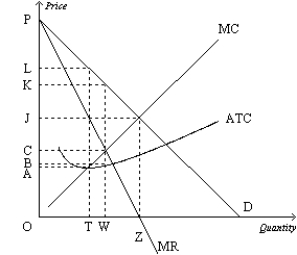 -Refer to Figure 15-6. What price will the monopolist charge?
 (Multiple Choice)
4.9/5 (75)
(75) 
Filters
- Essay(0)
- Multiple Choice(0)
- Short Answer(0)
- True False(0)
- Matching(0)