



 Chat with AI
Exam 14: Monopoly

Exam 1: Ten Principles of Economics438 Questions
Exam 2: Thinking Like an Economist620 Questions
Exam 3: Interdependence and the Gains From Trade527 Questions
Exam 4: The Market Forces of Supply and Demand700 Questions
Exam 5: Elasticity and Its Application598 Questions
Exam 6: Supply, Demand, and Government Policies648 Questions
Exam 7: Consumers, Producers, and the Efficiency of Markets550 Questions
Exam 8: Application: The Costs of Taxation514 Questions
Exam 9: Application: International Trade496 Questions
Exam 10: Externalities522 Questions
Exam 11: Public Goods and Common Resources434 Questions
Exam 12: The Costs of Production420 Questions
Exam 13: Firms in Competitive Markets543 Questions
Exam 14: Monopoly637 Questions
Exam 15: Measuring a Nations Income522 Questions
Exam 16: Measuring the Cost of Living545 Questions
Exam 17: Production and Growth507 Questions
Exam 18: Saving, Investment, and the Financial System567 Questions
Exam 19: The Basic Tools of Finance513 Questions
Exam 20: Unemployment699 Questions
Exam 21: The Monetary System518 Questions
Exam 22: Money Growth and Inflation487 Questions
Exam 23: Aggregate Demand and Aggregate Supply563 Questions
Exam 24: The Influence of Monetary and Fiscal Policy on Aggregate Demand512 Questions
Select questions type


Table 15-8
The following table provides information on the price, quantity, and average total cost for a monopoly.
 -Refer to Table 15-8. At what price will the monopolist maximize his profit?
 (Multiple Choice)
4.9/5  (88)
(88) There has been much discussion of deregulating electricity and natural gas delivery companies in the United States. Discuss the likely effect of deregulation on prices in these two industries.
(Essay)
4.8/5 (85)
(85) A firm that is the sole seller of a product without close substitutes is
(Multiple Choice)
4.9/5 (88)
(88) Suppose ABC Aluminum Inc. owns 80% of the world's bauxite, a mineral used in the production of aluminum. Which of the following reasons describes the fundamental barrier to entry for the aluminum industry?
(Multiple Choice)
4.8/5 (75)
(75) Table 15-4
A monopolist faces the following demand curve:
 -Refer to Table 15-4. If the monopolist produces 10 units, what is its marginal revenue?
 (Multiple Choice)
4.9/5 (72)
(72) Price discrimination can increase both the monopolist's profits and society's welfare.
(True/False)
4.9/5 (71)
(71) Figure 15-25  -Refer to Figure 15-25. If this firm profit maximizes, which letter represents the quantity it will produce?
 (Short Answer)
4.9/5 (78)
(78) Copyrights and patents are examples of barriers to entry that give firms monopoly pricing powers.
(True/False)
4.8/5 (73)
(73) Scenario 15-5
An airline knows that there are two types of travelers: business travelers and vacationers. For a particular flight, there are 100 business travelers who will pay $600 for a ticket while there are 50 vacationers who will pay $300 for a ticket. There are 150 seats available on the plane. Suppose the cost to the airline of providing the flight is $20,000, which includes the cost of the pilots, flight attendants, fuel, etc.
-Refer to Scenario 15-5. How much profit will the airline earn if it sets the price of each ticket at $600?
(Multiple Choice)
4.7/5 (82)
(82) Table 15-14
The following table gives information on the price, quantity, and total cost of production for a monopolist.
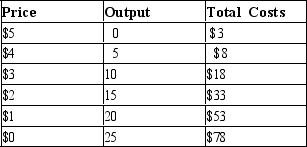 -Refer to Table 15-14. At what price does marginal revenue equal marginal cost?
 (Multiple Choice)
4.7/5 (75)
(75) Table 15-20
A monopolist faces the following demand curve:
 -Refer to Table 15-20. If a monopolist faces a constant marginal cost of $10, how much output should the firm produce in order to maximize profit?
 (Multiple Choice)
4.9/5 (75)
(75) Figure 15-18  -Refer to Figure 15-18. If the monopoly firm is not allowed to price discriminate, then the deadweight loss amounts to
 (Multiple Choice)
4.9/5 (81)
(81) Figure 15-4  -Refer to Figure 15-4. The demand curve for a monopoly firm is depicted by curve
 (Multiple Choice)
4.8/5 (82)
(82) Consider a profit-maximizing monopoly pricing under the following conditions. The profit-maximizing quantity is 40 units, the profit-maximizing price is $160, and the marginal cost of the 40th unit is $120. If the good were produced in a perfectly competitive market, the equilibrium quantity would be 50, and the equilibrium price would be $150. The demand curve and marginal cost curves are linear. What is the value of the deadweight loss created by the monopolist?
(Multiple Choice)
4.8/5 (80)
(80) Suppose a profit-maximizing monopolist faces a constant marginal cost of $10, produces an output level of 100 units, and charges a price of $50. The socially efficient level of output is 200 units. Assume that the demand curve and marginal revenue curve are the typical downward-sloping straight lines. The monopoly deadweight loss equals $2,000.
(True/False)
4.7/5 (83)
(83) Figure 15-20 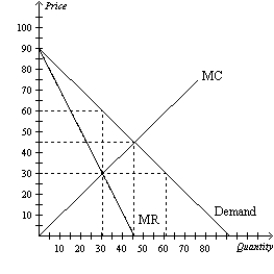 -Refer to Figure 15-20. The consumer surplus at the monopolist's profitmaximizing price is
 (Multiple Choice)
4.9/5 (86)
(86) Scenario 15-11
Vincent operates a scenic tour business in Boston. He has one bus which can fit 50 people per tour and each tour lasts 2 hours. His total cost of operating one tour is fixed at $450. Vincent's cost is not reduced if he runs a tour with a partially full bus. While his cost is the same for all tours, Vincent charges each passenger his/her willingness to pay: adults $18 per trip, children $10 per trip, and senior citizens $12 per trip. At those rates, on a typical day Vincent's demand is:
 Assume that Vincent's customers are always available for the tour; therefore, he can fill his bus for each tour as long as there is sufficient total demand for the day.
-Refer to Scenario 15-11. Vincent uses a pricing practice called
Assume that Vincent's customers are always available for the tour; therefore, he can fill his bus for each tour as long as there is sufficient total demand for the day.
-Refer to Scenario 15-11. Vincent uses a pricing practice called (Short Answer)
4.9/5 (85)
(85) 
Filters
- Essay(0)
- Multiple Choice(0)
- Short Answer(0)
- True False(0)
- Matching(0)