



 Chat with AI
Exam 14: Monopoly

Exam 1: Ten Principles of Economics438 Questions
Exam 2: Thinking Like an Economist620 Questions
Exam 3: Interdependence and the Gains From Trade527 Questions
Exam 4: The Market Forces of Supply and Demand700 Questions
Exam 5: Elasticity and Its Application598 Questions
Exam 6: Supply, Demand, and Government Policies648 Questions
Exam 7: Consumers, Producers, and the Efficiency of Markets550 Questions
Exam 8: Application: The Costs of Taxation514 Questions
Exam 9: Application: International Trade496 Questions
Exam 10: Externalities522 Questions
Exam 11: Public Goods and Common Resources434 Questions
Exam 12: The Costs of Production420 Questions
Exam 13: Firms in Competitive Markets543 Questions
Exam 14: Monopoly637 Questions
Exam 15: Measuring a Nations Income522 Questions
Exam 16: Measuring the Cost of Living545 Questions
Exam 17: Production and Growth507 Questions
Exam 18: Saving, Investment, and the Financial System567 Questions
Exam 19: The Basic Tools of Finance513 Questions
Exam 20: Unemployment699 Questions
Exam 21: The Monetary System518 Questions
Exam 22: Money Growth and Inflation487 Questions
Exam 23: Aggregate Demand and Aggregate Supply563 Questions
Exam 24: The Influence of Monetary and Fiscal Policy on Aggregate Demand512 Questions
Select questions type


Table 15-4
A monopolist faces the following demand curve:
 -Refer to Table 15-4. If the monopolist produces 10 units, what is its average revenue?
 (Multiple Choice)
4.8/5  (89)
(89) Price discrimination is a rational strategy for a profit-maximizing monopolist when
(Multiple Choice)
4.9/5 (68)
(68) Scenario 15-6
The concert promoters of a heavy-metal band, WeR2Loud, know that there are two types of concert-goers: die- hard fans and casual fans. For a particular WeR2Loud concert, there are 1,000 die-hard fans who will pay $150 for a ticket and 500 casual fans who will pay $50 for a ticket. There are 1,500 seats available at the concert venue. Suppose the cost of putting on the concert is $50,000, which includes the cost of the band, lighting, security, etc.
-Refer to Scenario 15-6. How much profit will the concert promoters earn if they engage in price discrimination?
(Multiple Choice)
4.9/5 (66)
(66) Some companies merge in order to lower costs through efficient joint production.
(True/False)
4.8/5 (87)
(87) Figure 15-4  -Refer to Figure 15-4. If the monopoly firm is currently producing Q3 units of output, then a decrease in output will necessarily cause profit to
 (Multiple Choice)
4.8/5 (92)
(92) Authors are allowed to be monopolists in the sale of their books in order to
(Multiple Choice)
4.8/5 (80)
(80) Figure 15-4
-Refer to Figure 15-4. The marginal revenue curve for a monopoly firm is depicted by curve
-Refer to Figure 15-4. The marginal revenue curve for a monopoly firm is depicted by curve (Multiple Choice)
4.8/5 (73)
(73) Figure 15-22  -Refer to Figure 15-22. How much consumer surplus results if this single-price monopolist profit-maximizes?
 (Short Answer)
4.9/5 (84)
(84) Scenario 15-5
An airline knows that there are two types of travelers: business travelers and vacationers. For a particular flight, there are 100 business travelers who will pay $600 for a ticket while there are 50 vacationers who will pay $300 for a ticket. There are 150 seats available on the plane. Suppose the cost to the airline of providing the flight is $20,000, which includes the cost of the pilots, flight attendants, fuel, etc.
-Refer to Scenario 15-5. How much profit will the airline earn if it sets the price of each ticket at $300?
(Multiple Choice)
4.9/5 (87)
(87) Competitive firms differ from monopolies in which of the following ways? i) Competitive firms do not have to worry about the price effect lowering their total revenue.
Ii) Marginal revenue for a competitive firm equals price, while marginal revenue for a monopoly is less than the price it is able to charge.
Iii) Monopolies must lower their price in order to sell more of their product, while competitive firms do not.
(Multiple Choice)
4.9/5 (81)
(81) Table 15-4
A monopolist faces the following demand curve:
-Refer to Table 15-4. If the monopolist produces 5 units, what is its average revenue?
-Refer to Table 15-4. If the monopolist produces 5 units, what is its average revenue? (Multiple Choice)
4.9/5 (66)
(66) Table 15-10
The monopolist faces the following demand curve:
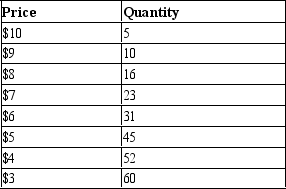 -Refer to Table 15-10. If the monopolist has total fixed costs of $40 and a constant marginal cost of $5, what is the profit-maximizing level of output?
 (Multiple Choice)
4.7/5 (94)
(94) Reduced competition through merging of companies will raise social welfare
(Multiple Choice)
4.9/5 (82)
(82) Allowing an inventor to have the exclusive rights to market her new invention will lead to i) a product that is priced higher than it would be without the exclusive rights.
Ii) desirable behavior in the sense that inventors are encouraged to invent.
Iii) higher profits for the inventor.
(Multiple Choice)
4.8/5 (80)
(80) The deadweight loss associated with a monopoly occurs because the monopolist
(Multiple Choice)
4.9/5 (79)
(79) 
Filters
- Essay(0)
- Multiple Choice(0)
- Short Answer(0)
- True False(0)
- Matching(0)