



 Chat with AI
Exam 2: Thinking Like an Economist

Exam 1: Ten Principles of Economics438 Questions
Exam 2: Thinking Like an Economist620 Questions
Exam 3: Interdependence and the Gains From Trade527 Questions
Exam 4: The Market Forces of Supply and Demand700 Questions
Exam 5: Elasticity and Its Application598 Questions
Exam 6: Supply, Demand, and Government Policies648 Questions
Exam 7: Consumers, Producers, and the Efficiency of Markets550 Questions
Exam 8: Application: The Costs of Taxation514 Questions
Exam 9: Application: International Trade496 Questions
Exam 10: Externalities522 Questions
Exam 11: Public Goods and Common Resources434 Questions
Exam 12: The Costs of Production420 Questions
Exam 13: Firms in Competitive Markets543 Questions
Exam 14: Monopoly637 Questions
Exam 15: Measuring a Nations Income522 Questions
Exam 16: Measuring the Cost of Living545 Questions
Exam 17: Production and Growth507 Questions
Exam 18: Saving, Investment, and the Financial System567 Questions
Exam 19: The Basic Tools of Finance513 Questions
Exam 20: Unemployment699 Questions
Exam 21: The Monetary System518 Questions
Exam 22: Money Growth and Inflation487 Questions
Exam 23: Aggregate Demand and Aggregate Supply563 Questions
Exam 24: The Influence of Monetary and Fiscal Policy on Aggregate Demand512 Questions
Select questions type


In the circular-flow diagram, which of the following is not a factor of production?

Free
(Multiple Choice)
4.7/5  (78)
(78) Correct Answer: Verified
D
For economists, historical episodes
Free
(Multiple Choice)
4.9/5 (75)
(75) Correct Answer:Verified
VerifiedD
Figure 2-2  -Refer to Figure 2-2. If households are buyers in the markets represented by Box C of this circular-flow diagram, then
 (Multiple Choice)
4.9/5 (70)
(70) Joe and Fred are economists. Joe thinks that the wealthiest 10% of the US population should be taxed a rate higher than the rest of society because they can better afford it. Fred thinks that everyone should be taxed at the same rate because that is the fairest scenario and the wealthy should not be penalized for their success. In this example, Joe and Fred
(Multiple Choice)
4.8/5 (89)
(89) Figure 2-9
Panel a) Panel b)

 -Refer to Figure 2-9, Panel a). The opportunity cost of moving from point M to point L is
 (Multiple Choice)
4.9/5 (78)
(78) In the markets for goods and services in the circular-flow diagram, households are buyers and firms are sellers.
(True/False)
5.0/5 (77)
(77) Positive statements can be evaluated using data alone, but normative statements cannot.
(True/False)
4.8/5 (102)
(102) Which of the following is an example of a positive, as opposed to normative, statement?
(Multiple Choice)
4.9/5 (95)
(95) Which of the following statements is an example of a positive, as opposed to normative, statement?
(Multiple Choice)
4.8/5 (94)
(94) In economics, graphs serve two purposes: they offer a way to visually express ideas, and they provide a way of finding and interpreting patterns when analyzing economic data.
(True/False)
5.0/5 (69)
(69) John Maynard Keynes described economics as an easy subject at which very few excel. Which of the following is not one of the reasons Keynes gave for why so few people excel at the study of economics?
(Multiple Choice)
4.9/5 (79)
(79) Figure 2-22  -Refer to Figure 2-22. Is a move from point A to point R considered a shift of the curve or a movement along the curve?
 (Short Answer)
4.9/5 (79)
(79) In the simple circular flow diagram, the flow of money from the firms to the markets for factors of production is called
(Multiple Choice)
4.9/5 (81)
(81) Figure 2-15 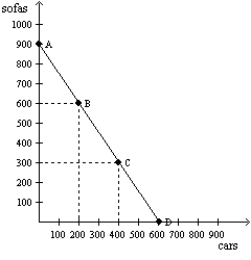 -Refer to Figure 2-15. Consider the production possibilities frontier for an economy that produces only sofas and cars. When society moves from point A to point B,
 (Multiple Choice)
4.8/5 (64)
(64) 
Filters
- Essay(0)
- Multiple Choice(0)
- Short Answer(0)
- True False(0)
- Matching(0)