



 Chat with AI
Exam 2: Thinking Like an Economist

Exam 1: Ten Principles of Economics438 Questions
Exam 2: Thinking Like an Economist620 Questions
Exam 3: Interdependence and the Gains From Trade527 Questions
Exam 4: The Market Forces of Supply and Demand700 Questions
Exam 5: Elasticity and Its Application598 Questions
Exam 6: Supply, Demand, and Government Policies648 Questions
Exam 7: Consumers, Producers, and the Efficiency of Markets550 Questions
Exam 8: Application: The Costs of Taxation514 Questions
Exam 9: Application: International Trade496 Questions
Exam 10: Externalities522 Questions
Exam 11: Public Goods and Common Resources434 Questions
Exam 12: The Costs of Production420 Questions
Exam 13: Firms in Competitive Markets543 Questions
Exam 14: Monopoly637 Questions
Exam 15: Measuring a Nations Income522 Questions
Exam 16: Measuring the Cost of Living545 Questions
Exam 17: Production and Growth507 Questions
Exam 18: Saving, Investment, and the Financial System567 Questions
Exam 19: The Basic Tools of Finance513 Questions
Exam 20: Unemployment699 Questions
Exam 21: The Monetary System518 Questions
Exam 22: Money Growth and Inflation487 Questions
Exam 23: Aggregate Demand and Aggregate Supply563 Questions
Exam 24: The Influence of Monetary and Fiscal Policy on Aggregate Demand512 Questions
Select questions type


What type of statement is a prescriptive statement about how the world ought to be?
(Short Answer)
4.8/5  (79)
(79) Which of the following is an example of a positive, as opposed to normative, statement?
(Multiple Choice)
4.9/5 (85)
(85) How did the influential economist John Maynard Keynes explain his remark that though economics is an easy subject compared with the higher branches of philosophy or pure science, it is a subject at which few excel?
(Multiple Choice)
4.9/5 (87)
(87) Table 2-6
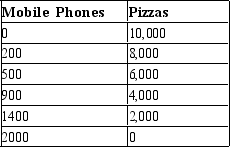 -Refer to Table 2-6. Consider the production possibilities table for an economy that produces only mobile phones and pizzas. Describe the shape of the production possibilities frontier.
 (Short Answer)
4.9/5 (90)
(90) Figure 2-3  -Refer to Figure 2-3. What do the inner arrows represent in the figure?
 (Short Answer)
4.7/5 (73)
(73) Figure 2-10
Panel a) Panel b)

 -Refer to Figure 2-10, Panel a). Production is
 (Multiple Choice)
4.9/5 (82)
(82) Since economists cannot use natural experiments offered by history, they must use carefully constructed laboratory experiments instead.
(True/False)
4.7/5 (76)
(76) Which of the following statements applies to economics, as well as to other sciences such as physics?
(Multiple Choice)
5.0/5 (68)
(68) Which of the following is an example of a normative, as opposed to positive, statement?
(Multiple Choice)
5.0/5 (77)
(77) Figure 2-12 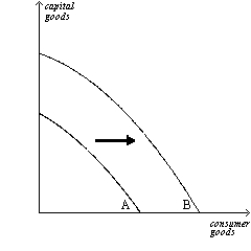 -Refer to Figure 2-12. The shift of the production possibilities frontier from A to B can best be described as
 (Multiple Choice)
4.8/5 (76)
(76) Figure 2-14  Consider the production possibilities curve for a country that can produce sweaters, apples in bushels), or a combination of the two.
-Refer to Figure 2-14. Which points) on the graph show unemployment of resources?
Consider the production possibilities curve for a country that can produce sweaters, apples in bushels), or a combination of the two.
-Refer to Figure 2-14. Which points) on the graph show unemployment of resources? (Short Answer)
4.9/5 (79)
(79) Figure 2-22  -Refer to Figure 2-22. What are the coordinates of point C?
 (Short Answer)
4.9/5 (82)
(82) A macroeconomist - as opposed to a microeconomist - might study the effect of
(Multiple Choice)
4.8/5 (71)
(71) The effects of foreign competition on the U.S. textile industry would be studied by a microeconomist rather than a macroeconomist.
(True/False)
4.8/5 (92)
(92) 
Filters
- Essay(0)
- Multiple Choice(0)
- Short Answer(0)
- True False(0)
- Matching(0)