



 Chat with AI
Exam 2: Thinking Like an Economist

Exam 1: Ten Principles of Economics438 Questions
Exam 2: Thinking Like an Economist620 Questions
Exam 3: Interdependence and the Gains From Trade527 Questions
Exam 4: The Market Forces of Supply and Demand700 Questions
Exam 5: Elasticity and Its Application598 Questions
Exam 6: Supply, Demand, and Government Policies648 Questions
Exam 7: Consumers, Producers, and the Efficiency of Markets550 Questions
Exam 8: Application: The Costs of Taxation514 Questions
Exam 9: Application: International Trade496 Questions
Exam 10: Externalities522 Questions
Exam 11: Public Goods and Common Resources434 Questions
Exam 12: The Costs of Production420 Questions
Exam 13: Firms in Competitive Markets543 Questions
Exam 14: Monopoly637 Questions
Exam 15: Measuring a Nations Income522 Questions
Exam 16: Measuring the Cost of Living545 Questions
Exam 17: Production and Growth507 Questions
Exam 18: Saving, Investment, and the Financial System567 Questions
Exam 19: The Basic Tools of Finance513 Questions
Exam 20: Unemployment699 Questions
Exam 21: The Monetary System518 Questions
Exam 22: Money Growth and Inflation487 Questions
Exam 23: Aggregate Demand and Aggregate Supply563 Questions
Exam 24: The Influence of Monetary and Fiscal Policy on Aggregate Demand512 Questions
Select questions type


Figure 2-5  -Refer to Figure 2-5. The opportunity cost of obtaining 40 additional dryers by moving from point D to point C is
 (Multiple Choice)
4.9/5  (76)
(76) Albert Einstein once made the following observation about science:
(Multiple Choice)
4.9/5 (83)
(83) Figure 2-19
In the following graph the x-axis shows the number of times a commuter rail train stops at a station per hour and the y-axis shows the number of commuter rail passengers per hour.
Commuter Rail Passengers by Frequency of Service 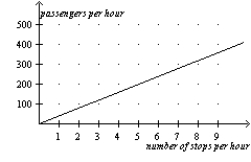 -Refer to Figure 2-19. Which of the following conclusions should not be drawn from observing this graph?
 (Multiple Choice)
4.9/5 (89)
(89) The trade-off between the production of one good and the production of another good can change over time because of technological advances.
(True/False)
4.8/5 (88)
(88) The President counts among his economic advisors the Congressional Budget Office.
(True/False)
4.9/5 (82)
(82) Figure 2-13  -Refer to Figure 2-13. One difference between points F and G is that
 (Multiple Choice)
4.8/5 (62)
(62) Figure 2-4  -Refer to Figure 2-4. This economy cannot produce at which points)?
 (Multiple Choice)
4.9/5 (81)
(81) Economists believe that production possibilities frontiers rarely have a bowed shape.
(True/False)
4.9/5 (74)
(74) Figure 2-14  Consider the production possibilities curve for a country that can produce sweaters, apples in bushels), or a combination of the two.
-Refer to Figure 2-14. What is the opportunity cost of moving from point T to point R?
Consider the production possibilities curve for a country that can produce sweaters, apples in bushels), or a combination of the two.
-Refer to Figure 2-14. What is the opportunity cost of moving from point T to point R? (Short Answer)
4.7/5 (76)
(76) Suppose that someone makes the argument that because empty alcohol containers are found at many accidents, the containers cause accidents. This would be an example of
(Multiple Choice)
4.9/5 (76)
(76) Policies such as rent control and trade barriers persist in spite of the fact that economists are virtually united in their opposition to such policies, probably because
(Multiple Choice)
4.8/5 (76)
(76) Figure 2-11 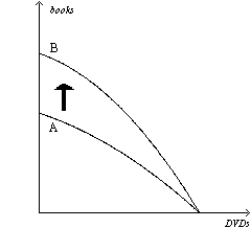 -Refer to Figure 2-11. The shift of the production possibilities frontier from A to B illustrates
 (Multiple Choice)
4.8/5 (83)
(83) Figure 2-18
Relationship between Price and Restaurant Meals  -Refer to Figure 2-18. The slope of the line containing points A and B is
 (Multiple Choice)
4.8/5 (79)
(79) Congress relies on economists at the Congressional Budget Office to
(Multiple Choice)
4.8/5 (78)
(78) John Maynard Keynes referred to economics as an easy subject,
(Multiple Choice)
4.8/5 (81)
(81) Suppose a war in the Middle East interrupts the flow of crude oil and oil prices skyrocket around the world. For economists, this historical episode serves as a
(Short Answer)
4.9/5 (99)
(99) The scientific method can be applied to the study of economics.
(True/False)
4.9/5 (72)
(72) When a production possibilities frontier is bowed outward, the opportunity cost of one good in terms of the other depends on how much of each good is being produced.
(True/False)
4.9/5 (85)
(85) In the circular-flow diagram, which of the following items flows from households to firms through the markets for the factors of production?
(Multiple Choice)
4.7/5 (81)
(81) 
Filters
- Essay(0)
- Multiple Choice(0)
- Short Answer(0)
- True False(0)
- Matching(0)