



 Chat with AI
Exam 2: Thinking Like an Economist

Exam 1: Ten Principles of Economics438 Questions
Exam 2: Thinking Like an Economist620 Questions
Exam 3: Interdependence and the Gains From Trade527 Questions
Exam 4: The Market Forces of Supply and Demand700 Questions
Exam 5: Elasticity and Its Application598 Questions
Exam 6: Supply, Demand, and Government Policies648 Questions
Exam 7: Consumers, Producers, and the Efficiency of Markets550 Questions
Exam 8: Application: The Costs of Taxation514 Questions
Exam 9: Application: International Trade496 Questions
Exam 10: Externalities522 Questions
Exam 11: Public Goods and Common Resources434 Questions
Exam 12: The Costs of Production420 Questions
Exam 13: Firms in Competitive Markets543 Questions
Exam 14: Monopoly637 Questions
Exam 15: Measuring a Nations Income522 Questions
Exam 16: Measuring the Cost of Living545 Questions
Exam 17: Production and Growth507 Questions
Exam 18: Saving, Investment, and the Financial System567 Questions
Exam 19: The Basic Tools of Finance513 Questions
Exam 20: Unemployment699 Questions
Exam 21: The Monetary System518 Questions
Exam 22: Money Growth and Inflation487 Questions
Exam 23: Aggregate Demand and Aggregate Supply563 Questions
Exam 24: The Influence of Monetary and Fiscal Policy on Aggregate Demand512 Questions
Select questions type


When a production possibilities frontier is bowed outward, the opportunity cost of the first good in terms of the second good increases as more of the second good is produced.
(True/False)
4.9/5  (84)
(84) Which of these statements about economic models is correct?
(Multiple Choice)
4.9/5 (72)
(72) Table 2-4
Production Possibilities for Picnicland
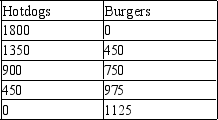 -Refer to Table 2-4. What is the opportunity cost to Picnicland of increasing the production of hotdogs from 450 to 900?
 (Multiple Choice)
5.0/5 (86)
(86) Which of the following is an example of a normative, as opposed to positive, statement?
(Multiple Choice)
4.8/5 (86)
(86) Which of the following is one of the basic reasons why economists often appear to give conflicting advice to policymakers?
(Multiple Choice)
4.9/5 (82)
(82) Which two groups of decision makers are included in the simple circular-flow diagram?
(Multiple Choice)
4.9/5 (75)
(75) Table 2-5
 -Home is a country that produces two goods, pears and cellular phones. Last year, Home produced 450 bushels of pears and 1050 cellular phones. This year it produced 450 bushels of pears and 2000 cellular phones. Given no other information, which of the following events could explain this change?
 (Multiple Choice)
4.9/5 (95)
(95) A microeconomist - as opposed to a macroeconomist - might study
(Multiple Choice)
4.9/5 (82)
(82) If a line passes through the points 20,5) and 10,10), then the slope of the line is -2.
(True/False)
4.8/5 (76)
(76) Figure 2-5  -Refer to Figure 2-5. The opportunity cost of this economy moving from point A to point B is
 (Multiple Choice)
4.9/5 (91)
(91) The concept of slope can be used to answer questions about how much one variable responds to changes in another variable.
(True/False)
4.8/5 (97)
(97) Figure 2-7  -Refer to Figure 2-7. What is the opportunity cost of moving from point M to point L?
 (Multiple Choice)
4.7/5 (69)
(69) Almost all economists agree that local and state governments should
(Multiple Choice)
5.0/5 (81)
(81) Figure 2-23  -Refer to Figure 2-23. The opportunity cost of moving from point B to point A is zero.
 (True/False)
4.8/5 (77)
(77) Figure 2-9
Panel a) Panel b)

 -Refer to Figure 2-9, Panel a). The movement from point M to point K could be caused by
 (Multiple Choice)
4.9/5 (77)
(77) The country of Gerance produces two goods, cars and wine. Last year, it produced 1,000 cars and 15,000 cases of wine. This year, it produced 1,300 cars and 20,000 cases of wine. Given no other information, which of the following events could not explain this change?
(Multiple Choice)
4.8/5 (71)
(71) 
Filters
- Essay(0)
- Multiple Choice(0)
- Short Answer(0)
- True False(0)
- Matching(0)