



 Chat with AI
Exam 2: Thinking Like an Economist

Exam 1: Ten Principles of Economics438 Questions
Exam 2: Thinking Like an Economist620 Questions
Exam 3: Interdependence and the Gains From Trade527 Questions
Exam 4: The Market Forces of Supply and Demand700 Questions
Exam 5: Elasticity and Its Application598 Questions
Exam 6: Supply, Demand, and Government Policies648 Questions
Exam 7: Consumers, Producers, and the Efficiency of Markets550 Questions
Exam 8: Application: The Costs of Taxation514 Questions
Exam 9: Application: International Trade496 Questions
Exam 10: Externalities522 Questions
Exam 11: Public Goods and Common Resources434 Questions
Exam 12: The Costs of Production420 Questions
Exam 13: Firms in Competitive Markets543 Questions
Exam 14: Monopoly637 Questions
Exam 15: Measuring a Nations Income522 Questions
Exam 16: Measuring the Cost of Living545 Questions
Exam 17: Production and Growth507 Questions
Exam 18: Saving, Investment, and the Financial System567 Questions
Exam 19: The Basic Tools of Finance513 Questions
Exam 20: Unemployment699 Questions
Exam 21: The Monetary System518 Questions
Exam 22: Money Growth and Inflation487 Questions
Exam 23: Aggregate Demand and Aggregate Supply563 Questions
Exam 24: The Influence of Monetary and Fiscal Policy on Aggregate Demand512 Questions
Select questions type


Figure 2-15 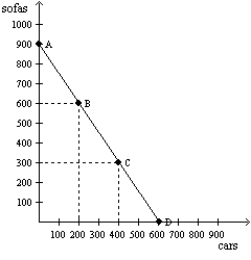 -Refer to Figure 2-15. Consider the production possibilities frontier for an economy that produces only sofas and cars. As the economy moves from point A to point D, is the opportunity cost of cars increasing, constant, or decreasing?
 (Short Answer)
4.8/5  (77)
(77) When two variables move in the same direction, the curve relating them is downward sloping, and we say the variables are negatively related.
(True/False)
4.9/5 (76)
(76) When income increases the slope of an individual's demand curve, the demand curve
(Multiple Choice)
4.9/5 (69)
(69) A production point is said to be efficient if there is no way for the economy to produce more of one good without producing less of another.
(True/False)
4.8/5 (72)
(72) In the markets for goods and services in the circular flow diagram, households act as
(Short Answer)
5.0/5 (76)
(76) Which of the following steps does an economist take when studying the economy?
(Multiple Choice)
4.7/5 (72)
(72) Different values are not a reason for disagreement among economists.
(True/False)
4.9/5 (77)
(77) Points outside the production possibilities frontier represent infeasible levels of production.
(True/False)
4.9/5 (78)
(78) Table 2-5
 -Refer to Table 2-5. Table 2-5 shows one set of production possibilities. Based on the values in the table, the production possibilities frontier is
 (Multiple Choice)
4.9/5 (78)
(78) According to John Maynard Keynes, an economist must possess a rare combination of skills including being a mathematician, historian, statesman, and philosopher.
(True/False)
4.8/5 (83)
(83) The slope of a line is equal to the change in the x-variable divided by the change in the y-variable.
(True/False)
4.8/5 (73)
(73) If Martina's income increases and, as a result, she chooses to buy more lattés per month at each price, then her demand curve will
(Multiple Choice)
4.8/5 (75)
(75) An economic model can accurately explain how the economy is organized because it is designed to include, to the extent possible, all features of the real world.
(True/False)
4.9/5 (77)
(77) In the circular flow diagram, when Brian provides labor through the markets for factors of production to ABC Company, the flow of money he receives in exchange is called
(Short Answer)
4.9/5 (94)
(94) Figure 2-5  -Refer to Figure 2-5. It is not possible for this economy to produce at point
 (Multiple Choice)
4.9/5 (92)
(92) Economists at which of the following offices help formulate spending plans and regulatory policies?
(Multiple Choice)
4.9/5 (77)
(77) Figure 2-14  Consider the production possibilities curve for a country that can produce sweaters, apples in bushels), or a combination of the two.
-Refer to Figure 2-14. Which points) on the graph isare) efficient production possibilities?
Consider the production possibilities curve for a country that can produce sweaters, apples in bushels), or a combination of the two.
-Refer to Figure 2-14. Which points) on the graph isare) efficient production possibilities? (Short Answer)
4.8/5 (72)
(72) 
Filters
- Essay(0)
- Multiple Choice(0)
- Short Answer(0)
- True False(0)
- Matching(0)