



 Chat with AI
Exam 2: Thinking Like an Economist

Exam 1: Ten Principles of Economics438 Questions
Exam 2: Thinking Like an Economist620 Questions
Exam 3: Interdependence and the Gains From Trade527 Questions
Exam 4: The Market Forces of Supply and Demand700 Questions
Exam 5: Elasticity and Its Application598 Questions
Exam 6: Supply, Demand, and Government Policies648 Questions
Exam 7: Consumers, Producers, and the Efficiency of Markets550 Questions
Exam 8: Application: The Costs of Taxation514 Questions
Exam 9: Application: International Trade496 Questions
Exam 10: Externalities522 Questions
Exam 11: Public Goods and Common Resources434 Questions
Exam 12: The Costs of Production420 Questions
Exam 13: Firms in Competitive Markets543 Questions
Exam 14: Monopoly637 Questions
Exam 15: Measuring a Nations Income522 Questions
Exam 16: Measuring the Cost of Living545 Questions
Exam 17: Production and Growth507 Questions
Exam 18: Saving, Investment, and the Financial System567 Questions
Exam 19: The Basic Tools of Finance513 Questions
Exam 20: Unemployment699 Questions
Exam 21: The Monetary System518 Questions
Exam 22: Money Growth and Inflation487 Questions
Exam 23: Aggregate Demand and Aggregate Supply563 Questions
Exam 24: The Influence of Monetary and Fiscal Policy on Aggregate Demand512 Questions
Select questions type


Figure 2-15 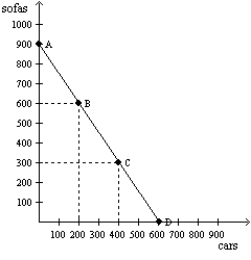 -Refer to Figure 2-15. Consider the production possibilities frontier for an economy that produces only sofas and cars. The opportunity cost of one car is
 (Short Answer)
4.8/5  (89)
(89) Figure 2-10
Panel a) Panel b)

 -Refer to Figure 2-10, Panel a) and Panel b). Which of the following is not a result of the shift of the economy's production possibilities frontier from Panel a) to Panel b)?
 (Multiple Choice)
4.9/5 (79)
(79) Figure 2-22  -Refer to Figure 2-22. Is a move from point A to point B considered a shift of the curve or a movement along the curve?
 (Short Answer)
5.0/5 (82)
(82) A certain production possibilities frontier shows production possibilities for two goods, jewelry and clothing. Which of the following concepts cannot be illustrated by this model?
(Multiple Choice)
4.8/5 (78)
(78) Normative statements describe how the world is, while positive statements prescribe how the world should be.
(True/False)
4.8/5 (85)
(85) Which of the following areas of study typifies microeconomics as opposed to macroeconomics?
(Multiple Choice)
4.8/5 (78)
(78) Table 2-2
The following table contains some production possibilities for an economy for a given year:
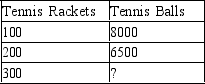 -Refer to Table 2-2. If the production possibilities frontier is bowed outward, then "?" could be
 (Multiple Choice)
4.9/5 (92)
(92) In the circular-flow diagram, factors of production include land, labor, and capital.
(True/False)
4.9/5 (72)
(72) A macroeconomist, rather than a microeconomist, would study the effects on a market from two firms merging.
(True/False)
4.8/5 (73)
(73) Figure 2-14  Consider the production possibilities curve for a country that can produce sweaters, apples in bushels), or a combination of the two.
-Refer to Figure 2-14. Which combination of points show production possibilities only achievable with improvements in technology or increases in resources?
Consider the production possibilities curve for a country that can produce sweaters, apples in bushels), or a combination of the two.
-Refer to Figure 2-14. Which combination of points show production possibilities only achievable with improvements in technology or increases in resources? (Multiple Choice)
4.9/5 (84)
(84) A model that shows how dollars flow through markets among households and firms is called the
(Multiple Choice)
5.0/5 (71)
(71) Just like models constructed in other areas of science, economic models
(Multiple Choice)
4.8/5 (78)
(78) In the circular-flow diagram, firms produce goods and services using the factors of production.
(True/False)
4.9/5 (92)
(92) When a variable that is not named on either axis of a graph changes, we read the change as a movement along the curve.
(True/False)
4.7/5 (86)
(86) Figure 2-15 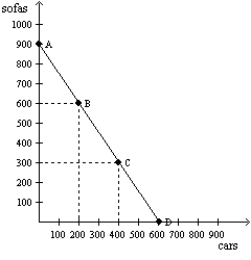 -Refer to Figure 2-15. Consider the production possibilities frontier for an economy that produces only sofas and cars. The opportunity cost of each car is
 (Multiple Choice)
4.8/5 (82)
(82) 
Filters
- Essay(0)
- Multiple Choice(0)
- Short Answer(0)
- True False(0)
- Matching(0)