



 Chat with AI
Exam 14: Monopoly

Exam 1: Ten Principles of Economics438 Questions
Exam 2: Thinking Like an Economist620 Questions
Exam 3: Interdependence and the Gains From Trade527 Questions
Exam 4: The Market Forces of Supply and Demand700 Questions
Exam 5: Elasticity and Its Application598 Questions
Exam 6: Supply, Demand, and Government Policies648 Questions
Exam 7: Consumers, Producers, and the Efficiency of Markets550 Questions
Exam 8: Application: The Costs of Taxation514 Questions
Exam 9: Application: International Trade496 Questions
Exam 10: Externalities522 Questions
Exam 11: Public Goods and Common Resources434 Questions
Exam 12: The Costs of Production420 Questions
Exam 13: Firms in Competitive Markets543 Questions
Exam 14: Monopoly637 Questions
Exam 15: Measuring a Nations Income522 Questions
Exam 16: Measuring the Cost of Living545 Questions
Exam 17: Production and Growth507 Questions
Exam 18: Saving, Investment, and the Financial System567 Questions
Exam 19: The Basic Tools of Finance513 Questions
Exam 20: Unemployment699 Questions
Exam 21: The Monetary System518 Questions
Exam 22: Money Growth and Inflation487 Questions
Exam 23: Aggregate Demand and Aggregate Supply563 Questions
Exam 24: The Influence of Monetary and Fiscal Policy on Aggregate Demand512 Questions
Select questions type


Scenario 15-11
Vincent operates a scenic tour business in Boston. He has one bus which can fit 50 people per tour and each tour lasts 2 hours. His total cost of operating one tour is fixed at $450. Vincent's cost is not reduced if he runs a tour with a partially full bus. While his cost is the same for all tours, Vincent charges each passenger his/her willingness to pay: adults $18 per trip, children $10 per trip, and senior citizens $12 per trip. At those rates, on a typical day Vincent's demand is:
 Assume that Vincent's customers are always available for the tour; therefore, he can fill his bus for each tour as long as there is sufficient total demand for the day.
-Refer to Scenario 15-11. What is Vincent's profit on a typical day?
Assume that Vincent's customers are always available for the tour; therefore, he can fill his bus for each tour as long as there is sufficient total demand for the day.
-Refer to Scenario 15-11. What is Vincent's profit on a typical day? (Short Answer)
4.9/5  (87)
(87) What are the four ways that government policymakers can respond to the problem of monopoly?
(Essay)
4.8/5 (82)
(82) Table 15-18
A monopolist faces the following demand curve:
 Suppose marginal cost is constant at $8 per unit.
-Refer to Table 15-18. The monopolist's marginal revenue is
Suppose marginal cost is constant at $8 per unit.
-Refer to Table 15-18. The monopolist's marginal revenue is (Multiple Choice)
4.8/5 (72)
(72) Figure 15-8  -Refer to Figure 15-8. What is the socially efficient price and quantity?
 (Multiple Choice)
5.0/5 (84)
(84) Which of the following is an example of price discrimination?
(Multiple Choice)
4.8/5 (98)
(98) The socially efficient level of production occurs where the marginal cost curve intersects
(Multiple Choice)
4.8/5 (70)
(70) Which of the following statements is correct for both a monopolist and a perfectly competitive firm? i) The firm maximizes profits by equating marginal revenue with marginal cost.
Ii) The firm maximizes profits by equating price with marginal cost.
Iii) Demand equals marginal revenue.
Iv) Average revenue equals price.
(Multiple Choice)
4.7/5 (80)
(80) When the government creates a monopoly, the social loss may include
(Multiple Choice)
4.9/5 (75)
(75) Scenario 15-6
The concert promoters of a heavy-metal band, WeR2Loud, know that there are two types of concert-goers: die- hard fans and casual fans. For a particular WeR2Loud concert, there are 1,000 die-hard fans who will pay $150 for a ticket and 500 casual fans who will pay $50 for a ticket. There are 1,500 seats available at the concert venue. Suppose the cost of putting on the concert is $50,000, which includes the cost of the band, lighting, security, etc.
-Refer to Scenario 15-6. How much profit will the concert promoters earn if they set the price of each ticket at $50?
(Multiple Choice)
4.9/5 (83)
(83) Table 15-7
Sally owns the only shoe store in town. She has the following cost and revenue information.
 -Refer to Table 15-7. What is the marginal cost of the 8th pair of shoes?
 (Multiple Choice)
4.9/5 (74)
(74) Figure 15-3  -Refer to Figure 15-3. Which panel could represent the demand curve facing the soybean industry?
 (Multiple Choice)
4.9/5 (81)
(81) Table 15-7
Sally owns the only shoe store in town. She has the following cost and revenue information.
-Refer to Table 15-7. What is the marginal cost of the 6th pair of shoes?
-Refer to Table 15-7. What is the marginal cost of the 6th pair of shoes? (Multiple Choice)
4.9/5 (82)
(82) Table 15-12
The following table provides information on the price, quantity, and average total cost for a monopoly.
 -Refer to Table 15-12. In order to maximize profits, the firm should produce
 (Multiple Choice)
4.9/5 (76)
(76) With no price discrimination, the monopolist sells every unit at the same price. Therefore
(Multiple Choice)
4.7/5 (83)
(83) Encouraging firms to invest in research and development and individuals to engage in creative endeavors such as writing novels is one justification for
(Multiple Choice)
4.8/5 (81)
(81) Table 15-11
The following table shows quantity, price, and marginal cost information for a monopoly:
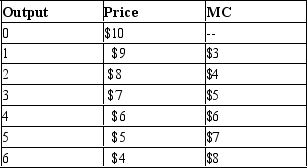 -Refer to Table 15-11. What level of output should the firm produce to maximize its profit?
 (Multiple Choice)
4.8/5 (67)
(67) 
Filters
- Essay(0)
- Multiple Choice(0)
- Short Answer(0)
- True False(0)
- Matching(0)