



 Chat with AI
Exam 14: Monopoly

Exam 1: Ten Principles of Economics438 Questions
Exam 2: Thinking Like an Economist620 Questions
Exam 3: Interdependence and the Gains From Trade527 Questions
Exam 4: The Market Forces of Supply and Demand700 Questions
Exam 5: Elasticity and Its Application598 Questions
Exam 6: Supply, Demand, and Government Policies648 Questions
Exam 7: Consumers, Producers, and the Efficiency of Markets550 Questions
Exam 8: Application: The Costs of Taxation514 Questions
Exam 9: Application: International Trade496 Questions
Exam 10: Externalities522 Questions
Exam 11: Public Goods and Common Resources434 Questions
Exam 12: The Costs of Production420 Questions
Exam 13: Firms in Competitive Markets543 Questions
Exam 14: Monopoly637 Questions
Exam 15: Measuring a Nations Income522 Questions
Exam 16: Measuring the Cost of Living545 Questions
Exam 17: Production and Growth507 Questions
Exam 18: Saving, Investment, and the Financial System567 Questions
Exam 19: The Basic Tools of Finance513 Questions
Exam 20: Unemployment699 Questions
Exam 21: The Monetary System518 Questions
Exam 22: Money Growth and Inflation487 Questions
Exam 23: Aggregate Demand and Aggregate Supply563 Questions
Exam 24: The Influence of Monetary and Fiscal Policy on Aggregate Demand512 Questions
Select questions type


Figure 15-15 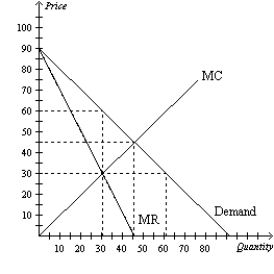 -Refer to Figure 15-15. To maximize total surplus, a benevolent social planner would choose which of the following outcomes?
 (Multiple Choice)
4.9/5  (75)
(75) Goods that do not have close substitutes have downward-sloping demand curves.
(True/False)
4.9/5 (75)
(75) When a certain monopoly sets its price at $8 it sells 64 units. When the monopoly sets its price at $10 it sells 60 units. The marginal revenue for the firm over this range is
(Multiple Choice)
4.9/5 (85)
(85) Suppose when a monopolist produces 50 units its average revenue is $8 per unit, its marginal revenue is $4 per unit, its marginal cost is $4 per unit, and its average total cost is $3 per unit. What can we conclude about this monopolist?
(Multiple Choice)
4.8/5 (75)
(75) Figure 15-5  -Refer to Figure 15-5. A profit-maximizing monopoly will produce an output level of
 (Multiple Choice)
4.9/5 (78)
(78) Even with market power, monopolists cannot achieve any level of profit they desire because they will sell lower quantities at higher prices.
(True/False)
4.9/5 (71)
(71) Figure 15-14 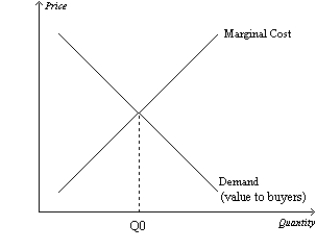 -Refer to Figure 15-14. A benevolent social planner would have the monopoly operate at an output level
 (Multiple Choice)
4.8/5 (81)
(81) To maximize total surplus with a monopoly firm, a benevolent social planner would choose the level of output where
(Multiple Choice)
4.9/5 (76)
(76) After the patent runs out on a brand name drug, generic drugs enter the market. What happens next in the market?
(Multiple Choice)
4.7/5 (70)
(70) A monopoly firm can sell 150 units of output for $10 per unit. Alternatively, it can sell 151 units of output for $9.90 per unit. The marginal revenue of the 151st unit of output is
(Multiple Choice)
4.7/5 (91)
(91) Comparing firms in perfectly competitive markets to monopoly firms, which can earn economic profits in the long run?
(Short Answer)
4.9/5 (78)
(78) The legislation passed by Congress in 1890 to reduce the market power of large and powerful "trusts" was the
(Multiple Choice)
4.9/5 (82)
(82) Which of the following would be most likely to have monopoly power?
(Multiple Choice)
4.9/5 (76)
(76) Which of the following is not an example of a barrier to entry?
(Multiple Choice)
4.8/5 (77)
(77) What is the shape of the monopolist's marginal revenue curve?
(Multiple Choice)
4.8/5 (77)
(77) Table 15-9
Consider the following demand and cost information for a monopoly.
 -Refer to Table 15-9. What is the monopolist's average total cost of production at the profitmaximizing price?
 (Multiple Choice)
4.9/5 (83)
(83) 
Filters
- Essay(0)
- Multiple Choice(0)
- Short Answer(0)
- True False(0)
- Matching(0)