



 Chat with AI
Exam 13: Firms in Competitive Markets

Exam 1: Ten Principles of Economics438 Questions
Exam 2: Thinking Like an Economist620 Questions
Exam 3: Interdependence and the Gains From Trade527 Questions
Exam 4: The Market Forces of Supply and Demand700 Questions
Exam 5: Elasticity and Its Application598 Questions
Exam 6: Supply, Demand, and Government Policies648 Questions
Exam 7: Consumers, Producers, and the Efficiency of Markets550 Questions
Exam 8: Application: The Costs of Taxation514 Questions
Exam 9: Application: International Trade496 Questions
Exam 10: Externalities522 Questions
Exam 11: Public Goods and Common Resources434 Questions
Exam 12: The Costs of Production420 Questions
Exam 13: Firms in Competitive Markets543 Questions
Exam 14: Monopoly637 Questions
Exam 15: Measuring a Nations Income522 Questions
Exam 16: Measuring the Cost of Living545 Questions
Exam 17: Production and Growth507 Questions
Exam 18: Saving, Investment, and the Financial System567 Questions
Exam 19: The Basic Tools of Finance513 Questions
Exam 20: Unemployment699 Questions
Exam 21: The Monetary System518 Questions
Exam 22: Money Growth and Inflation487 Questions
Exam 23: Aggregate Demand and Aggregate Supply563 Questions
Exam 24: The Influence of Monetary and Fiscal Policy on Aggregate Demand512 Questions
Select questions type


Table 14-13
Diana's Dress Emporium
 -Refer to Table 14-13. In order to maximize profits, how many units should Diana's Dress Emporium produce?
 (Multiple Choice)
4.9/5  (80)
(80) The marginal firm in a competitive market will earn zero economic profit in the long run.
(True/False)
4.8/5 (81)
(81) Suppose a firm in a competitive market produces and sells 8 units of output and has a marginal revenue of $8. What would be the firm's total revenue if it instead produced and sold 4 units of output?
(Multiple Choice)
4.8/5 (77)
(77) A firm in a competitive market has the following cost structure: 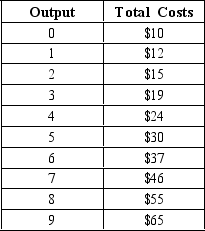 If the market price is $8, how many units of output should the firm produce to maximize profit?
 (Multiple Choice)
4.9/5 (81)
(81) Figure 14-2
Suppose a firm operating in a competitive market has the following cost curves:  -Refer to Figure 14-2. If the market price is Pd, in the short run the firm will earn
 (Multiple Choice)
4.8/5 (81)
(81) A firm operating in a competitive market will stay in business in the short run so long as the market price exceeds the firm's average total cost; otherwise, the firm will shut down.
(True/False)
4.9/5 (73)
(73) Table 14-12
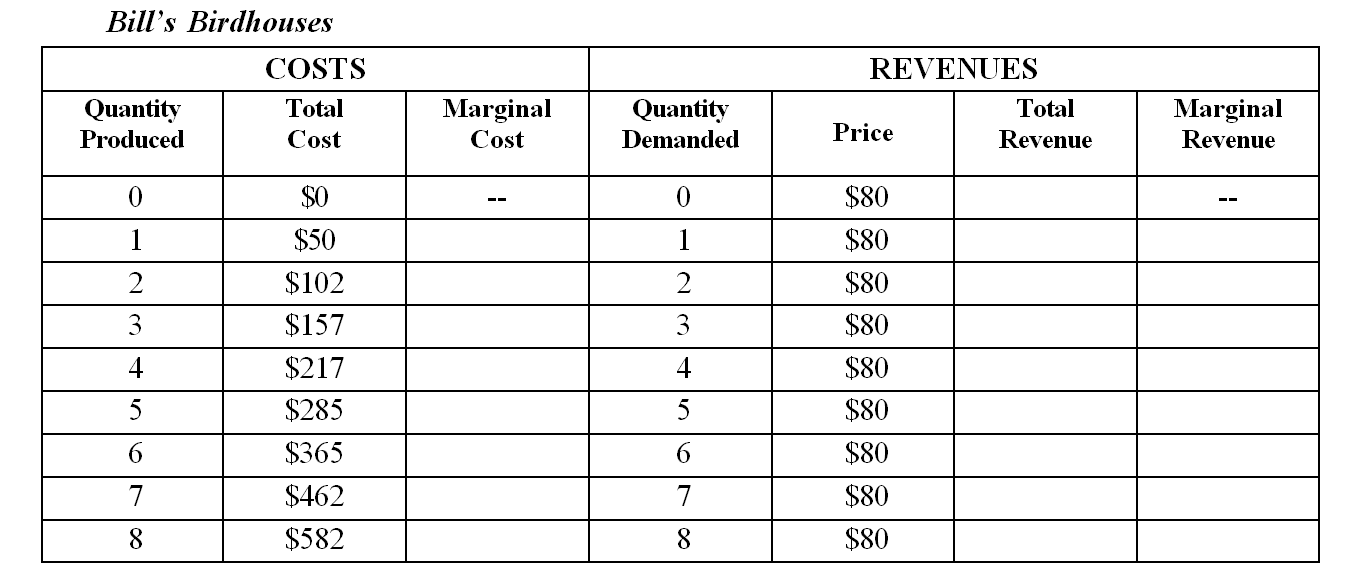 -Refer to Table 14-12. At what quantity does Bill maximize profits?
 (Multiple Choice)
4.8/5 (83)
(83) Figure 14-7  -Refer to Figure 14-7. Suppose the price of the good is $175. If the firm produces and sells 514 units of output, its profit is approximately
 (Multiple Choice)
4.8/5 (75)
(75) A firm operating in a perfectly competitive industry will continue to operate if it earns zero economic profits because it is likely to be earning positive accounting profits.
(True/False)
4.9/5 (86)
(86) Figure 14-6
Suppose a firm operating in a competitive market has the following cost curves:  -Refer to Figure 14-6. Firms will be encouraged to enter this market for all prices that exceed
 (Multiple Choice)
4.9/5 (83)
(83) Figure 14-6
Suppose a firm operating in a competitive market has the following cost curves:
-Refer to Figure 14-6. When market price is P3, a profit-maximizing firm's total costs
-Refer to Figure 14-6. When market price is P3, a profit-maximizing firm's total costs (Multiple Choice)
4.9/5 (93)
(93) Figure 14-6
Suppose a firm operating in a competitive market has the following cost curves:
-Refer to Figure 14-6. When market price is P3, a profit-maximizing firm's total revenue
-Refer to Figure 14-6. When market price is P3, a profit-maximizing firm's total revenue (Multiple Choice)
4.8/5 (71)
(71) In competitive markets, firms that raise their prices are typically rewarded with larger profits.
(True/False)
4.7/5 (89)
(89) In the long run, each firm in a competitive industry earns
(Multiple Choice)
4.9/5 (71)
(71) Scenario 14-5
A study sponsored by the Food Consumer Safety Board found that consumption of irradiated tomatoes increased the health of laboratory rats. As a result of national press coverage of the report, the demand for irradiated tomatoes increased dramatically. Organic farmers were able to switch from organic production of tomatoes to irradiated production with no additional cost. Assume that the tomato market satisfies all of the assumptions of perfect competition.
-Refer to Scenario 14-5. If the increased production of irradiated tomatoes caused a rise in the marginal transportation costs of moving irradiated tomatoes to market, the
(Multiple Choice)
4.8/5 (78)
(78) When a perfectly competitive firm decides to shut down, it is most likely that
(Multiple Choice)
4.8/5 (78)
(78) Suppose a firm is considering producing zero units of output. We call this exiting an industry in the short run and shutting down in the long run.
(True/False)
4.9/5 (85)
(85) Figure 14-2
Suppose a firm operating in a competitive market has the following cost curves:
-Refer to Figure 14-2. If the market price is Pb, in the short run the firm will earn
-Refer to Figure 14-2. If the market price is Pb, in the short run the firm will earn (Multiple Choice)
4.7/5 (66)
(66) Which of the following firms is the closest to being a perfectly competitive firm?
(Multiple Choice)
5.0/5 (76)
(76) 
Filters
- Essay(0)
- Multiple Choice(0)
- Short Answer(0)
- True False(0)
- Matching(0)