



 Chat with AI
Exam 13: Firms in Competitive Markets

Exam 1: Ten Principles of Economics438 Questions
Exam 2: Thinking Like an Economist620 Questions
Exam 3: Interdependence and the Gains From Trade527 Questions
Exam 4: The Market Forces of Supply and Demand700 Questions
Exam 5: Elasticity and Its Application598 Questions
Exam 6: Supply, Demand, and Government Policies648 Questions
Exam 7: Consumers, Producers, and the Efficiency of Markets550 Questions
Exam 8: Application: The Costs of Taxation514 Questions
Exam 9: Application: International Trade496 Questions
Exam 10: Externalities522 Questions
Exam 11: Public Goods and Common Resources434 Questions
Exam 12: The Costs of Production420 Questions
Exam 13: Firms in Competitive Markets543 Questions
Exam 14: Monopoly637 Questions
Exam 15: Measuring a Nations Income522 Questions
Exam 16: Measuring the Cost of Living545 Questions
Exam 17: Production and Growth507 Questions
Exam 18: Saving, Investment, and the Financial System567 Questions
Exam 19: The Basic Tools of Finance513 Questions
Exam 20: Unemployment699 Questions
Exam 21: The Monetary System518 Questions
Exam 22: Money Growth and Inflation487 Questions
Exam 23: Aggregate Demand and Aggregate Supply563 Questions
Exam 24: The Influence of Monetary and Fiscal Policy on Aggregate Demand512 Questions
Select questions type


Scenario 14-1
Assume a certain firm in a competitive market is producing Q = 1,000 units of output. At Q = 1,000, the firm's marginal cost equals $15 and its average total cost equals $11. The firm sells its output for $12 per unit.
-Refer to Scenario 14-1. To maximize its profit, the firm should
(Multiple Choice)
4.8/5  (64)
(64) Figure 14-7  -Refer to Figure 14-7. Suppose the price of the good is $175. If the firm produces and sells 515 units of output, its total revenue is
 (Multiple Choice)
4.8/5 (92)
(92) A dairy farmer must be able to calculate sunk costs in order to determine how much revenue the farm receives for the typical gallon of milk.
(True/False)
4.9/5 (79)
(79) In the long-run equilibrium of a market with free entry and exit, marginal firms are operating
(Multiple Choice)
4.8/5 (83)
(83) Figure 14-1
Suppose that a firm in a competitive market has the following cost curves:  -Refer to Figure 14-1. The firm should shut down if the market price is
 (Multiple Choice)
4.8/5 (73)
(73) In the short run, a firm operating in a competitive industry will produce the quantity of output where price equals marginal cost as long as the
(Multiple Choice)
4.7/5 (95)
(95) A firm in a competitive market has the following cost structure: 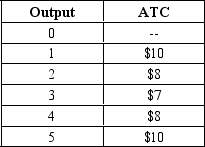 If the firm's fixed cost of production is $3, and the market price is $10, how many units should the firm produce to maximize profit?
 (Multiple Choice)
4.9/5 (70)
(70) Suppose that a firm operating in perfectly competitive market sells 50 units of output. Its total revenues from the sale are $500. Which of the following statements is correct? i) Marginal revenue equals $5.
Ii) Average revenue equals $10.
Iii) Price equals $15.
(Multiple Choice)
4.8/5 (76)
(76) Figure 14-1
Suppose that a firm in a competitive market has the following cost curves:
-Refer to Figure 14-1. The firm's shortrun supply curve is its marginal cost curve above
-Refer to Figure 14-1. The firm's shortrun supply curve is its marginal cost curve above (Multiple Choice)
5.0/5 (85)
(85) Which of the following statements is not correct about competitive firms?
(Multiple Choice)
4.9/5 (91)
(91) When price exceeds average variable cost in the short run, a competitive firm's marginal cost curve is regarded as its supply curve because
(Multiple Choice)
5.0/5 (69)
(69) Scenario 14-3
Suppose a certain competitive firm is producing Q=500 units of output. The marginal cost of the 500th unit is $17, and the average total cost of producing 500 units is $12. The firm sells its output for $20.
-Refer to Scenario 14-3. If the marginal cost of producing the 501st unit would be $19, producing and selling the 501st unit would
(Multiple Choice)
5.0/5 (78)
(78) When total revenue is less than variable costs, a firm in a competitive market will
(Multiple Choice)
4.9/5 (71)
(71) In the short run, a firm operating in a competitive industry will shut down if price is
(Multiple Choice)
4.9/5 (93)
(93) Figure 14-1
Suppose that a firm in a competitive market has the following cost curves:
-Refer to Figure 14-1. If the market price is $6.30, the firm will earn
-Refer to Figure 14-1. If the market price is $6.30, the firm will earn (Multiple Choice)
4.7/5 (74)
(74) Suppose the long-run supply curve for a good is upward-sloping. The upward slope could be explained by
(Multiple Choice)
4.7/5 (83)
(83) A competitive firm is currently producing a quantity of output at which marginal revenue exceeds marginal cost. In order to increase its profit, the firm should
(Multiple Choice)
4.9/5 (78)
(78) 
Filters
- Essay(0)
- Multiple Choice(0)
- Short Answer(0)
- True False(0)
- Matching(0)