



 Chat with AI
Exam 13: Firms in Competitive Markets

Exam 1: Ten Principles of Economics438 Questions
Exam 2: Thinking Like an Economist620 Questions
Exam 3: Interdependence and the Gains From Trade527 Questions
Exam 4: The Market Forces of Supply and Demand700 Questions
Exam 5: Elasticity and Its Application598 Questions
Exam 6: Supply, Demand, and Government Policies648 Questions
Exam 7: Consumers, Producers, and the Efficiency of Markets550 Questions
Exam 8: Application: The Costs of Taxation514 Questions
Exam 9: Application: International Trade496 Questions
Exam 10: Externalities522 Questions
Exam 11: Public Goods and Common Resources434 Questions
Exam 12: The Costs of Production420 Questions
Exam 13: Firms in Competitive Markets543 Questions
Exam 14: Monopoly637 Questions
Exam 15: Measuring a Nations Income522 Questions
Exam 16: Measuring the Cost of Living545 Questions
Exam 17: Production and Growth507 Questions
Exam 18: Saving, Investment, and the Financial System567 Questions
Exam 19: The Basic Tools of Finance513 Questions
Exam 20: Unemployment699 Questions
Exam 21: The Monetary System518 Questions
Exam 22: Money Growth and Inflation487 Questions
Exam 23: Aggregate Demand and Aggregate Supply563 Questions
Exam 24: The Influence of Monetary and Fiscal Policy on Aggregate Demand512 Questions
Select questions type


In a long-run equilibrium where firms have identical costs, it is possible that some firms in a competitive market are making a positive economic profit.
(True/False)
4.9/5  (86)
(86) A firm will shut down in the short run if revenue is not sufficient to cover all of its fixed costs of production.
(True/False)
4.8/5 (80)
(80) Which of the following statements best expresses a firm's profitmaximizing decision rule?
(Multiple Choice)
4.7/5 (86)
(86) In the long run, assuming that the owner of a firm in a competitive industry has positive opportunity costs, she
(Multiple Choice)
4.7/5 (85)
(85) Robin owns a horse stables and riding academy and gives riding lessons for children at "pony camp." Her business operates in a competitive industry. Robin gives riding lessons to 20 children per month. Her monthly total revenue is $4,000. The marginal cost of pony camp is $100 per child. In order to maximize profits, Robin should
(Multiple Choice)
4.9/5 (74)
(74) A corporation has been steadily losing money on one of its product lines, plastic flamingo lawn ornaments. The firm produces plastic flamingos in a factory that cost $20 million to build 10 years ago. The firm is now considering an offer to buy that factory for $15 million. Which of the following statements about the decision to sell or not to sell is correct?
(Multiple Choice)
4.9/5 (74)
(74) Figure 14-2
Suppose a firm operating in a competitive market has the following cost curves:  -Refer to Figure 14-2. If the market price is Pa, in the short run the firm will earn
 (Multiple Choice)
4.8/5 (74)
(74) Scenario 14-2
Assume a certain firm is producing Q = 1,000 units of output. At Q = 1,000, the firm's marginal cost equals $20 and its average total cost equals $25. The firm sells its output for $30 per unit.
-Refer to Scenario 14-2. To maximize its profit, the firm should
(Multiple Choice)
4.8/5 (83)
(83) A firm's marginal cost has a minimum value of $80, its average variable cost has a minimum value of $90, and its average total cost has a minimum value of $100. Then the firm will shut down in the short run once the price of its product falls below
(Multiple Choice)
4.9/5 (52)
(52) Shrimp Galore, a shrimp harvesting business in the Pacific Northwest, has a 30-year loan on its shrimp harvesting boat. The annual loan payment is $25,000 and the boat has a market salvage) value that exceeds its outstanding loan balance. Prior to the 2010 shrimp harvesting season, Shrimp Galore's accountant predicted that at expected market prices for shrimp, Shrimp Galore would have a net loss of $75,000 dollars after paying all 2010 expenses including the annual loan payment). In this case, Shrimp Galore should
(Multiple Choice)
4.8/5 (91)
(91) Figure 14-3
Suppose a firm operating in a competitive market has the following cost curves:  -Refer to Figure 14-3. The firm will earn positive economic profit if the market price is
 (Multiple Choice)
4.9/5 (80)
(80) Suppose that you value a hat from your favorite university at $20. The university bookstore has the hat on sale for $15. You purchase the hat but lose it on the way home. What should you do? Assume that losing the hat does not alter how you value it.
(Multiple Choice)
4.9/5 (87)
(87) Scenario 14-4
The information below applies to a competitive firm that sells its output for $40 per unit.
• When the firm produces and sells 150 units of output, its average total cost is $24.50.
• When the firm produces and sells 151 units of output, its average total cost is $24.55.
-Refer to Scenario 14-4. How does the firm's marginal revenue MR) compare to its marginal cost MC) when it increases its output from 150 units to 151 units?
(Multiple Choice)
4.7/5 (88)
(88) Which of these types of costs can be ignored when an individual or a firm is making decisions?
(Multiple Choice)
4.9/5 (78)
(78) Which of these curves is the competitive firm's short-run supply curve?
(Multiple Choice)
4.7/5 (72)
(72) Table 14-12
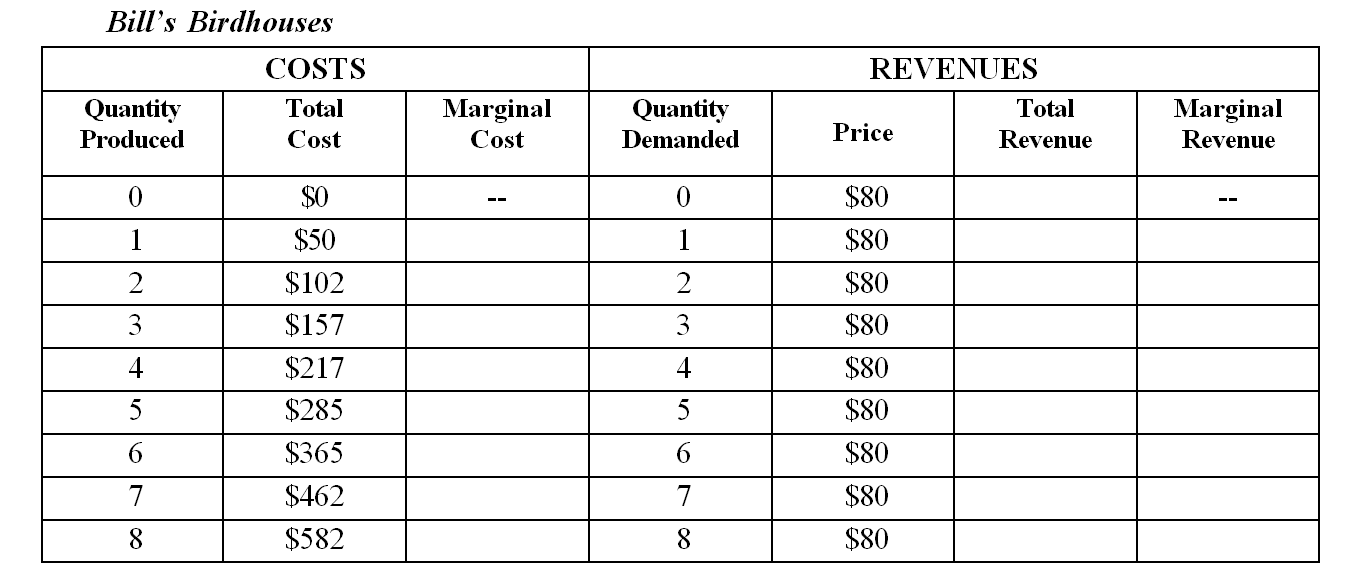 -Refer to Table 14-12. What is the average revenue when 4 units are sold?
 (Multiple Choice)
4.9/5 (83)
(83) In the short run, a firm should exit the industry if its marginal cost exceeds its marginal revenue.
(True/False)
4.8/5 (83)
(83) In a competitive market the current price is $6. The typical firm in the market has ATC = $5.00 and AVC = $4.50.
(Multiple Choice)
4.7/5 (81)
(81) A long-run supply curve is flatter than a short-run supply curve because
(Multiple Choice)
4.9/5 (76)
(76) 
Filters
- Essay(0)
- Multiple Choice(0)
- Short Answer(0)
- True False(0)
- Matching(0)