



 Chat with AI
Exam 10: A Violent Pulse: Earthquakes

Exam 1: Cosmology and the Birth of the Earth60 Questions
Exam 2: Journey to the Center of the Earth60 Questions
Exam 3: Drifting Continents and Spreading Seas60 Questions
Exam 4: The Way the Earth Works: Plate Tectonics63 Questions
Exam 5: Patterns in Nature: Minerals60 Questions
Exam 6: Up From the Inferno: Magma and Igneous Rocks60 Questions
Exam 7: Pages of Earths Past: Sedimentary Rocks60 Questions
Exam 8: Metamorphism: a Process of Change60 Questions
Exam 9: The Wrath of Vulcan: Volcanic Eruptions60 Questions
Exam 10: A Violent Pulse: Earthquakes60 Questions
Exam 11: Crags,cracks,and Crumples: Crustal Deformation and Mountain Building60 Questions
Exam 12: Deep Time: How Old Is Old60 Questions
Exam 13: A Biography of the Earth60 Questions
Exam 14: Squeezing Power From a Stone: Energy Resources63 Questions
Exam 15: Riches in Rock: Mineral Resources61 Questions
Exam 16: Unsafe Ground: Landslides and Other Mass Movements60 Questions
Exam 17: Streams and Floods: the Geology of Running Water60 Questions
Exam 18: Restless Realm: Oceans and Coasts60 Questions
Exam 19: A Hidden Reserve: Groundwater60 Questions
Exam 20: An Envelope of Gas: the Earths Atmosphere and Climate60 Questions
Exam 21: Dry Regions: the Geology of Deserts60 Questions
Exam 22: Amazing Ice: Glaciers and Ice Ages60 Questions
Exam 23: Global Change in the Earth System59 Questions
Exam 24: Introducing Rocks30 Questions
Exam 25: a Surface Veneer: Sediments and Soils31 Questions
Exam 26: the Rock Cycle in the Earth System30 Questions
Exam 27: the Earths Interior, Revisited: Seismic Layering, Gravity, and the Magnetic Field30 Questions
Exam 28: Memories of Past Life: Fossils and Evolution30 Questions
Exam 29: Ever-Changing Landscapes and the Hydrologic Cycle30 Questions
Exam 30: Prelude: and Just What Is Geology30 Questions
Select questions type


If a fault is nearly vertical in orientation and the two walls of rock on opposite sides slide past one another horizontally,the fault is termed a ________ fault.Refer to the figure below for an example of such a feature. 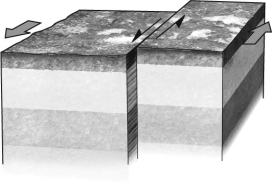
(Multiple Choice)
5.0/5  (81)
(81) At a minimum,how many seismic stations are necessary to locate the epicenter of an earthquake?
(Multiple Choice)
4.9/5 (78)
(78) If an earthquake's magnitude is measured based on the Richter scale,how is this abbreviated?
(Multiple Choice)
4.8/5 (75)
(75) At any point along the surface of any nonvertical fault,as is shown in the figure below,the 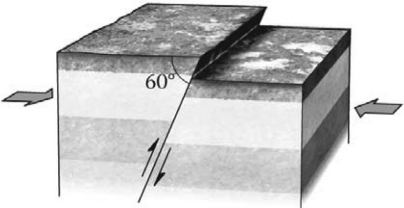
(Multiple Choice)
4.9/5 (77)
(77) Faulting and earthquakes are examples of ________ and generally occur when rocks are relatively ________.
(Multiple Choice)
4.9/5 (80)
(80) Earthquake waves that travel along the Earth's surface are termed
(Multiple Choice)
4.8/5 (83)
(83) Periods of intermittent sliding on a fault because of stress release during episodes of slip,followed by stress buildup to the point that the fault is reactivated,are termed
(Multiple Choice)
5.0/5 (86)
(86) Look at the figure below.Which letter corresponds to the S-wave arrival time? 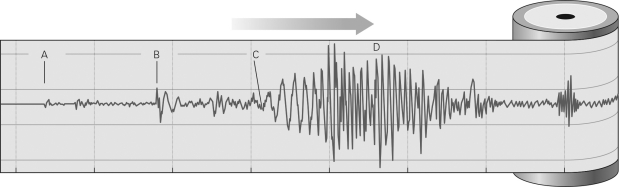
(Multiple Choice)
4.8/5 (76)
(76) Which of the following hazards is most likely to occur days to weeks after an earthquake?
(Multiple Choice)
4.8/5 (92)
(92) Which earthquake scale is used to assess the effects of an earthquake on humans and human-made structures?
(Multiple Choice)
4.8/5 (71)
(71) As shown in the figure below,a coiled spring would be useful in illustrating any ________ wave. 
(Multiple Choice)
4.8/5 (82)
(82) The point on the Earth's surface directly above the point where an earthquake occurs is termed the
(Multiple Choice)
4.9/5 (81)
(81) Where do earthquakes occur? Please explain your answer in the context of plate tectonics.Are there exceptions?
(Essay)
4.8/5 (81)
(81) Which geological setting would you NOT expect to produce a large amount of seismic activity?
(Multiple Choice)
4.8/5 (69)
(69) Generally,which type of earthquake waves travel with the slowest velocity?
(Multiple Choice)
5.0/5 (90)
(90) 
Filters
- Essay(0)
- Multiple Choice(0)
- Short Answer(0)
- True False(0)
- Matching(0)