



 Chat with AI
Exam 20: An Envelope of Gas: the Earths Atmosphere and Climate

Exam 1: Cosmology and the Birth of the Earth60 Questions
Exam 2: Journey to the Center of the Earth60 Questions
Exam 3: Drifting Continents and Spreading Seas60 Questions
Exam 4: The Way the Earth Works: Plate Tectonics63 Questions
Exam 5: Patterns in Nature: Minerals60 Questions
Exam 6: Up From the Inferno: Magma and Igneous Rocks60 Questions
Exam 7: Pages of Earths Past: Sedimentary Rocks60 Questions
Exam 8: Metamorphism: a Process of Change60 Questions
Exam 9: The Wrath of Vulcan: Volcanic Eruptions60 Questions
Exam 10: A Violent Pulse: Earthquakes60 Questions
Exam 11: Crags,cracks,and Crumples: Crustal Deformation and Mountain Building60 Questions
Exam 12: Deep Time: How Old Is Old60 Questions
Exam 13: A Biography of the Earth60 Questions
Exam 14: Squeezing Power From a Stone: Energy Resources63 Questions
Exam 15: Riches in Rock: Mineral Resources61 Questions
Exam 16: Unsafe Ground: Landslides and Other Mass Movements60 Questions
Exam 17: Streams and Floods: the Geology of Running Water60 Questions
Exam 18: Restless Realm: Oceans and Coasts60 Questions
Exam 19: A Hidden Reserve: Groundwater60 Questions
Exam 20: An Envelope of Gas: the Earths Atmosphere and Climate60 Questions
Exam 21: Dry Regions: the Geology of Deserts60 Questions
Exam 22: Amazing Ice: Glaciers and Ice Ages60 Questions
Exam 23: Global Change in the Earth System59 Questions
Exam 24: Introducing Rocks30 Questions
Exam 25: a Surface Veneer: Sediments and Soils31 Questions
Exam 26: the Rock Cycle in the Earth System30 Questions
Exam 27: the Earths Interior, Revisited: Seismic Layering, Gravity, and the Magnetic Field30 Questions
Exam 28: Memories of Past Life: Fossils and Evolution30 Questions
Exam 29: Ever-Changing Landscapes and the Hydrologic Cycle30 Questions
Exam 30: Prelude: and Just What Is Geology30 Questions
Select questions type


Examine the map below.Using the points A-E,label the region with the highest pressure gradient.Draw an arrow showing which direction wind would blow within this region.Explain. 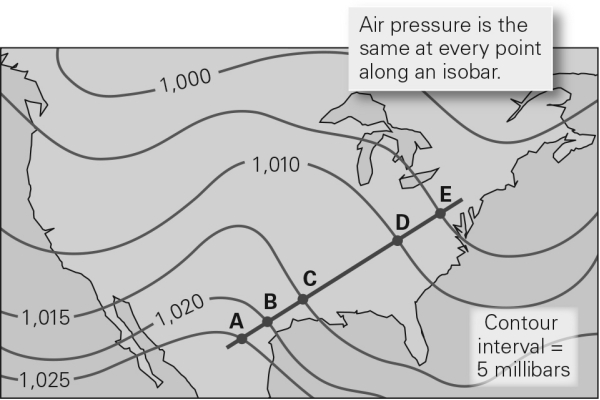

Free
(Essay)
4.9/5  (78)
(78) Correct Answer: Verified
The pressure gradient is greatest between points A and B.Wind would blow from point A toward point B because wind travels from regions of higher pressure to those with lower pressure.
What is the ionosphere? Why is it important for modern communication?
Free
(Essay)
5.0/5 (76)
(76) Correct Answer:Verified
VerifiedThe ionosphere includes most of the mesosphere and the lower part of the thermosphere.It contains a relatively high concentration of ions.The ionosphere plays an important role in modern communication in that,like a mirror,it reflects radio transmissions from the Earth back down so that they can travel around the curve of the surface.
Which two gases are most abundant within the Earth's modern atmosphere?
Free
(Multiple Choice)
4.8/5 (83)
(83) Correct Answer:Verified
VerifiedA
In global convective circulation,air rises at the ________ and the ________. 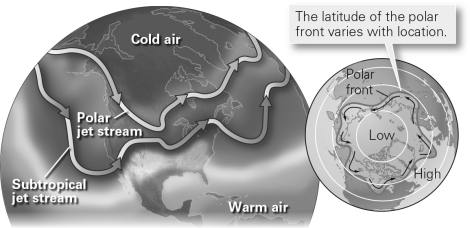
(Multiple Choice)
4.9/5 (95)
(95) In the northern hemisphere,how do winds move in a low-pressure system?
(Multiple Choice)
4.8/5 (80)
(80) Starting from the equator and moving toward either pole,how many rows of global convection cells are present within the troposphere?
(Multiple Choice)
4.9/5 (73)
(73) According to geological evidence and computer models based on that evidence,which statement about the concentration of oxygen in our atmosphere is correct?
(Multiple Choice)
4.8/5 (76)
(76) The life-sustaining part of the Earth System is known as the __________.
(Multiple Choice)
4.8/5 (82)
(82) The very first Earth atmosphere,forming with the Earth itself,was probably dominated by the cosmically abundant gases ________ and ________.
(Multiple Choice)
5.0/5 (87)
(87) Label the cloud types in the images below using the word bank provided. 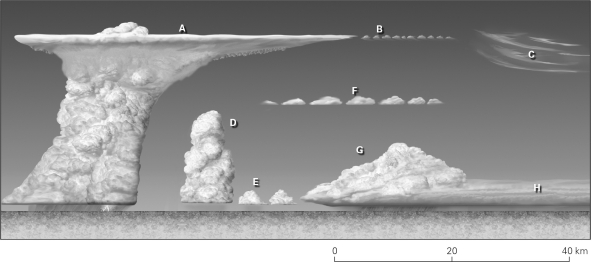 cumulonimbus cumulus congestus
stratus cirrocumulus
cirrus altocumulus
cumulus nimbostratus
cumulonimbus cumulus congestus
stratus cirrocumulus
cirrus altocumulus
cumulus nimbostratus (Essay)
4.9/5 (77)
(77) Which two gases are most important in producing the greenhouse effect on the Earth?
(Multiple Choice)
4.8/5 (82)
(82) Which of these factors is NOT important in controlling the climate of a region?
(Multiple Choice)
4.9/5 (80)
(80) In which layer in the figure below will the temperature steadily increase as you move to higher altitudes? 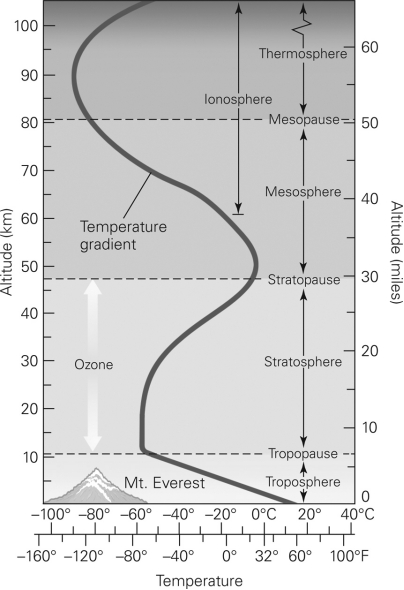
(Multiple Choice)
4.8/5 (66)
(66) Which of the following is a likely consequence of El Niño for the eastern Pacific (the west coast of North and South America)?
(Multiple Choice)
4.8/5 (73)
(73) When moisture-laden wind is forced over a mountain range,clouds will form because of ________ lifting.
(Multiple Choice)
4.9/5 (74)
(74) Lines connecting points of equal temperature on a map are termed ________.
(Multiple Choice)
4.7/5 (63)
(63) In the figure below,the intertropical surface convergence became known as the doldrums because ________. 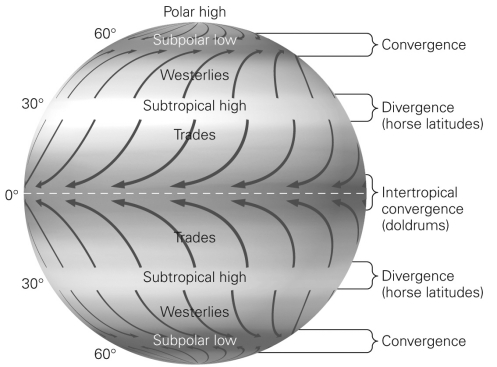
(Multiple Choice)
4.8/5 (79)
(79) In the figure below,the pressure gradient is the greatest between point ________ and point ________. 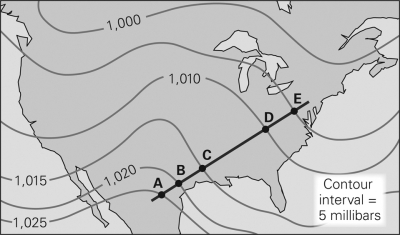
(Multiple Choice)
4.7/5 (71)
(71) 
Filters
- Essay(0)
- Multiple Choice(0)
- Short Answer(0)
- True False(0)
- Matching(0)