



 Chat with AI
Exam 19: A Hidden Reserve: Groundwater

Exam 1: Cosmology and the Birth of the Earth60 Questions
Exam 2: Journey to the Center of the Earth60 Questions
Exam 3: Drifting Continents and Spreading Seas60 Questions
Exam 4: The Way the Earth Works: Plate Tectonics63 Questions
Exam 5: Patterns in Nature: Minerals60 Questions
Exam 6: Up From the Inferno: Magma and Igneous Rocks60 Questions
Exam 7: Pages of Earths Past: Sedimentary Rocks60 Questions
Exam 8: Metamorphism: a Process of Change60 Questions
Exam 9: The Wrath of Vulcan: Volcanic Eruptions60 Questions
Exam 10: A Violent Pulse: Earthquakes60 Questions
Exam 11: Crags,cracks,and Crumples: Crustal Deformation and Mountain Building60 Questions
Exam 12: Deep Time: How Old Is Old60 Questions
Exam 13: A Biography of the Earth60 Questions
Exam 14: Squeezing Power From a Stone: Energy Resources63 Questions
Exam 15: Riches in Rock: Mineral Resources61 Questions
Exam 16: Unsafe Ground: Landslides and Other Mass Movements60 Questions
Exam 17: Streams and Floods: the Geology of Running Water60 Questions
Exam 18: Restless Realm: Oceans and Coasts60 Questions
Exam 19: A Hidden Reserve: Groundwater60 Questions
Exam 20: An Envelope of Gas: the Earths Atmosphere and Climate60 Questions
Exam 21: Dry Regions: the Geology of Deserts60 Questions
Exam 22: Amazing Ice: Glaciers and Ice Ages60 Questions
Exam 23: Global Change in the Earth System59 Questions
Exam 24: Introducing Rocks30 Questions
Exam 25: a Surface Veneer: Sediments and Soils31 Questions
Exam 26: the Rock Cycle in the Earth System30 Questions
Exam 27: the Earths Interior, Revisited: Seismic Layering, Gravity, and the Magnetic Field30 Questions
Exam 28: Memories of Past Life: Fossils and Evolution30 Questions
Exam 29: Ever-Changing Landscapes and the Hydrologic Cycle30 Questions
Exam 30: Prelude: and Just What Is Geology30 Questions
Select questions type


A person is digging a hole,when the hole suddenly starts to fill with water.What have they found?

Free
(Multiple Choice)
4.9/5  (72)
(72) Correct Answer: Verified
C
If a material is porous,it ________.
Free
(Multiple Choice)
4.9/5 (75)
(75) Correct Answer:Verified
VerifiedC
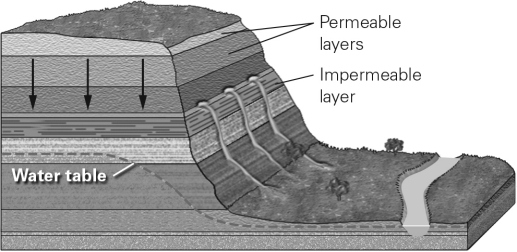
The images below are of two different geological scenarios in which springs could form.Describe the similarities and differences between these two scenarios. 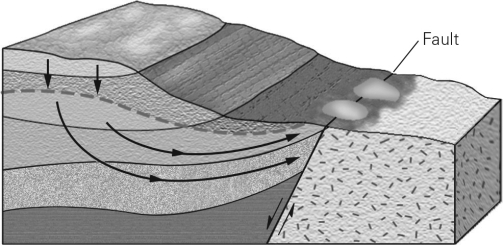
Free
(Essay)
4.9/5 (88)
(88) Correct Answer:Verified
VerifiedThe images both show how impermeable layers can restrict groundwater flow and create springs.However,in image A the fault has juxtaposed permeable,water-bearing layers against impermeable rock,thus forcing the water to the surface along the fault.In image B,water that percolates down from the surface reaches the impermeable layer and must flow along the top surface of the impermeable layer until it seeps out of the hillside in a spring.One situation is tectonically created; the other is due to the stratigraphy itself.
You have a choice to drill your water well into a shallower unconfined aquifer or a deeper confined aquifer.Drilling deeper will cost more money; however,you choose to drill into the confined aquifer.Why?
(Multiple Choice)
4.8/5 (63)
(63) In the figure below,where would be the best place to locate a well that would supply the most water? 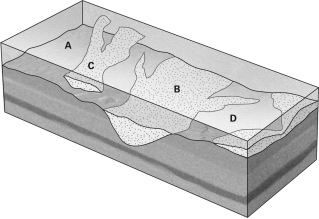
(Multiple Choice)
4.8/5 (76)
(76) Hot springs can be formed by the heating of groundwater by magma or by ________.
(Multiple Choice)
4.9/5 (92)
(92) Hard water results from relatively high concentrations of dissolved ________.
(Multiple Choice)
5.0/5 (84)
(84) For several generations,your family has lived on a farm with a water well.There has never been a problem with the water supply in the past; however,your well has now gone dry.There are several small farms nearby and a large,growing city 50 miles to the north.What can you conclude is the most likely reason for your well to become dry?
(Multiple Choice)
4.8/5 (83)
(83) You are testing the groundwater quality of an aquifer and find that it has high amounts of arsenic.What is the likely source?
(Multiple Choice)
4.7/5 (88)
(88) Label the three zones that water moves through as it percolates into the Earth on the image below.Also include where the water table is by marking it with an arrow. 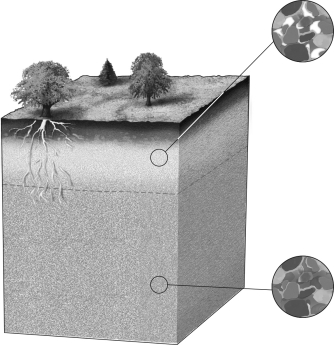
(Essay)
4.9/5 (75)
(75) Which of the following lists correctly orders the three types of subsurface water from shallowest to deepest?
(Multiple Choice)
4.7/5 (76)
(76) The majority of caves are formed by the dissolution of bedrock ________.
(Multiple Choice)
4.9/5 (65)
(65) For a well to function properly,it must be drilled below the water table and into a(n)_________.
(Multiple Choice)
4.9/5 (80)
(80) You have a choice to drill your water well into a shallow unconfined aquifer or a deeper artesian aquifer.Drilling deeper will cost more money; nevertheless,you chose to drill into the artesian aquifer.Why?
(Multiple Choice)
4.8/5 (64)
(64) If an intrusive igneous rock is unfractured,it serves as a(n)________ in local hydrogeology.
(Multiple Choice)
4.8/5 (71)
(71) Consult the figure below.What will eventually happen to the Everglades if the people of Miami and Fort Myers do not stop using the water? 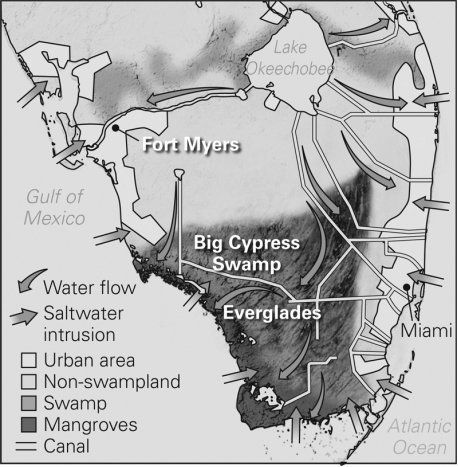
(Multiple Choice)
4.8/5 (80)
(80) An aquifer has ________ porosity and ________ permeability.
(Multiple Choice)
5.0/5 (86)
(86) Explain how limestone caves are formed,making sure to include the name of the acids involved and how they form.
(Essay)
5.0/5 (85)
(85) What does it mean if the potentiometric surface does NOT reach above the ground surface?
(Multiple Choice)
4.7/5 (85)
(85) 
Filters
- Essay(0)
- Multiple Choice(0)
- Short Answer(0)
- True False(0)
- Matching(0)