



 Chat with AI
Exam 1: Cosmology and the Birth of the Earth

Exam 1: Cosmology and the Birth of the Earth60 Questions
Exam 2: Journey to the Center of the Earth60 Questions
Exam 3: Drifting Continents and Spreading Seas60 Questions
Exam 4: The Way the Earth Works: Plate Tectonics63 Questions
Exam 5: Patterns in Nature: Minerals60 Questions
Exam 6: Up From the Inferno: Magma and Igneous Rocks60 Questions
Exam 7: Pages of Earths Past: Sedimentary Rocks60 Questions
Exam 8: Metamorphism: a Process of Change60 Questions
Exam 9: The Wrath of Vulcan: Volcanic Eruptions60 Questions
Exam 10: A Violent Pulse: Earthquakes60 Questions
Exam 11: Crags,cracks,and Crumples: Crustal Deformation and Mountain Building60 Questions
Exam 12: Deep Time: How Old Is Old60 Questions
Exam 13: A Biography of the Earth60 Questions
Exam 14: Squeezing Power From a Stone: Energy Resources63 Questions
Exam 15: Riches in Rock: Mineral Resources61 Questions
Exam 16: Unsafe Ground: Landslides and Other Mass Movements60 Questions
Exam 17: Streams and Floods: the Geology of Running Water60 Questions
Exam 18: Restless Realm: Oceans and Coasts60 Questions
Exam 19: A Hidden Reserve: Groundwater60 Questions
Exam 20: An Envelope of Gas: the Earths Atmosphere and Climate60 Questions
Exam 21: Dry Regions: the Geology of Deserts60 Questions
Exam 22: Amazing Ice: Glaciers and Ice Ages60 Questions
Exam 23: Global Change in the Earth System59 Questions
Exam 24: Introducing Rocks30 Questions
Exam 25: a Surface Veneer: Sediments and Soils31 Questions
Exam 26: the Rock Cycle in the Earth System30 Questions
Exam 27: the Earths Interior, Revisited: Seismic Layering, Gravity, and the Magnetic Field30 Questions
Exam 28: Memories of Past Life: Fossils and Evolution30 Questions
Exam 29: Ever-Changing Landscapes and the Hydrologic Cycle30 Questions
Exam 30: Prelude: and Just What Is Geology30 Questions
Select questions type


Because of the Doppler effect,a light- or sound-emitting object moving toward you has a ________ than a stationary object.

Free
(Multiple Choice)
4.8/5  (84)
(84) Correct Answer: Verified
D
Briefly describe how our Solar System formed,according to the nebular theory.
Free
(Essay)
4.7/5 (84)
(84) Correct Answer:Verified
VerifiedOur Solar System formed from a nebular cloud of gas and dust that flattened into an accretionary disk under the influence of gravity.The Sun formed at the center of this disk,and the planets formed via accretion of materials in the rings surrounding the protosun.
The figure below shows a moving source of light with four stationary observers at different locations.Which observer will see red-shifted light from the moving source? 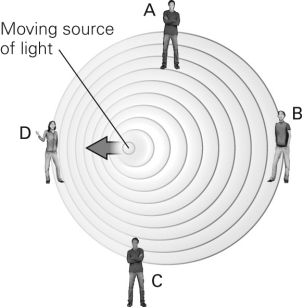
Free
(Multiple Choice)
4.8/5 (78)
(78) Correct Answer:Verified
VerifiedB
The change in wavelength (and therefore frequency)of waves that happens if the source of the waves is moving is explained by the
(Multiple Choice)
4.9/5 (86)
(86) The images below show two different nuclear reactions.The left image shows ________,while the right image shows ________. 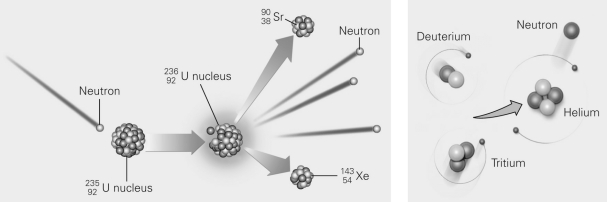
(Multiple Choice)
4.8/5 (86)
(86) The branch of science that studies the structure and history of the Universe is
(Multiple Choice)
5.0/5 (86)
(86) The current scientific explanation for the origin of planets,moons,asteroids,and comets in our Solar System is the
(Multiple Choice)
4.8/5 (73)
(73) When we say that light from a distant stellar object is red-shifted,this means that the light we see
(Multiple Choice)
4.9/5 (95)
(95) Researchers have determined that the Universe began expanding after the Big Bang.When did the Big Bang event occur?
(Multiple Choice)
4.9/5 (89)
(89) Eratosthenes was the first person to accurately estimate the size of the Earth.He accomplished this feat by
(Multiple Choice)
4.9/5 (83)
(83) The metal alloy that makes up the core of the Earth is ________,as compared to the rocky mantle.
(Multiple Choice)
4.9/5 (77)
(77) By far the most common elements in the Universe and in our Solar System are
(Multiple Choice)
4.9/5 (86)
(86) Terrestrial planets are mainly composed of ________,while the giant planets are made predominantly of ________.
(Multiple Choice)
4.9/5 (73)
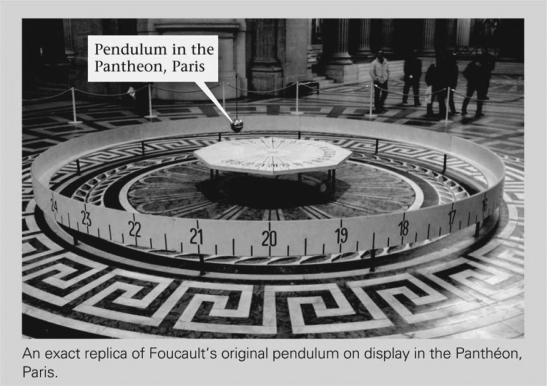
(73) 
Differentiation of the core from the mantle early in the Earth's history was possible because the planet was ________ at the time.
(Multiple Choice)
4.8/5 (88)
(88) 
Filters
- Essay(0)
- Multiple Choice(0)
- Short Answer(0)
- True False(0)
- Matching(0)