



 Chat with AI
Exam 11: Crags,cracks,and Crumples: Crustal Deformation and Mountain Building

Exam 1: Cosmology and the Birth of the Earth60 Questions
Exam 2: Journey to the Center of the Earth60 Questions
Exam 3: Drifting Continents and Spreading Seas60 Questions
Exam 4: The Way the Earth Works: Plate Tectonics63 Questions
Exam 5: Patterns in Nature: Minerals60 Questions
Exam 6: Up From the Inferno: Magma and Igneous Rocks60 Questions
Exam 7: Pages of Earths Past: Sedimentary Rocks60 Questions
Exam 8: Metamorphism: a Process of Change60 Questions
Exam 9: The Wrath of Vulcan: Volcanic Eruptions60 Questions
Exam 10: A Violent Pulse: Earthquakes60 Questions
Exam 11: Crags,cracks,and Crumples: Crustal Deformation and Mountain Building60 Questions
Exam 12: Deep Time: How Old Is Old60 Questions
Exam 13: A Biography of the Earth60 Questions
Exam 14: Squeezing Power From a Stone: Energy Resources63 Questions
Exam 15: Riches in Rock: Mineral Resources61 Questions
Exam 16: Unsafe Ground: Landslides and Other Mass Movements60 Questions
Exam 17: Streams and Floods: the Geology of Running Water60 Questions
Exam 18: Restless Realm: Oceans and Coasts60 Questions
Exam 19: A Hidden Reserve: Groundwater60 Questions
Exam 20: An Envelope of Gas: the Earths Atmosphere and Climate60 Questions
Exam 21: Dry Regions: the Geology of Deserts60 Questions
Exam 22: Amazing Ice: Glaciers and Ice Ages60 Questions
Exam 23: Global Change in the Earth System59 Questions
Exam 24: Introducing Rocks30 Questions
Exam 25: a Surface Veneer: Sediments and Soils31 Questions
Exam 26: the Rock Cycle in the Earth System30 Questions
Exam 27: the Earths Interior, Revisited: Seismic Layering, Gravity, and the Magnetic Field30 Questions
Exam 28: Memories of Past Life: Fossils and Evolution30 Questions
Exam 29: Ever-Changing Landscapes and the Hydrologic Cycle30 Questions
Exam 30: Prelude: and Just What Is Geology30 Questions
Select questions type


Movement along faults often produces a rock formed from sharply angled rock fragments termed ________.

Free
(Multiple Choice)
4.8/5  (86)
(86) Correct Answer: Verified
C
Why do earthquakes occur only above the brittle/plastic transition depth?
Free
(Multiple Choice)
4.8/5 (75)
(75) Correct Answer:Verified
VerifiedA
Mountain ranges formed along subduction zones are formed,in part,by ___________ in the crust.
Free
(Multiple Choice)
4.9/5 (80)
(80) Correct Answer:Verified
VerifiedA
Which of these properly illustrates the principle of isostasy?
(Multiple Choice)
4.9/5 (92)
(92) Which fault below could result from both strike-slip and dip-slip stresses? 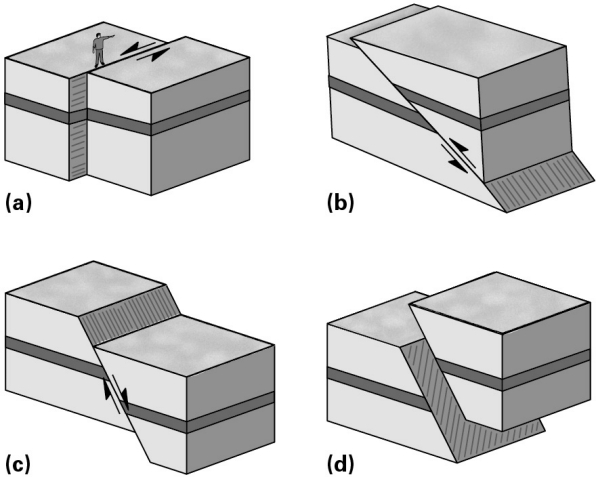
(Multiple Choice)
4.8/5 (81)
(81) Compare and contrast domes and basins.If both are composed solely of sedimentary beds that have been eroded such that the ground surface is level,how would you identify each?
(Essay)
4.9/5 (84)
(84) In the image below,the rocks have been bent into an elongate arch.This is a(n)________. 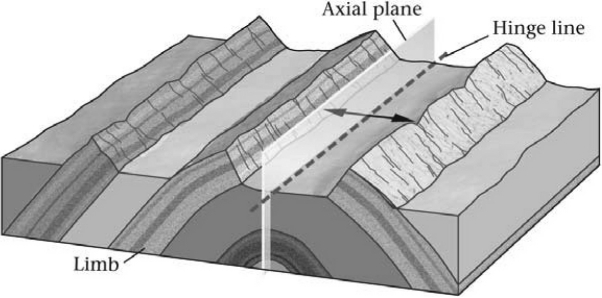
(Multiple Choice)
4.9/5 (91)
(91) How is tectonic foliation,such as elongation of quartz grains,oriented relative to the original bedding plane of a body of rock?
(Multiple Choice)
4.8/5 (71)
(71) Normal faulting is most often associated with mountain building along ___________ boundaries,whereas reverse faulting is generally observed at ___________ boundaries.
(Multiple Choice)
4.7/5 (79)
(79) Shear stress at sufficient depth within a fault plane can induce plastic shear,forming a fine-grained metamorphic rock named ________.
(Multiple Choice)
4.8/5 (75)
(75) What can be said about a mountain range that is being uplifted at 2 cm/year but is not growing any taller?
(Multiple Choice)
4.7/5 (71)
(71) What is the difference between a dip-slip fault and a strike-slip fault? Describe each and give specific examples (use sketches if that helps).
(Essay)
4.8/5 (85)
(85) A polished surface produced by scraping of rock along a fault is termed a(n)________.
(Multiple Choice)
5.0/5 (77)
(77) Regions of continents that have NOT been subjected to orogeny during the past 1 billion years are termed ________.
(Multiple Choice)
5.0/5 (81)
(81) Compared to the Rocky Mountains,the Appalachian Mountains are a series of gently sloping hills.Have they always looked this way? Explain.
(Essay)
4.8/5 (97)
(97) What types of geologic structures would you expect to find in an area that had undergone compression?
(Essay)
4.7/5 (88)
(88) 
Filters
- Essay(0)
- Multiple Choice(0)
- Short Answer(0)
- True False(0)
- Matching(0)