



 Chat with AI
Exam 22: Amazing Ice: Glaciers and Ice Ages

Exam 1: Cosmology and the Birth of the Earth60 Questions
Exam 2: Journey to the Center of the Earth60 Questions
Exam 3: Drifting Continents and Spreading Seas60 Questions
Exam 4: The Way the Earth Works: Plate Tectonics63 Questions
Exam 5: Patterns in Nature: Minerals60 Questions
Exam 6: Up From the Inferno: Magma and Igneous Rocks60 Questions
Exam 7: Pages of Earths Past: Sedimentary Rocks60 Questions
Exam 8: Metamorphism: a Process of Change60 Questions
Exam 9: The Wrath of Vulcan: Volcanic Eruptions60 Questions
Exam 10: A Violent Pulse: Earthquakes60 Questions
Exam 11: Crags,cracks,and Crumples: Crustal Deformation and Mountain Building60 Questions
Exam 12: Deep Time: How Old Is Old60 Questions
Exam 13: A Biography of the Earth60 Questions
Exam 14: Squeezing Power From a Stone: Energy Resources63 Questions
Exam 15: Riches in Rock: Mineral Resources61 Questions
Exam 16: Unsafe Ground: Landslides and Other Mass Movements60 Questions
Exam 17: Streams and Floods: the Geology of Running Water60 Questions
Exam 18: Restless Realm: Oceans and Coasts60 Questions
Exam 19: A Hidden Reserve: Groundwater60 Questions
Exam 20: An Envelope of Gas: the Earths Atmosphere and Climate60 Questions
Exam 21: Dry Regions: the Geology of Deserts60 Questions
Exam 22: Amazing Ice: Glaciers and Ice Ages60 Questions
Exam 23: Global Change in the Earth System59 Questions
Exam 24: Introducing Rocks30 Questions
Exam 25: a Surface Veneer: Sediments and Soils31 Questions
Exam 26: the Rock Cycle in the Earth System30 Questions
Exam 27: the Earths Interior, Revisited: Seismic Layering, Gravity, and the Magnetic Field30 Questions
Exam 28: Memories of Past Life: Fossils and Evolution30 Questions
Exam 29: Ever-Changing Landscapes and the Hydrologic Cycle30 Questions
Exam 30: Prelude: and Just What Is Geology30 Questions
Select questions type


Glacial deposits consist primarily of __________.

Free
(Multiple Choice)
4.9/5  (81)
(81) Correct Answer: Verified
D
Imagine you are living in your current home but during the Pleistocene Ice Age.Contrast the present climate with that of your new climate in the Pleistocene.In one sentence,summarize how the climate is different now.
Free
(Essay)
4.9/5 (87)
(87) Correct Answer:Verified
VerifiedStudent answers should indicate the following.The climate in the Pleistocene was colder than it is today.In general,all climate belts of the northern hemisphere shifted southward during the Pleistocene Ice Age.
What type of glacier is seen in the foreground of the following picture? 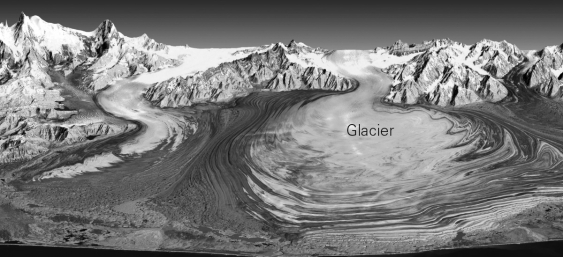
Free
(Multiple Choice)
4.8/5 (99)
(99) Correct Answer:Verified
VerifiedC
Using the figure below,identify which way the glacier advanced. 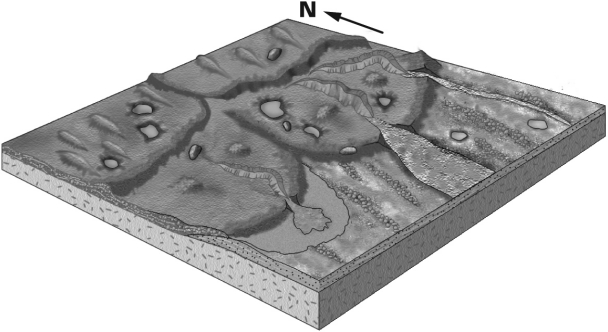
(Multiple Choice)
4.9/5 (87)
(87) The effect of periodic changes in the Earth's orbital eccentricity and magnitude and direction (precession)of its axial tilt on the advance and retreat of ice sheets was first proposed by ________.
(Multiple Choice)
5.0/5 (68)
(68) Sediments deposited directly by glaciers as they melt are characterized by ________.
(Multiple Choice)
4.8/5 (83)
(83) Which of the following figures is of glacial lake-bed deposits? 
(Multiple Choice)
4.9/5 (74)
(74) Label the glaciers in the image below using words from the word bank included.(Hint: not all the names will be used.)
Piedmont glacier Continental glacier Tidewater glacier Valley glacier Hanging glacier Cirque glacier Ice apron Mountain ice car
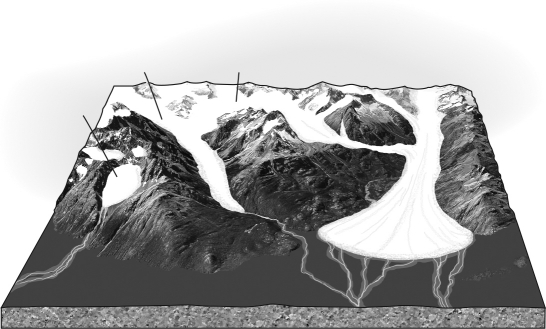
(Essay)
4.7/5 (84)
(84) You are hiking in your favorite forest when you encounter a surface that appears to have very fine scratches in it.What are these features?
(Multiple Choice)
4.9/5 (85)
(85) During the last ice age,a ________ glacier covered much of the northern United States.
(Multiple Choice)
4.8/5 (79)
(79) Currently,almost all the glaciers on the Earth are in a state of retreat,which means that the rate of ________ is less than the rate of ________.
(Multiple Choice)
5.0/5 (75)
(75) Sediments deposited directly by glaciers as they melt are ________.
(Multiple Choice)
4.8/5 (67)
(67) 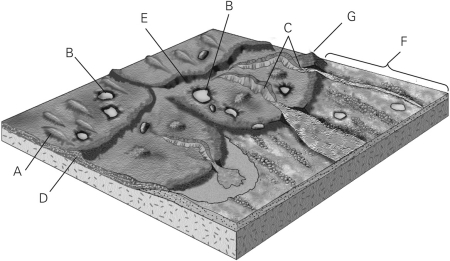
A(n)________ in global sea level is ultimately the result of a ________ event.
(Multiple Choice)
4.9/5 (72)
(72) At the present,glaciers cover about ________ of the surface of the continents.
(Multiple Choice)
4.8/5 (81)
(81) The current interglacial interval began a little more than ________ years ago.
(Multiple Choice)
4.8/5 (85)
(85) At depths of greater than 60 m,ice moves by plastic deformation.What causes this transition from brittle to ductile behavior?
(Multiple Choice)
4.7/5 (81)
(81) 
Filters
- Essay(0)
- Multiple Choice(0)
- Short Answer(0)
- True False(0)
- Matching(0)