



 Chat with AI
Exam 10: A Violent Pulse: Earthquakes

Exam 1: Cosmology and the Birth of the Earth60 Questions
Exam 2: Journey to the Center of the Earth60 Questions
Exam 3: Drifting Continents and Spreading Seas60 Questions
Exam 4: The Way the Earth Works: Plate Tectonics63 Questions
Exam 5: Patterns in Nature: Minerals60 Questions
Exam 6: Up From the Inferno: Magma and Igneous Rocks60 Questions
Exam 7: Pages of Earths Past: Sedimentary Rocks60 Questions
Exam 8: Metamorphism: a Process of Change60 Questions
Exam 9: The Wrath of Vulcan: Volcanic Eruptions60 Questions
Exam 10: A Violent Pulse: Earthquakes60 Questions
Exam 11: Crags,cracks,and Crumples: Crustal Deformation and Mountain Building60 Questions
Exam 12: Deep Time: How Old Is Old60 Questions
Exam 13: A Biography of the Earth60 Questions
Exam 14: Squeezing Power From a Stone: Energy Resources63 Questions
Exam 15: Riches in Rock: Mineral Resources61 Questions
Exam 16: Unsafe Ground: Landslides and Other Mass Movements60 Questions
Exam 17: Streams and Floods: the Geology of Running Water60 Questions
Exam 18: Restless Realm: Oceans and Coasts60 Questions
Exam 19: A Hidden Reserve: Groundwater60 Questions
Exam 20: An Envelope of Gas: the Earths Atmosphere and Climate60 Questions
Exam 21: Dry Regions: the Geology of Deserts60 Questions
Exam 22: Amazing Ice: Glaciers and Ice Ages60 Questions
Exam 23: Global Change in the Earth System59 Questions
Exam 24: Introducing Rocks30 Questions
Exam 25: a Surface Veneer: Sediments and Soils31 Questions
Exam 26: the Rock Cycle in the Earth System30 Questions
Exam 27: the Earths Interior, Revisited: Seismic Layering, Gravity, and the Magnetic Field30 Questions
Exam 28: Memories of Past Life: Fossils and Evolution30 Questions
Exam 29: Ever-Changing Landscapes and the Hydrologic Cycle30 Questions
Exam 30: Prelude: and Just What Is Geology30 Questions
Select questions type


Which earthquake scale measures the amplitude of deflection of a seismograph pen,standardized to an idealized distance of 100 km between the epicenter and the seismograph?
(Multiple Choice)
4.9/5  (68)
(68) Faults that have moved recently or are likely to move in the future are referred to as ________ faults.
(Multiple Choice)
4.8/5 (79)
(79) Why do deep-focus earthquakes occur along convergent plate boundaries? Why are they absent along divergent or transform boundaries?
(Essay)
4.9/5 (80)
(80) Earthquakes that occur in a band called the ________ can be used to track the motion of subducted oceanic lithosphere.
(Multiple Choice)
4.8/5 (72)
(72) Why is an early warning system NOT considered a short-term earthquake prediction tool?
(Essay)
4.9/5 (84)
(84) Which type of fault does NOT,by definition,have a fault trace?
(Multiple Choice)
4.9/5 (85)
(85) During an earthquake,if the hanging wall slides upward relative to the footwall,the fault is termed a ________ fault if the fault is steep (closer to vertical than horizontal).Refer to the figure below for an example of such a feature. 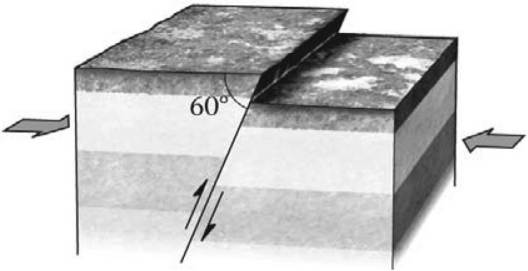
(Multiple Choice)
4.7/5 (80)
(80) How is the epicenter of an earthquake different from the focus? Why are both terms useful?
(Essay)
4.7/5 (78)
(78) An earthquake occurs with an epicenter in the town of New Madrid,Missouri,in the interior of the North American Plate.What is the most likely location of the hypocenter?
(Multiple Choice)
4.9/5 (79)
(79) How is the Mercalli intensity scale used to determine the magnitude of an earthquake? What errors might be associated with this technique?
(Essay)
4.9/5 (86)
(86) Which of the following structures is LEAST likely to survive an earthquake?
(Multiple Choice)
4.8/5 (84)
(84) Which earthquake severity scale varies from locality to locality for a single earthquake?
(Multiple Choice)
4.8/5 (79)
(79) Sketch a seismogram that has recorded an earthquake.Be sure to label the arrival of each of the three types of seismic waves and include at least one aftershock.
(Essay)
4.9/5 (84)
(84) 
Filters
- Essay(0)
- Multiple Choice(0)
- Short Answer(0)
- True False(0)
- Matching(0)