



 Chat with AI
Exam 4: Solution Chemistry: The Hydrosphere

Exam 1: Matter and Energy: The Origin of the Universe103 Questions
Exam 2: Atoms, Ions, and Molecules: Matter Starts Here144 Questions
Exam 3: Stoichiometry: Mass, Formulas, and Reactions141 Questions
Exam 4: Solution Chemistry: The Hydrosphere148 Questions
Exam 5: Thermochemistry: Energy Changes in Reactions139 Questions
Exam 6: Properties of Gases: The Air We Breathe164 Questions
Exam 7: A Quantum Model of Atoms: Waves and Particles166 Questions
Exam 8: Chemical Bonds: What Makes a Gas a Greenhouse Gas156 Questions
Exam 9: Molecular Geometry: Shape Determines Function188 Questions
Exam 10: Intermolecular Forces: The Uniqueness of Water165 Questions
Exam 11: Solutions: Properties and Behavior150 Questions
Exam 12: Solids: Crystals, Alloys, and Polymers130 Questions
Exam 13: Chemical Kinetics: Reactions in the Atmosphere155 Questions
Exam 14: Chemical Equilibrium: How Much Product Does a Reaction Really Make111 Questions
Exam 15: Acidbase Equilibria: Proton Transfer in Biological Systems122 Questions
Exam 16: Additional Aqueous Equilibria: Chemistry and the Oceans127 Questions
Exam 17: Thermodynamics: Spontaneous and Nonspontaneous Reactions and Processes186 Questions
Exam 18: Electrochemistry: The Quest for Clean Energy167 Questions
Exam 19: Nuclear Chemistry: Applications to Energy and Medicine165 Questions
Exam 20: Organic and Biological Molecules: the Compounds of Life168 Questions
Exam 21: The Main Group Elements: Life and the Periodic Table96 Questions
Exam 22: Transition Metals: Biological and Medical Applications142 Questions
Select questions type


Solutions of hydrochloric acid, sulfuric acid, and phosphoric acid with equal concentrations and volumes are neutralized by a solution of sodium hydroxide. If it takes 25.0 mL of the sodium hydroxide solution to neutralize the hydrochloric acid, what volume of the sodium hydroxide solution does it take to neutralize each of the other two solutions? Explain.
(Essay)
4.8/5  (86)
(86) Nitrogen-fixing bacteria and plants are capable of converting atmospheric nitrogen (N2) to ammonia (NH3). This process is an example of ________
(Multiple Choice)
4.9/5 (82)
(82) Which picture best represents an atomic-level view of hydrochloric acid, which is a strong acid, in aqueous solution (water molecules not shown)?
(Multiple Choice)
4.8/5 (75)
(75) Lead is the least toxic metal ion to fish compared to zinc, copper, and mercury ions. Fish can tolerate a lead concentration slightly above 0.850 mM. What is this concentration in ppm? Assume the density of the water is 1.00 g/mL.
(Multiple Choice)
4.8/5 (86)
(86) A homogeneous mixture of two or more substances is called ________
(Multiple Choice)
4.9/5 (68)
(68) What mass of silver chloride will be recovered if excess sodium chloride is added to 500 mL of solution containing 10.79 g of Ag+?
(Multiple Choice)
4.8/5 (68)
(68) Chlorine gas easily gains two electrons to form two chloride ions. In this process, chlorine is ________
(Multiple Choice)
4.9/5 (87)
(87) If the molar concentration of sodium sulfate (Na2SO4) is 0.10 M, what is the concentration of sodium ion?
(Multiple Choice)
4.8/5 (84)
(84) Which picture best represents an atomic-level view of a weak electrolyte solution (water molecules not shown)?
(Multiple Choice)
4.9/5 (75)
(75) Identify which of the following compounds are insoluble in water.
(Multiple Choice)
4.9/5 (56)
(56) Chalk contains calcium carbonate. What would be the best solution for cleaning a sidewalk that a preschool class covered with smiling suns, flowers, birds, rainbows, and houses using sidewalk chalk?
(Multiple Choice)
4.8/5 (71)
(71) Determine the molar concentration of ethanol (C2H6O) in a wine that is 14% ethanol by mass. The density of this wine is 0.93 g/cm3.
(Multiple Choice)
4.7/5 (72)
(72) Lead sinkers used for saltwater fishing do not react with sodium ions in the water. From this we can infer that ________
(Multiple Choice)
5.0/5 (81)
(81) Based on the activity series shown below, predict which metal or metal ions from the table could reduce Ba2+ ions. 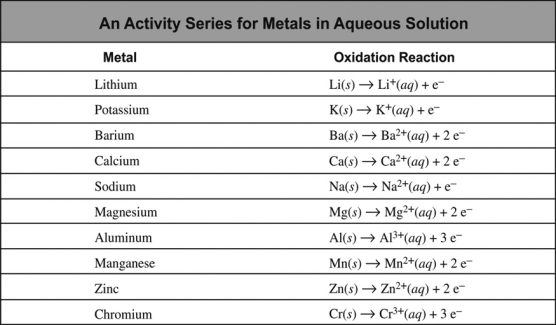
(Essay)
4.9/5 (88)
(88) If 120 g of NaOH were used to prepare 500 mL of solution, what would the concentration be?
(Multiple Choice)
5.0/5 (82)
(82) Water-soluble toxic chromium compounds are waste products of electroplating operations, but the chromium can be precipitated as Cr(OH)3 to remediate the water. How much 1.0 M NaOH solution is needed to remove the chromium from 100 L of a solution that is 0.001 M in Cr3+?
(Multiple Choice)
4.9/5 (72)
(72) 
Filters
- Essay(0)
- Multiple Choice(0)
- Short Answer(0)
- True False(0)
- Matching(0)