



 Chat with AI
Exam 4: Solution Chemistry: The Hydrosphere

Exam 1: Matter and Energy: The Origin of the Universe103 Questions
Exam 2: Atoms, Ions, and Molecules: Matter Starts Here144 Questions
Exam 3: Stoichiometry: Mass, Formulas, and Reactions141 Questions
Exam 4: Solution Chemistry: The Hydrosphere148 Questions
Exam 5: Thermochemistry: Energy Changes in Reactions139 Questions
Exam 6: Properties of Gases: The Air We Breathe164 Questions
Exam 7: A Quantum Model of Atoms: Waves and Particles166 Questions
Exam 8: Chemical Bonds: What Makes a Gas a Greenhouse Gas156 Questions
Exam 9: Molecular Geometry: Shape Determines Function188 Questions
Exam 10: Intermolecular Forces: The Uniqueness of Water165 Questions
Exam 11: Solutions: Properties and Behavior150 Questions
Exam 12: Solids: Crystals, Alloys, and Polymers130 Questions
Exam 13: Chemical Kinetics: Reactions in the Atmosphere155 Questions
Exam 14: Chemical Equilibrium: How Much Product Does a Reaction Really Make111 Questions
Exam 15: Acidbase Equilibria: Proton Transfer in Biological Systems122 Questions
Exam 16: Additional Aqueous Equilibria: Chemistry and the Oceans127 Questions
Exam 17: Thermodynamics: Spontaneous and Nonspontaneous Reactions and Processes186 Questions
Exam 18: Electrochemistry: The Quest for Clean Energy167 Questions
Exam 19: Nuclear Chemistry: Applications to Energy and Medicine165 Questions
Exam 20: Organic and Biological Molecules: the Compounds of Life168 Questions
Exam 21: The Main Group Elements: Life and the Periodic Table96 Questions
Exam 22: Transition Metals: Biological and Medical Applications142 Questions
Select questions type


Groundwater often has low levels of dissolved oxygen because it is not continually exposed to the atmosphere. When groundwater reaches the surface, the following reaction involving soluble iron(II) can occur. What are the oxidation numbers of the elements in the product, Fe(OH)3? 4Fe2+(aq)  O2(g)
 2H2O(l )
 8OH-
 4Fe(OH)3(s)
O2(g) 2H2O(l ) 8OH- 4Fe(OH)3(s) (Multiple Choice)
5.0/5  (69)
(69) Which of the following ionic compounds is insoluble in water?
(Multiple Choice)
4.7/5 (83)
(83) What is the molar concentration of sodium in a 200.0 mL solution prepared from 1.223 g of sodium phosphate (Na3PO4, 163.9 g/mol), which is a cleaning agent, food additive, and stain remover?
(Multiple Choice)
4.9/5 (81)
(81) In a demonstration of strong electrolytes, weak electrolytes, and nonelectrolytes, Professor Popsnorkle used a lightbulb apparatus that showed how much a solution conducted electricity by the brightness of the lightbulb. When pure water was tested, the bulb did not light. When some acetic acid was added to the water, the bulb burned dimly. When more acetic acid was added to the solution, the bulb burned a little more brightly. In his frustration to make the bulb shine brightly with acetic acid, Professor Popsnorkle started over by testing the beaker of the pure acetic acid. What was the result?
(Multiple Choice)
4.8/5 (84)
(84) Hartmann's solution is used in intravenous therapy to replace lost body fluid and mineral salts. Hartmann's solution contains 5.00 mM potassium chloride, 2.00 mM calcium chloride, and 102 mM sodium chloride. What is the total chloride ion concentration in Hartmann's solution?
(Multiple Choice)
4.9/5 (78)
(78) When the oxidation reduction reaction shown here is balanced, how many electrons are transferred for each atom of copper that reacts? Ag+(aq)  Cu(s)
 Ag(s)
 Cu2+(aq)
Cu(s) Ag(s) Cu2+(aq) (Multiple Choice)
4.9/5 (96)
(96) What volume of 12 M HCl solution needs to be diluted to produce 275 mL of 2.1 M HCl solution?
(Multiple Choice)
4.8/5 (83)
(83) Based on the activity series shown below, which of the following statements is true? 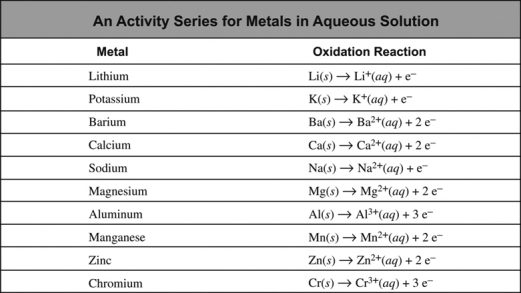
(Multiple Choice)
4.8/5 (79)
(79) Controlling the ammonia and ammonium ion concentrations is one of the biggest problems in maintaining a healthy fish aquarium. Ammonia, which is highly toxic to fish because it interferes with their uptake of oxygen, is formed from wastes excreted by the fish, uneaten food, and decaying plants. Beneficial bacteria oxidize the ammonia and ammonium to nitrate, which is not highly toxic to fish in low to moderate levels. Complete and balance the following reaction equation describing the oxidation of ammonium to nitrate ions in acidic solution.
NH4+(aq) + O2(aq)  NO3-
NO3- (Essay)
4.8/5 (85)
(85) A 500 mg dietary supplement of L-lysine (an amino acid, 146.2 g/mol) required 68.4 mL of 0.100 M NaOH to reach the end point. How many protons were removed for each L-lysine molecule in this titration?
(Multiple Choice)
5.0/5 (79)
(79) What volume of a 12 M KOH solution needs to be diluted to produce 475 mL of 3.1 M KOH solution?
(Short Answer)
4.8/5 (79)
(79) Ammonia (NH3) is a weak base that reacts with a strong acid to form the ammonium ion, NH4+. If 5.00 mL of a solution of an ammonia cleaner is titrated directly with 42.6 mL of 0.5000 M HCl, what is the concentration of the NH3 in solution? (Assume that the ammonia is the only solute that reacts with the acid.)
(Multiple Choice)
4.9/5 (77)
(77) Which picture best represents an atomic-level view of a strong electrolyte solution (water molecules not shown)?
(Multiple Choice)
4.8/5 (89)
(89) According to the label on a bottle of concentrated hydrochloric acid, the contents are 35% HCl by mass and have a density of 1.2 g/mL. What is the molarity of commercial concentrated hydrochloric acid?
(Short Answer)
4.9/5 (78)
(78) Ion-exchange resins can remove Mg2+ and Ca2+0 in water (called softening) by releasing Na+. What would be the concentration of sodium ion in the softened water if the combined concentration of these Group 2A ions that were removed from the hard water was 0.026 M ?
(Multiple Choice)
4.7/5 (85)
(85) A reaction that takes place between dissolved barium nitrate and dissolved sodium sulfate results in formation of solid barium sulfate. Which equation describes this reaction?
(Multiple Choice)
4.8/5 (77)
(77) Concentrated sulfuric acid contains 4 g of water for every 100 g of solution. The solvent is ________
(Multiple Choice)
4.8/5 (71)
(71) The oxidation number of carbon in carbon dioxide is ________
(Multiple Choice)
4.8/5 (76)
(76) 
Filters
- Essay(0)
- Multiple Choice(0)
- Short Answer(0)
- True False(0)
- Matching(0)