



 Chat with AI
Exam 12: Solids: Crystals, Alloys, and Polymers

Exam 1: Matter and Energy: The Origin of the Universe103 Questions
Exam 2: Atoms, Ions, and Molecules: Matter Starts Here144 Questions
Exam 3: Stoichiometry: Mass, Formulas, and Reactions141 Questions
Exam 4: Solution Chemistry: The Hydrosphere148 Questions
Exam 5: Thermochemistry: Energy Changes in Reactions139 Questions
Exam 6: Properties of Gases: The Air We Breathe164 Questions
Exam 7: A Quantum Model of Atoms: Waves and Particles166 Questions
Exam 8: Chemical Bonds: What Makes a Gas a Greenhouse Gas156 Questions
Exam 9: Molecular Geometry: Shape Determines Function188 Questions
Exam 10: Intermolecular Forces: The Uniqueness of Water165 Questions
Exam 11: Solutions: Properties and Behavior150 Questions
Exam 12: Solids: Crystals, Alloys, and Polymers130 Questions
Exam 13: Chemical Kinetics: Reactions in the Atmosphere155 Questions
Exam 14: Chemical Equilibrium: How Much Product Does a Reaction Really Make111 Questions
Exam 15: Acidbase Equilibria: Proton Transfer in Biological Systems122 Questions
Exam 16: Additional Aqueous Equilibria: Chemistry and the Oceans127 Questions
Exam 17: Thermodynamics: Spontaneous and Nonspontaneous Reactions and Processes186 Questions
Exam 18: Electrochemistry: The Quest for Clean Energy167 Questions
Exam 19: Nuclear Chemistry: Applications to Energy and Medicine165 Questions
Exam 20: Organic and Biological Molecules: the Compounds of Life168 Questions
Exam 21: The Main Group Elements: Life and the Periodic Table96 Questions
Exam 22: Transition Metals: Biological and Medical Applications142 Questions
Select questions type


In addition to carbon and iron, stainless steel contains ________
(Multiple Choice)
4.9/5  (72)
(72) Stainless steel is less susceptible to rusting than iron because ________
(Multiple Choice)
4.8/5 (80)
(80) Which of the following refers to an alloy in which the composition is variable and the elements have comparable radii?
(Multiple Choice)
4.8/5 (86)
(86) What type of packing best describes the layering patterns shown below?
a) 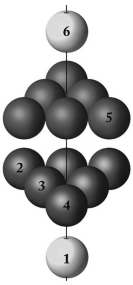 b)
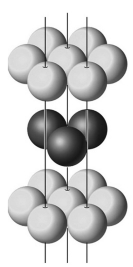 c)
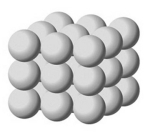
b) c) (Essay)
4.8/5 (78)
(78) If a salt has a face-centered cubic (fcc) unit cell and a 1:2 cation:anion stoichiometry with cations occupying the fcc positions, then the anions fill all the ________ holes.
(Multiple Choice)
4.9/5 (78)
(78) Bronze that is composed of 10% tin and 90% copper is ________
(Multiple Choice)
4.9/5 (76)
(76) The cubic unit cell of rhenium trioxide (ReO3) has Re atoms at the corners and O atoms on each of the 12 edges. The atoms touch along the edges. The radii are Re 137 pm and O 73 pm. What is the density of ReO3?
(Multiple Choice)
4.8/5 (87)
(87) Iron crystallizes in a body-centered cubic pattern. How many iron atoms are in each unit cell?
(Multiple Choice)
4.9/5 (76)
(76) If a body-centered cubic unit cell has a volume of 1.447 108 pm3, what must be the dimension of the cube's edge?
(Multiple Choice)
4.8/5 (79)
(79) If a face-centered cubic unit cell has a volume of 1.447 108 pm3 and the ions at the corners touch the ion on the face, what must be the ion's radius in picometers?
(Short Answer)
4.9/5 (81)
(81) Which of the following tends to be true of polymers but not small molecules?
I.variable instead of constant composition
II.a poorly defined melting point
III.solid state regions that are disordered
(Multiple Choice)
4.8/5 (74)
(74) An octahedral hole in a crystal lattice is defined as ________
(Multiple Choice)
4.8/5 (81)
(81) Why does a pure metal not crystallize in a fluorite or antifluorite unit cell?
(Multiple Choice)
4.9/5 (80)
(80) Hexamethylenediamine and adipic acid, a dicarboxylic acid, undergo ________
(Multiple Choice)
4.9/5 (76)
(76) If half of the tetrahedral holes in a face-centered cubic unit cell are filled, what must be the stoichiometry of the ionic compound, written as nonhole sites:hole sites in lowest terms?
(Multiple Choice)
4.9/5 (93)
(93) 
Filters
- Essay(0)
- Multiple Choice(0)
- Short Answer(0)
- True False(0)
- Matching(0)