



 Chat with AI
Exam 12: Solids: Crystals, Alloys, and Polymers

Exam 1: Matter and Energy: The Origin of the Universe103 Questions
Exam 2: Atoms, Ions, and Molecules: Matter Starts Here144 Questions
Exam 3: Stoichiometry: Mass, Formulas, and Reactions141 Questions
Exam 4: Solution Chemistry: The Hydrosphere148 Questions
Exam 5: Thermochemistry: Energy Changes in Reactions139 Questions
Exam 6: Properties of Gases: The Air We Breathe164 Questions
Exam 7: A Quantum Model of Atoms: Waves and Particles166 Questions
Exam 8: Chemical Bonds: What Makes a Gas a Greenhouse Gas156 Questions
Exam 9: Molecular Geometry: Shape Determines Function188 Questions
Exam 10: Intermolecular Forces: The Uniqueness of Water165 Questions
Exam 11: Solutions: Properties and Behavior150 Questions
Exam 12: Solids: Crystals, Alloys, and Polymers130 Questions
Exam 13: Chemical Kinetics: Reactions in the Atmosphere155 Questions
Exam 14: Chemical Equilibrium: How Much Product Does a Reaction Really Make111 Questions
Exam 15: Acidbase Equilibria: Proton Transfer in Biological Systems122 Questions
Exam 16: Additional Aqueous Equilibria: Chemistry and the Oceans127 Questions
Exam 17: Thermodynamics: Spontaneous and Nonspontaneous Reactions and Processes186 Questions
Exam 18: Electrochemistry: The Quest for Clean Energy167 Questions
Exam 19: Nuclear Chemistry: Applications to Energy and Medicine165 Questions
Exam 20: Organic and Biological Molecules: the Compounds of Life168 Questions
Exam 21: The Main Group Elements: Life and the Periodic Table96 Questions
Exam 22: Transition Metals: Biological and Medical Applications142 Questions
Select questions type


Which of the following refers to an alloy in which the composition of the elements is constant?
(Multiple Choice)
4.8/5  (66)
(66) Which of the following refers to an alloy in which the composition of the elements is variable and one element must have a much smaller radius than the other?
(Multiple Choice)
4.8/5 (67)
(67) Which statement regarding the formation of an alloy is correct?
(Multiple Choice)
4.8/5 (84)
(84) Nickel (Ni) crystallizes as a face-centered unit cell with an edge length of 382 pm. What is the atomic radius of nickel?
(Multiple Choice)
4.8/5 (72)
(72) Iron (Fe) has a density of 7.874 g/cm3 and crystallizes in a body-centered cubic structure. What is the atomic radius of iron?
(Multiple Choice)
4.9/5 (66)
(66) In the cubic closest-packed structure of sodium chloride, which ions are touching or nearly touching?
I.sodium ions and sodium ions
II.chloride ions and chloride ions
III.sodium ions and chloride ions
(Multiple Choice)
4.8/5 (83)
(83) The hybridization of atomic orbitals in graphite is ________
(Multiple Choice)
4.7/5 (76)
(76) Which of the following contribute to the arrangement of ions in the unit cells of an ionic solid?
I.the empirical formula
II.the relative radii of the ions
III.the shape of polyatomic ions
(Multiple Choice)
4.9/5 (83)
(83) Silver crystallizes with a face-centered cubic unit cell. The edge length is 407.7 pm. What is the volume of this unit cell?
(Multiple Choice)
4.9/5 (82)
(82) Platinum (Pt) has a face-centered cubic structure with an edge length of 135 pm. What is the calculated value of the density of platinum based on this information?
(Short Answer)
4.8/5 (84)
(84) Briefly explain why the density of LDPE (low-density polyethylene) is less than that of HDPE (high-density polyethylene).
(Essay)
4.7/5 (77)
(77) Write the chemical reaction using skeleton structures for the polymerization of adipic acid (HOOC(CH2)4COOH) and 1,6-diaminohexane (H2N(CH2)6NH2), and note the general name for this type of reaction.
(Essay)
4.8/5 (74)
(74) Would you expect the linear allotrope of carbon to conduct electricity? (Fragments of it were first prepared and characterized in 1998.)
(Multiple Choice)
4.9/5 (71)
(71) Aluminum (Al) has a density of 2.70 g/cm3 and crystallizes in a face-centered cubic structure. What is the unit cell edge length in picometers?
(Short Answer)
4.8/5 (86)
(86) Gold has a face-centered cubic structure with a unit cell edge length of 407.8 pm. What is the contribution to the density from each individual gold atom in g/cm3?
(Short Answer)
4.8/5 (81)
(81) The monomer for polystyrene is shown below. Which of the bonds is involved in the polymerization process? 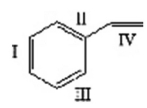
(Multiple Choice)
4.9/5 (86)
(86) 
Filters
- Essay(0)
- Multiple Choice(0)
- Short Answer(0)
- True False(0)
- Matching(0)