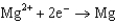
Exam 18: Electrochemistry: The Quest for Clean Energy

arrow
  • Select Tags
search iconSearch Question
flashcardsStudy Flashcards
  • Select Tags

You have a job as a summer intern in an orange juice processing plant. Part of your job is to determine the amount of vitamin C in a given quantity of orange juice. To make this determination, you titrate the orange juice with I3, the triiodide ion. To make sure you know what you are doing, your supervisor asks you how many electrons are transferred in the reaction. The reaction describing the titration is given below. What is your response? ascorbate You have a job as a summer intern in an orange juice processing plant. Part of your job is to determine the amount of vitamin C in a given quantity of orange juice. To make this determination, you titrate the orange juice with I<sub>3</sub><font face=symbol><sup></sup></font>, the triiodide ion. To make sure you know what you are doing, your supervisor asks you how many electrons are transferred in the reaction. The reaction describing the titration is given below. What is your response? ascorbate   <font face=symbol></font>dehydroascorbate <font face=symbol></font> 2H<font face=symbol><sup></sup></font> <font face=symbol></font> 3I<font face=symbol><sup></sup></font> dehydroascorbate 2H 3I

(Multiple Choice)
4.8/5
(65)

A voltaic cell is constructed based on the oxidation of zinc metal and the reduction of silver cations. Solutions of silver nitrate and zinc nitrate also were used. Locate the zinc nitrate on the diagram. A voltaic cell is constructed based on the oxidation of zinc metal and the reduction of silver cations. Solutions of silver nitrate and zinc nitrate also were used. Locate the zinc nitrate on the diagram.
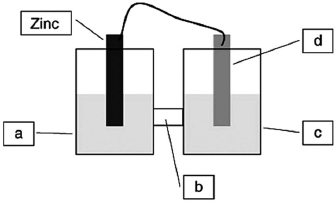
(Multiple Choice)
4.8/5
(86)

For the following electrochemical cell, draw and label a diagram representing the components of the voltaic cell. Al(s)|Al3(aq) (0.50 M )||Ni2(aq) (0.30 M )|Ni(s)

(Essay)
4.8/5
(87)

Based on the information in the table of standard reduction potentials below, what is the standard cell potential for an electrochemical cell that has iron, Fe, and magnesium, Mg, electrodes? Also, identify the cathode. Standard Reduction Potentials (volts) in Aqueous Solution Based on the information in the table of standard reduction potentials below, what is the standard cell potential for an electrochemical cell that has iron, Fe, and magnesium, Mg, electrodes? Also, identify the cathode. Standard Reduction Potentials (volts) in Aqueous Solution   <font face=symbol></font>1.80   <font face=symbol></font>1.50   <font face=symbol></font>0.771   <font face=symbol></font>0.535   <font face=symbol></font>0.124   <font face=symbol></font>1.66   <font face=symbol></font>2.37   <font face=symbol></font>2.93 1.80 Based on the information in the table of standard reduction potentials below, what is the standard cell potential for an electrochemical cell that has iron, Fe, and magnesium, Mg, electrodes? Also, identify the cathode. Standard Reduction Potentials (volts) in Aqueous Solution   <font face=symbol></font>1.80   <font face=symbol></font>1.50   <font face=symbol></font>0.771   <font face=symbol></font>0.535   <font face=symbol></font>0.124   <font face=symbol></font>1.66   <font face=symbol></font>2.37   <font face=symbol></font>2.93 1.50 Based on the information in the table of standard reduction potentials below, what is the standard cell potential for an electrochemical cell that has iron, Fe, and magnesium, Mg, electrodes? Also, identify the cathode. Standard Reduction Potentials (volts) in Aqueous Solution   <font face=symbol></font>1.80   <font face=symbol></font>1.50   <font face=symbol></font>0.771   <font face=symbol></font>0.535   <font face=symbol></font>0.124   <font face=symbol></font>1.66   <font face=symbol></font>2.37   <font face=symbol></font>2.93 0.771 Based on the information in the table of standard reduction potentials below, what is the standard cell potential for an electrochemical cell that has iron, Fe, and magnesium, Mg, electrodes? Also, identify the cathode. Standard Reduction Potentials (volts) in Aqueous Solution   <font face=symbol></font>1.80   <font face=symbol></font>1.50   <font face=symbol></font>0.771   <font face=symbol></font>0.535   <font face=symbol></font>0.124   <font face=symbol></font>1.66   <font face=symbol></font>2.37   <font face=symbol></font>2.93 0.535 Based on the information in the table of standard reduction potentials below, what is the standard cell potential for an electrochemical cell that has iron, Fe, and magnesium, Mg, electrodes? Also, identify the cathode. Standard Reduction Potentials (volts) in Aqueous Solution   <font face=symbol></font>1.80   <font face=symbol></font>1.50   <font face=symbol></font>0.771   <font face=symbol></font>0.535   <font face=symbol></font>0.124   <font face=symbol></font>1.66   <font face=symbol></font>2.37   <font face=symbol></font>2.93 0.124 Based on the information in the table of standard reduction potentials below, what is the standard cell potential for an electrochemical cell that has iron, Fe, and magnesium, Mg, electrodes? Also, identify the cathode. Standard Reduction Potentials (volts) in Aqueous Solution   <font face=symbol></font>1.80   <font face=symbol></font>1.50   <font face=symbol></font>0.771   <font face=symbol></font>0.535   <font face=symbol></font>0.124   <font face=symbol></font>1.66   <font face=symbol></font>2.37   <font face=symbol></font>2.93 1.66 Based on the information in the table of standard reduction potentials below, what is the standard cell potential for an electrochemical cell that has iron, Fe, and magnesium, Mg, electrodes? Also, identify the cathode. Standard Reduction Potentials (volts) in Aqueous Solution   <font face=symbol></font>1.80   <font face=symbol></font>1.50   <font face=symbol></font>0.771   <font face=symbol></font>0.535   <font face=symbol></font>0.124   <font face=symbol></font>1.66   <font face=symbol></font>2.37   <font face=symbol></font>2.93 2.37 Based on the information in the table of standard reduction potentials below, what is the standard cell potential for an electrochemical cell that has iron, Fe, and magnesium, Mg, electrodes? Also, identify the cathode. Standard Reduction Potentials (volts) in Aqueous Solution   <font face=symbol></font>1.80   <font face=symbol></font>1.50   <font face=symbol></font>0.771   <font face=symbol></font>0.535   <font face=symbol></font>0.124   <font face=symbol></font>1.66   <font face=symbol></font>2.37   <font face=symbol></font>2.93 2.93

(Multiple Choice)
4.8/5
(91)

The unit of current, ampere (A), is defined as ________

(Multiple Choice)
4.9/5
(68)

Where in the periodic table do you find the elements that typically do not participate in redox processes?

(Multiple Choice)
4.8/5
(80)

A hydrogen fuel cell depends on ________

(Multiple Choice)
4.7/5
(85)

The oxidation of methanol, as described by the equation below, has a G value of 937.9 kJ/mol. What is the standard cell potential for a methanol fuel cell? The oxidation of methanol, as described by the equation below, has a <font face=symbol></font>G<font face=symbol></font> value of <font face=symbol></font>937.9 kJ/mol. What is the standard cell potential for a methanol fuel cell?

(Multiple Choice)
4.7/5
(78)

The Nernst equation can be used to calculate ________

(Multiple Choice)
4.8/5
(74)

For the following electrochemical cell, write the cell diagram using standard notation. For the following electrochemical cell, write the cell diagram using standard notation.
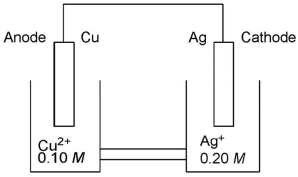
(Essay)
4.8/5
(78)

Permanganate ion can oxidize sulfite in basic solution according to the following equation. The relevant standard reduction potentials are 0.59 V for the manganese compound and 0.92 V for the sulfur compound. Determine the cell potential for the reaction at 298 K with the concentrations in the table. Permanganate ion can oxidize sulfite in basic solution according to the following equation. The relevant standard reduction potentials are 0.59 V for the manganese compound and <font face=symbol></font>0.92 V for the sulfur compound. Determine the cell potential for the reaction at 298 K with the concentrations in the table.   Species Concentration MnO<sub>4</sub><font face=symbol><sup></sup></font>0.250 M SO<sub>3</sub><sup>2</sup><font face=symbol><sup></sup></font>0.356 M SO<sub>4</sub><sup>2</sup><font face=symbol><sup></sup></font>0.278 M OH<font face=symbol><sup></sup></font>0.0222 M Species Concentration MnO40.250 M SO320.356 M SO420.278 M OH0.0222 M

(Short Answer)
4.9/5
(76)

Cadmium is a toxic heavy metal. The U.S. Environmental Protection Agency limits the concentration of cadmium ions in drinking water to less than 4 108 M. Assess the feasibility of monitoring of cadmium in drinking water using a voltaic cell based on the following half-reactions. Cadmium is a toxic heavy metal. The U.S. Environmental Protection Agency limits the concentration of cadmium ions in drinking water to less than 4 <font face=symbol></font> 10<font face=symbol><sup></sup></font><sup>8</sup> M. Assess the feasibility of monitoring of cadmium in drinking water using a voltaic cell based on the following half-reactions.   E<font face=symbol></font> <font face=symbol></font> <font face=symbol></font>0.7996 V   E<font face=symbol></font> <font face=symbol></font> <font face=symbol></font>0.4030 V If the silver ion concentration were 0.100 M, what cadmium ion concentration at 298 K would increase the cell potential by 10 mV from the standard cell potential? E 0.7996 V Cadmium is a toxic heavy metal. The U.S. Environmental Protection Agency limits the concentration of cadmium ions in drinking water to less than 4 <font face=symbol></font> 10<font face=symbol><sup></sup></font><sup>8</sup> M. Assess the feasibility of monitoring of cadmium in drinking water using a voltaic cell based on the following half-reactions.   E<font face=symbol></font> <font face=symbol></font> <font face=symbol></font>0.7996 V   E<font face=symbol></font> <font face=symbol></font> <font face=symbol></font>0.4030 V If the silver ion concentration were 0.100 M, what cadmium ion concentration at 298 K would increase the cell potential by 10 mV from the standard cell potential? E 0.4030 V If the silver ion concentration were 0.100 M, what cadmium ion concentration at 298 K would increase the cell potential by 10 mV from the standard cell potential?

(Multiple Choice)
4.9/5
(79)

Which one of the following statements about the recharging of a voltaic cell is not correct? When a voltaic cell is recharged, it is run as an electrolytic cell.

(Multiple Choice)
4.8/5
(75)

The unit of electrical power, watt (W), is defined as ________

(Multiple Choice)
4.9/5
(71)

The electrodes on batteries are labeled and . The ________ is labeled ________, and ________ occurs there.

(Multiple Choice)
4.9/5
(74)

From the following table of standard reduction potentials, identify the best oxidizing and reducing agents. Also, determine the species from the table that is(are) capable of oxidizing iron to iron(III). Standard Reduction Potentials (volts) in Aqueous Solution From the following table of standard reduction potentials, identify the best oxidizing and reducing agents. Also, determine the species from the table that is(are) capable of oxidizing iron to iron(III). Standard Reduction Potentials (volts) in Aqueous Solution   <font face=symbol></font>1.80   <font face=symbol></font>1.50   <font face=symbol></font>0.771   <font face=symbol></font>0.535   <font face=symbol></font>0.124   <font face=symbol></font>1.66   <font face=symbol></font>2.37   <font face=symbol></font>2.93 1.80 From the following table of standard reduction potentials, identify the best oxidizing and reducing agents. Also, determine the species from the table that is(are) capable of oxidizing iron to iron(III). Standard Reduction Potentials (volts) in Aqueous Solution   <font face=symbol></font>1.80   <font face=symbol></font>1.50   <font face=symbol></font>0.771   <font face=symbol></font>0.535   <font face=symbol></font>0.124   <font face=symbol></font>1.66   <font face=symbol></font>2.37   <font face=symbol></font>2.93 1.50 From the following table of standard reduction potentials, identify the best oxidizing and reducing agents. Also, determine the species from the table that is(are) capable of oxidizing iron to iron(III). Standard Reduction Potentials (volts) in Aqueous Solution   <font face=symbol></font>1.80   <font face=symbol></font>1.50   <font face=symbol></font>0.771   <font face=symbol></font>0.535   <font face=symbol></font>0.124   <font face=symbol></font>1.66   <font face=symbol></font>2.37   <font face=symbol></font>2.93 0.771 From the following table of standard reduction potentials, identify the best oxidizing and reducing agents. Also, determine the species from the table that is(are) capable of oxidizing iron to iron(III). Standard Reduction Potentials (volts) in Aqueous Solution   <font face=symbol></font>1.80   <font face=symbol></font>1.50   <font face=symbol></font>0.771   <font face=symbol></font>0.535   <font face=symbol></font>0.124   <font face=symbol></font>1.66   <font face=symbol></font>2.37   <font face=symbol></font>2.93 0.535 From the following table of standard reduction potentials, identify the best oxidizing and reducing agents. Also, determine the species from the table that is(are) capable of oxidizing iron to iron(III). Standard Reduction Potentials (volts) in Aqueous Solution   <font face=symbol></font>1.80   <font face=symbol></font>1.50   <font face=symbol></font>0.771   <font face=symbol></font>0.535   <font face=symbol></font>0.124   <font face=symbol></font>1.66   <font face=symbol></font>2.37   <font face=symbol></font>2.93 0.124 From the following table of standard reduction potentials, identify the best oxidizing and reducing agents. Also, determine the species from the table that is(are) capable of oxidizing iron to iron(III). Standard Reduction Potentials (volts) in Aqueous Solution   <font face=symbol></font>1.80   <font face=symbol></font>1.50   <font face=symbol></font>0.771   <font face=symbol></font>0.535   <font face=symbol></font>0.124   <font face=symbol></font>1.66   <font face=symbol></font>2.37   <font face=symbol></font>2.93 1.66 From the following table of standard reduction potentials, identify the best oxidizing and reducing agents. Also, determine the species from the table that is(are) capable of oxidizing iron to iron(III). Standard Reduction Potentials (volts) in Aqueous Solution   <font face=symbol></font>1.80   <font face=symbol></font>1.50   <font face=symbol></font>0.771   <font face=symbol></font>0.535   <font face=symbol></font>0.124   <font face=symbol></font>1.66   <font face=symbol></font>2.37   <font face=symbol></font>2.93 2.37 From the following table of standard reduction potentials, identify the best oxidizing and reducing agents. Also, determine the species from the table that is(are) capable of oxidizing iron to iron(III). Standard Reduction Potentials (volts) in Aqueous Solution   <font face=symbol></font>1.80   <font face=symbol></font>1.50   <font face=symbol></font>0.771   <font face=symbol></font>0.535   <font face=symbol></font>0.124   <font face=symbol></font>1.66   <font face=symbol></font>2.37   <font face=symbol></font>2.93 2.93

(Essay)
4.9/5
(83)

Which cell diagram is correct for this electrochemical cell? Which cell diagram is correct for this electrochemical cell?
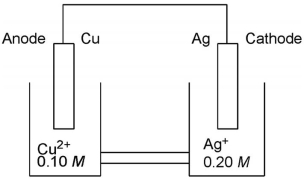
(Multiple Choice)
4.9/5
(79)

What is the mass of copper used if it was oxidized to copper(II) over 35s, given the average electrical current delivered was 200 A?

(Multiple Choice)
4.9/5
(80)

A NiMH battery uses ________ as the oxidizing agent.

(Multiple Choice)
4.8/5
(69)

Using the following data, determine the standard cell potential Using the following data, determine the standard cell potential   for the electrochemical cell constructed using the following reaction, where zinc is the anode and lead is the cathode.   Half-reaction Standard Reduction Potential (V)   <font face=symbol></font>0.34   <font face=symbol></font>1.66 for the electrochemical cell constructed using the following reaction, where zinc is the anode and lead is the cathode. Using the following data, determine the standard cell potential   for the electrochemical cell constructed using the following reaction, where zinc is the anode and lead is the cathode.   Half-reaction Standard Reduction Potential (V)   <font face=symbol></font>0.34   <font face=symbol></font>1.66 Half-reaction Standard Reduction Potential (V) Using the following data, determine the standard cell potential   for the electrochemical cell constructed using the following reaction, where zinc is the anode and lead is the cathode.   Half-reaction Standard Reduction Potential (V)   <font face=symbol></font>0.34   <font face=symbol></font>1.66 0.34 Using the following data, determine the standard cell potential   for the electrochemical cell constructed using the following reaction, where zinc is the anode and lead is the cathode.   Half-reaction Standard Reduction Potential (V)   <font face=symbol></font>0.34   <font face=symbol></font>1.66 1.66


(Short Answer)
4.8/5
(74)
Showing 101 - 120 of 167
close modal

Filters

  • Essay(0)
  • Multiple Choice(0)
  • Short Answer(0)
  • True False(0)
  • Matching(0)