



 Chat with AI
Exam 18: Electrochemistry: The Quest for Clean Energy

Exam 1: Matter and Energy: The Origin of the Universe103 Questions
Exam 2: Atoms, Ions, and Molecules: Matter Starts Here144 Questions
Exam 3: Stoichiometry: Mass, Formulas, and Reactions141 Questions
Exam 4: Solution Chemistry: The Hydrosphere148 Questions
Exam 5: Thermochemistry: Energy Changes in Reactions139 Questions
Exam 6: Properties of Gases: The Air We Breathe164 Questions
Exam 7: A Quantum Model of Atoms: Waves and Particles166 Questions
Exam 8: Chemical Bonds: What Makes a Gas a Greenhouse Gas156 Questions
Exam 9: Molecular Geometry: Shape Determines Function188 Questions
Exam 10: Intermolecular Forces: The Uniqueness of Water165 Questions
Exam 11: Solutions: Properties and Behavior150 Questions
Exam 12: Solids: Crystals, Alloys, and Polymers130 Questions
Exam 13: Chemical Kinetics: Reactions in the Atmosphere155 Questions
Exam 14: Chemical Equilibrium: How Much Product Does a Reaction Really Make111 Questions
Exam 15: Acidbase Equilibria: Proton Transfer in Biological Systems122 Questions
Exam 16: Additional Aqueous Equilibria: Chemistry and the Oceans127 Questions
Exam 17: Thermodynamics: Spontaneous and Nonspontaneous Reactions and Processes186 Questions
Exam 18: Electrochemistry: The Quest for Clean Energy167 Questions
Exam 19: Nuclear Chemistry: Applications to Energy and Medicine165 Questions
Exam 20: Organic and Biological Molecules: the Compounds of Life168 Questions
Exam 21: The Main Group Elements: Life and the Periodic Table96 Questions
Exam 22: Transition Metals: Biological and Medical Applications142 Questions
Select questions type


Because of recent advances in recovery technology, the supply of natural gas, which is mostly methane, has increased significantly. If 1 mole of methane is consumed in a fuel cell powering an automobile, estimate (1) how much work is produced, and (2) the voltage produced by the cell. The data in the table below may be helpful.
Species 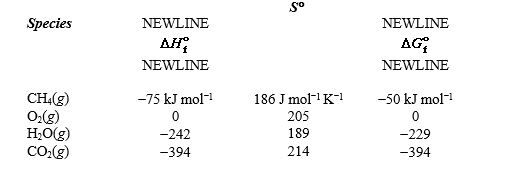
(Essay)
4.9/5  (85)
(85) For the following reaction, predict the pH if the pressure of O2 is 3.00 atm and the bromide ion concentration is 2.10 M. The measured cell potential (Ecell) was 0.100 V.  Half reactions:
 E 1.077 V
 E 1.229 V
Half reactions: E 1.077 V E 1.229 V (Multiple Choice)
4.8/5 (72)
(72) Which one of the following items does not characterize an oxidizing agent?
(Multiple Choice)
4.8/5 (80)
(80) The diagram below represents a voltaic cell. In this cell, which species is the oxidizing agent? Al(s)|Al3(1.0 M)||Cu2(1.0 M)|Cu(s)
(Multiple Choice)
5.0/5 (87)
(87) For the following reaction, predict the pH if the pressure of O2 is 3.00 atm and the bromide ion concentration is 2.10 M. The measured cell potential (Ecell) was 0.100V.  Half reactions:
 E 1.077 V
 E 1.229 V
Half reactions: E 1.077 V E 1.229 V (Short Answer)
4.8/5 (70)
(70) 
A voltaic cell is constructed based on the oxidation of zinc metal and the reduction of silver cations. Solutions of silver nitrate and zinc nitrate also were used. Locate the silver nitrate on the diagram. 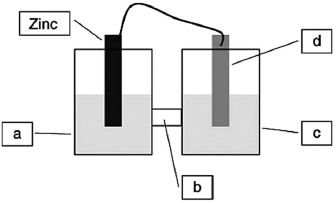
(Multiple Choice)
4.8/5 (85)
(85) An electrochemical cell at 298 K is composed of two compartments, labeled C1 and C2. C1 consists of a copper metal electrode immersed in a 0.30 M copper sulfate solution.
C2 consists of a copper metal electrode immersed in a 1.5 M copper sulfate solution.  ,
 0.34 V
Which statement regarding this electrochemical cell is not correct?
, 0.34 V
Which statement regarding this electrochemical cell is not correct? (Multiple Choice)
4.8/5 (70)
(70) The capacity of a battery usually is specified in units of amperes hours. Show that with this information and the voltage of the battery, you can determine the amount of energy that can be obtained from the battery.
(Essay)
4.8/5 (75)
(75) When aluminum metal is obtained from aluminum oxide (Al2O3), ________ moles of electrons must be transferred for each mole of aluminum oxide processed.
(Multiple Choice)
4.8/5 (86)
(86) The following reaction is called the "super iron reaction." In this reaction, identify
(1) the species oxidized,
(2) the species reduced, and
(3) the number of electrons transferred for the reaction as written, and
(4) explain why it is called the "super iron reaction." 
(Essay)
4.9/5 (70)
(70) Where in the periodic table do you find the elements that are the best reducing agents with the most negative standard reduction potentials?
(Multiple Choice)
4.8/5 (75)
(75) What is the standard cell potential for a voltaic cell using the Pb2/Pb and Mg2/Mg half-reactions? Which metal is the cathode? Standard Reduction
Potentials (volts) in Aqueous Solution  1.80
 1.50
 0.771
 0.535
 0.124
 1.66
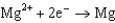 2.37
 2.93
1.80 1.50 0.771 0.535 0.124 1.66 2.37 2.93 (Multiple Choice)
4.9/5 (82)
(82) Which statement about a cathode in a voltaic cell is not correct?
(Multiple Choice)
4.8/5 (83)
(83) The charge supplied by a battery can be determined by ________
(Multiple Choice)
5.0/5 (85)
(85) If the potential of a voltaic cell is 0.837 V, what is the free-energy change when two moles of electrons are transferred in the oxidation-reduction reaction?
(Multiple Choice)
4.8/5 (89)
(89) How much work can be done using a 1.50-V alkaline battery in which 2 moles of electrons are transferred from the anode to the cathode?
(Short Answer)
4.7/5 (84)
(84) 
Filters
- Essay(0)
- Multiple Choice(0)
- Short Answer(0)
- True False(0)
- Matching(0)