



 Chat with AI
Exam 18: Electrochemistry: The Quest for Clean Energy

Exam 1: Matter and Energy: The Origin of the Universe103 Questions
Exam 2: Atoms, Ions, and Molecules: Matter Starts Here144 Questions
Exam 3: Stoichiometry: Mass, Formulas, and Reactions141 Questions
Exam 4: Solution Chemistry: The Hydrosphere148 Questions
Exam 5: Thermochemistry: Energy Changes in Reactions139 Questions
Exam 6: Properties of Gases: The Air We Breathe164 Questions
Exam 7: A Quantum Model of Atoms: Waves and Particles166 Questions
Exam 8: Chemical Bonds: What Makes a Gas a Greenhouse Gas156 Questions
Exam 9: Molecular Geometry: Shape Determines Function188 Questions
Exam 10: Intermolecular Forces: The Uniqueness of Water165 Questions
Exam 11: Solutions: Properties and Behavior150 Questions
Exam 12: Solids: Crystals, Alloys, and Polymers130 Questions
Exam 13: Chemical Kinetics: Reactions in the Atmosphere155 Questions
Exam 14: Chemical Equilibrium: How Much Product Does a Reaction Really Make111 Questions
Exam 15: Acidbase Equilibria: Proton Transfer in Biological Systems122 Questions
Exam 16: Additional Aqueous Equilibria: Chemistry and the Oceans127 Questions
Exam 17: Thermodynamics: Spontaneous and Nonspontaneous Reactions and Processes186 Questions
Exam 18: Electrochemistry: The Quest for Clean Energy167 Questions
Exam 19: Nuclear Chemistry: Applications to Energy and Medicine165 Questions
Exam 20: Organic and Biological Molecules: the Compounds of Life168 Questions
Exam 21: The Main Group Elements: Life and the Periodic Table96 Questions
Exam 22: Transition Metals: Biological and Medical Applications142 Questions
Select questions type


Which statement about this concentration cell is incorrect? 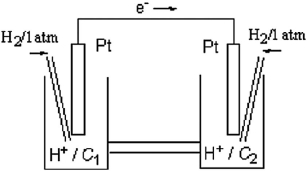
(Multiple Choice)
4.7/5  (80)
(80) If the free-energy change of the following voltaic cell  is 46.3 kJ, what is the standard potential of the cell?
 (Short Answer)
4.8/5 (64)
(64) Which statement regarding battery-powered electric cars is not correct? Currently, battery-powered electric cars ________
(Multiple Choice)
5.0/5 (74)
(74) Copper metal is purified by electrolysis. How much copper metal could be produced from copper(II) oxide by applying a current of 10.0 amps at the appropriate negative potential for 12.0 hours?
(Multiple Choice)
4.9/5 (71)
(71) The energy supplied by a battery can be determined by ________
(Multiple Choice)
4.8/5 (70)
(70) A voltaic cell is constructed based on the oxidation of zinc metal and the reduction of silver cations. Solutions of silver nitrate and zinc nitrate also were used. Locate the silver metal on the diagram. 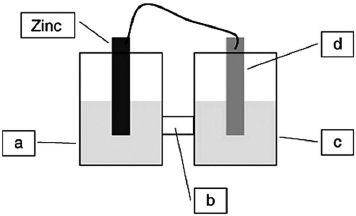
(Multiple Choice)
4.8/5 (75)
(75) Use the table of standard reduction potentials below to identify the metal or metal ion that is the weakest reducing agent. Standard Reduction
Potentials (volts) in Aqueous Solution  1.70
 0.520
 0.036
 0.400
 0.73
 1.66
1.70 0.520 0.036 0.400 0.73 1.66 (Multiple Choice)
4.8/5 (88)
(88) Consider the following standard reduction potentials. Reduction Half-Reaction  (volts)
 2.38
 0.76
 0.16
The Mg/Mg2 half-reaction can be paired with the other two to produce voltaic cells because ________
(volts) 2.38 0.76 0.16
The Mg/Mg2 half-reaction can be paired with the other two to produce voltaic cells because ________ (Multiple Choice)
4.7/5 (86)
(86) The diagram below represents a voltaic cell. In this cell, which species is oxidized? Cd(s)|Cd2(aq)||Fe2(aq),Fe3(aq)|Pt(s)
(Multiple Choice)
4.8/5 (78)
(78) Sodium carbonate is produced using the Solvay process, which involves a final step where sodium bicarbonate is heated to produce sodium carbonate, water, and carbon dioxide. What are the oxidation numbers of the sodium, carbon, and oxygen, respectively, in sodium carbonate?
(Multiple Choice)
4.9/5 (70)
(70) Which one of the following is not an advantage of lithium batteries?
(Multiple Choice)
4.8/5 (79)
(79) What must be true about the standard reduction potentials for the following reaction to proceed spontaneously? 
(Essay)
4.9/5 (75)
(75) In the following reaction  what is the change in oxidation number for S?
 (Multiple Choice)
4.9/5 (76)
(76) If in using a lead-acid battery to start a car, 1.00 gram of Pb is consumed on the anode, how long will it take to recharge the battery, using a current of 0.500 amperes, and turn the PbSO4 that was produced back into Pb?
(Multiple Choice)
5.0/5 (72)
(72) A voltaic cell is constructed based on the oxidation of zinc metal and the reduction of silver cations. Solutions of silver nitrate and zinc nitrate also were used. Locate the salt bridge in the diagram. 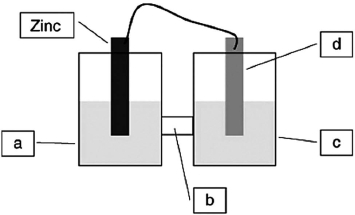
(Multiple Choice)
4.7/5 (88)
(88) Which statement does not correctly describe a standard hydrogen electrode (SHE)?
(Multiple Choice)
4.9/5 (92)
(92) Neuron cells generate electrical signals by concentration gradients across membranes. Assuming a potassium ion concentration of 0.003 M inside the cell, and a concentration of 0.135 M outside the cell, what is the electrical potential across the cell membrane? Body temperature is 310 K. The sign identifies the change in the electrical potential across the membrane and which way the ions flow.
(Multiple Choice)
4.7/5 (70)
(70) The standard cell potential for the nickel-cadmium battery is 1.35 V, and the cell reaction can be written as  Which one of the following statements do you expect to be true based on the Nernst equation? Note Q reaction quotient, and K equilibrium constant for the cell reaction.
 (Multiple Choice)
4.8/5 (80)
(80) 
Filters
- Essay(0)
- Multiple Choice(0)
- Short Answer(0)
- True False(0)
- Matching(0)