



 Chat with AI
Exam 22: Transition Metals: Biological and Medical Applications

Exam 1: Matter and Energy: The Origin of the Universe103 Questions
Exam 2: Atoms, Ions, and Molecules: Matter Starts Here144 Questions
Exam 3: Stoichiometry: Mass, Formulas, and Reactions141 Questions
Exam 4: Solution Chemistry: The Hydrosphere148 Questions
Exam 5: Thermochemistry: Energy Changes in Reactions139 Questions
Exam 6: Properties of Gases: The Air We Breathe164 Questions
Exam 7: A Quantum Model of Atoms: Waves and Particles166 Questions
Exam 8: Chemical Bonds: What Makes a Gas a Greenhouse Gas156 Questions
Exam 9: Molecular Geometry: Shape Determines Function188 Questions
Exam 10: Intermolecular Forces: The Uniqueness of Water165 Questions
Exam 11: Solutions: Properties and Behavior150 Questions
Exam 12: Solids: Crystals, Alloys, and Polymers130 Questions
Exam 13: Chemical Kinetics: Reactions in the Atmosphere155 Questions
Exam 14: Chemical Equilibrium: How Much Product Does a Reaction Really Make111 Questions
Exam 15: Acidbase Equilibria: Proton Transfer in Biological Systems122 Questions
Exam 16: Additional Aqueous Equilibria: Chemistry and the Oceans127 Questions
Exam 17: Thermodynamics: Spontaneous and Nonspontaneous Reactions and Processes186 Questions
Exam 18: Electrochemistry: The Quest for Clean Energy167 Questions
Exam 19: Nuclear Chemistry: Applications to Energy and Medicine165 Questions
Exam 20: Organic and Biological Molecules: the Compounds of Life168 Questions
Exam 21: The Main Group Elements: Life and the Periodic Table96 Questions
Exam 22: Transition Metals: Biological and Medical Applications142 Questions
Select questions type


Ingestion of mercury, which is poisonous, often is treated using chelation therapy. One agent used in this therapy is dimercaprol, which is shown below. Identify the features in the structure of this molecule that make it an effective chelation agent. 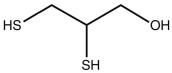
(Essay)
4.7/5  (76)
(76) Consider two complex ions: (I) [Co(CN)6]3, and (II) [CoCl6]3. In view of the ordering of ligands in the spectrochemical series, which one of the following sets of predictions is most likely correct? Spectrochemical Series 
(Multiple Choice)
4.8/5 (68)
(68) How many d electrons are there in the octahedral complex ion, Mn(CN)64?
(Multiple Choice)
4.9/5 (72)
(72) Co(NH3)63(aq) absorbs light in the blue region of the spectrum. The color of a solution containing this ion is ________
(Multiple Choice)
4.9/5 (68)
(68) The dxy, dxz, and dyz orbitals are lower in energy than the dz2 and dx2 y2 orbitals in an octahedral complex because these three orbitals ________
(Multiple Choice)
4.7/5 (86)
(86) Anemia is associated with a deficiency of which element in the body?
(Multiple Choice)
4.9/5 (84)
(84) How many unpaired spins are there in the square planar complex ion, AuCl4?
(Multiple Choice)
4.8/5 (65)
(65) Which 3d orbitals have a higher energy in an octahedral field?
(Multiple Choice)
4.8/5 (89)
(89) Why are compounds of most of the first-row transition metals colored?
(Essay)
4.9/5 (86)
(86) Which d orbital(s) is/are lowest in energy in a tetrahedral complex?
(Multiple Choice)
4.7/5 (79)
(79) How many unpaired electrons are there in a weak-field octahedral Co3 complex?
(Multiple Choice)
5.0/5 (68)
(68) The coordination number for nickel in the compound Na3[Ni(CN)5] is ________
(Multiple Choice)
4.8/5 (67)
(67) The coordination number around the Ni ion in [Co(NH3)6][Ni(CN)5] is ________
(Multiple Choice)
4.8/5 (84)
(84) Transition metals with ________ tend to form square planar complexes.
(Multiple Choice)
4.7/5 (75)
(75) Unlike most transition metal compounds, those of scandium(III) are colorless. Why?
(Essay)
4.9/5 (74)
(74) Oxalic acid is a dicarboxylic acid with the structure HOOCCOOH. How many coordination sites does the ion (OOCCOO)2 have?
(Multiple Choice)
4.8/5 (78)
(78) Which of the following metal ions could be found in both high-spin and low-spin configurations in octahedral complex ions?
(Multiple Choice)
4.7/5 (60)
(60) What determines whether a transition metal ion is in a high-spin or a low-spin electron configuration?
(Essay)
4.9/5 (80)
(80) 
Filters
- Essay(0)
- Multiple Choice(0)
- Short Answer(0)
- True False(0)
- Matching(0)