



 Chat with AI
Exam 4: Market Failures: Public Goods and Externalities

Exam 1: Limits, Alternatives, and Choices212 Questions
Exam 2: The Market System and the Circular Flow141 Questions
Exam 3: Demand, Supply, and Market Equilibrium202 Questions
Exam 4: Market Failures: Public Goods and Externalities155 Questions
Exam 5: Governments Role and Government Failure148 Questions
Exam 6: An Introduction to Macroeconomics123 Questions
Exam 7: Measuring Domestic Output and National Income157 Questions
Exam 8: Economic Growth114 Questions
Exam 9: Business Cycles, Unemployment, and Inflation143 Questions
Exam 10: Basic Macroeconomic Relationships142 Questions
Exam 11: The Aggregate Expenditures Model143 Questions
Exam 12: Aggregate Demand and Aggregate Supply152 Questions
Exam 13: Fiscal Policy, Deficits, and Debt164 Questions
Exam 14: Money, Banking, and Financial Institutions130 Questions
Exam 15: Money Creation127 Questions
Exam 16: Interest Rates and Monetary Policy174 Questions
Exam 17: Financial Economics136 Questions
Exam 18: Extending the Analysis of Aggregate Supply135 Questions
Exam 19: Current Issues in Macro Theory and Policy134 Questions
Exam 20: International Trade151 Questions
Exam 21: The Balance of Payments, Exchange Rates, and Trade Deficits152 Questions
Exam 22: The Economics of Developing Countries135 Questions
Select questions type


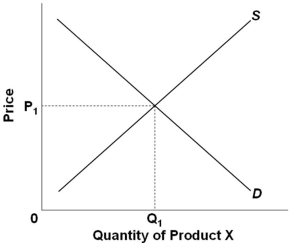 Refer to the above supply and demand graph of Product X. What would happen if the government taxed the producers of this product because it has negative externalities in production?
 (Multiple Choice)
4.8/5  (83)
(83) If some activity creates external benefits as well as private benefits, then economic theory suggests that the activity ought to be:
(Multiple Choice)
4.8/5 (82)
(82) For the music industry, the rise of Internet file-sharing of music has:
(Multiple Choice)
4.9/5 (87)
(87) Which of the following statements about market failure is not true:
(Multiple Choice)
4.8/5 (73)
(73) 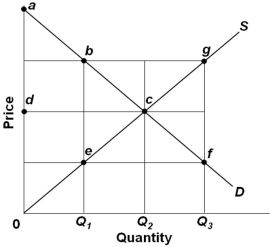 Refer to the above graph. If the output level is Q1, then there are efficiency losses indicated by the area:
 (Multiple Choice)
4.9/5 (85)
(85) 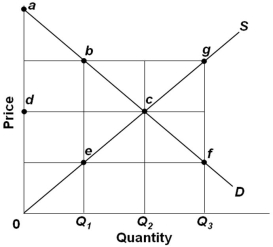 Refer to the above graph. If the output level is Q2, then there will be:
 (Multiple Choice)
5.0/5 (93)
(93) If a good that generates negative externalities were priced to take these negative externalities into account, then its:
(Multiple Choice)
4.8/5 (96)
(96) 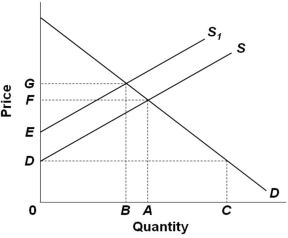 Refer to the above supply and demand graph. In the graph, line S is the current supply of this product, while line S1 is the optimal supply from the society's perspective. One solution to this externality problem is to:
 (Multiple Choice)
4.8/5 (79)
(79) Excludability means that when someone is consuming a good, then others are excluded from using the good anymore.
(True/False)
4.8/5 (77)
(77) 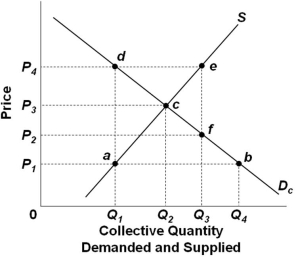 Refer to the above supply and demand graph for a public good. Point c on the graph shows where the:
 (Multiple Choice)
4.8/5 (86)
(86) Because in any period of time and in any region the quantity of pollutants that can be absorbed by nature is fixed, the supply of "pollution rights" in a cap-and-trade system will be perfectly elastic.
(True/False)
4.8/5 (74)
(74) Which of the following would be an example of government intervention to correct a market failure caused by buyers having inadequate information about sellers?
(Multiple Choice)
4.7/5 (67)
(67) Production subsidies are a way of internalizing external costs among polluting firms.
(True/False)
4.9/5 (84)
(84) Market failures refer to those situations where the sellers are not producing as much as the buyers are wanting to buy.
(True/False)
4.8/5 (74)
(74) 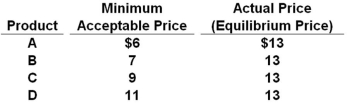 Refer to the above table. If the equilibrium price increases, then the:
 (Multiple Choice)
4.9/5 (68)
(68) 
Filters
- Essay(0)
- Multiple Choice(0)
- Short Answer(0)
- True False(0)
- Matching(0)